
Subscribe
Subscribe
- Motoring
- Style
- Home & Design
- Travel
- Food & Drink
- Specials
- News & Tech
- Videos
As we arrive at the Garde Républicaine in Paris—the historic home of the city’s military corps—two horses with uniformed officers trot out, almost on cue. It’s a fitting prelude to Hermès’ Spring–Summer 2026 showcase, a maison whose spirit has always been bound to the saddle and deeply steeped in its equestrian lineage.
This time around, a shift felt palpable as we took our seats in a room with sandy floors, much like riding arenas. An air of lightness and ease defined the atmosphere. And then out came the first look—a brown leather harness-style bodice under a leather and canvas coat, worn with leather Bermuda shorts—signalling a more liberated Hermès. For SS’26, the brand’s equestrian heritage finds a new expression: modern, playful and utterly free-spirited.

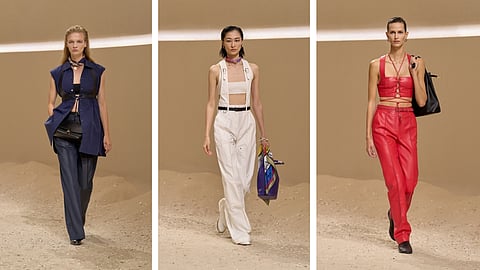
Artistic director of women’s ready-to-wear, Nadège Vanhée presented a collection that was made for the Hermès woman of today: a well-travelled, on-the-go multi-hyphenate, with a quiet confidence that sets her apart. Everything from the clothes to the accessories reflected this sensibility. The collection—chic, utilitarian, and equestrian-inspired—was laced with house codes through subtle, intelligent gestures: silk scarves reimagined within garments and jewellery, saddle-inspired contours translated into ready-to-wear, and age-old craft techniques grounding it all in timeless artistry.
Vanhée is said to have sought inspiration in Provençal folklore to design this collection for the bohemian at heart. This nomadic spirit extended seamlessly to the handbags, among the most coveted expressions of the Hermès universe. And while the Birkin remains a perennial icon, the focus this season shifted elsewhere.
At centre stage was the Kelly Hobo, a reinterpretation of the So Kelly shoulder bag, updated with longer, adjustable straps for a more effortless, on-the-go appeal. Styled with a silk scarf and casually slung over the shoulder, it embodied a new kind of ease—the Hermès woman as instinctive rather than curated.
The same sentiment extended to the larger of the Bel-il bags, inspired by sailor bags, made to jet-set with your whole world deftly secured in your arms. And then there was the Bride de Jour, in whose structured shape the brand’s equestrian DNA was most identifiable. Such as the martingale (a lightweight tack used to control a horse’s head) that was seen in the flat shoulder strap. Or the discreet ‘H’ hangs on the clasp, hidden in plain sight, only for those who know.
But the show was also more than just the bags the brand has become somewhat synonymous with. The silk scarves—in the brand’s archival prints—played a deeply pivotal role. They appeared reinterpreted and re-contextualised: paired with leather harnesses to form sculptural bodice tops or linked with chain necklaces to become jewellery in motion.
Equestrian influences ran deep, drawn from the archival Camargue saddle of the 1930s, whose anatomy informed the collection’s shapes and silhouettes. The sinuous S-shaped cut of jackets and skirt flaps echoed the saddle’s curves, while waxed leather and quilted detailing—also inspired by its construction—anchored the ready-to-wear.
What truly bound the collection, though, was the use of bouti: a traditional hand-stitching technique native to Marseille and Provence, passed down from mother to daughter through generations. Unique to each artisan family, it lent the pieces a quiet continuity, where the time-honoured and the contemporary co-existed seamlessly.
Whether in the bags or the impossibly cool jackets, this was luxury at its most assured. But not without a sense of that nonchalant je nai sais quoi (a quality that cannot be adequately expressed). In this world, ease never equates to simplicity in that banal way. Definitely not in Hermès’ world where timeless craftsmanship ultimately underpins every warp and weft.