
Subscribe
Subscribe
- Motoring
- Style
- Home & Design
- Travel
- Food & Drink
- Specials
- News & Tech
- Videos
Global design houses like Chanel, Dior, Gucci, Mugler, Loewe, Bottega Veneta, Balenciaga, and Versace, with the newly appointed artistic directors at the helm, are mining the house's rich archives and reinterpreting them with a contemporary spin. The recently concluded Milan and Paris Fashion Weeks, which showcased Spring Summer 26 collections, were anthropologically significant for both luxury brands and their consumers. This season saw a considerable number of creative directors taking charge of the storied heritage houses and proposing pieces that were deeply linked to the brand's archives yet modern and personal in interpretation.

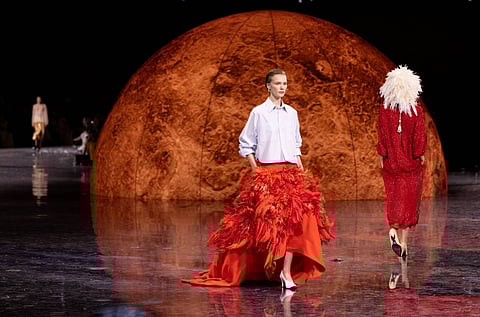
Matthieu Blazy's (former artistic director at Bottega Veneta) Chanel debut was immensely anticipated, and his showcase was steeped in the house's time-honoured heritage and savoir-faire, brimming with meaning and symbolism. The show opened with a jacket informed by a piece from Blazy’s own. In a stroke of genius, he slashed it to the length of a Chanel suit jacket. Also worth mentioning are the metallic Baroque Chanel buttons, which, earlier, more often than not featured the interlocking Cs, were rendered sans logo. In fact, they slightly evoked the buttons Gabrielle Chanel experimented with in the 1960s.
All in all, Matthieu was deeply tuned into Coco Chanel's vibrant and evocative body of work, and he managed to recreate it with his own whimsy. A case in point being the virtuoso pairing of the textured evening skirts with men’s shirts created with Charvet (Chanel was a client there). In fact, these crisp shirts were hemmed with the metallic chains that Coco used in her jacket hems to ensure that they hung in a specific way.
Boy Arthur Capel, who was the first love of Coco Chanel, was at the heart of Blazy's showcase. Boy's Charvet shirts and tweed blazers had a deep impact on Chanel's body of work, and Blazy managed to rekindle that borrow-from-the-boys-but-make-it-your-own spirit.
Embroidered blooms have always been a key Chanel insignia, and Matthieu peppered his extravagant, bouncing skirts with the 3D bloom appliques subtly evoking the Chanel prints from the 1920s. In fact, some of the statement-making skirts resonated with the archival gypsy styles Chanel revolutionised in the 1930s. Moreover, the 2.55 bag, the holy grail of the maison, which also clocked in 70 years recently, was deconstructed, embodying the idea that it was borrowed and passed down from generations of Chanel-loving grannies.
At Dior too, Jonathan Anderson looked deep in the house's historic archives and reimagined some epoch-defining styles synonymous with the eras of Monsieur Christian Dior, Yves Saint Laurent, John Galliano, Raf Simons, and Maria Grazia Chiuri. The Dior press note mentioned, "Daring to enter the house of Dior requires an empathy with its history, a willingness to decode its language, which is part of the collective imagination, and the resoluteness to put all of it in a box. Not to erase it, but to store it, looking ahead, coming back to bits, traces or entire silhouettes from time to time, like revisiting memories." Anderson's first Dior ready-to-wear womenswear collection was a cohesive, intelligent, and heartwarming outing where he straddled myriad eras of the French maison and recontextualised some of its noteworthy archival touch points with his own point of view and extraordinary vision.
The showcase opened with a haunting soundtrack and the line “Do you dare enter the house of Dior?” The film framed the collection as a dialogue with Dior’s history. Then glided in a white bell-shaped crinoline dress accented with two bows, which was an embrace of Dior's iconic New Look circa 1947. Jonathan went on to wrestle with the house's most emblematic code, the Bar jacket, and crafted it in shrunken proportions, offset with a collegiate pleated skirt. One of the lace collar looks was informed by a Dior AW 1959 dress brought to life by the brand's then creative director, Yves Saint Laurent. Also, it was hard to overlook heritage references at Balenciaga. The newly appointed Pierpaolo Piccioli at Balenciaga was inspired by a Cristobal Balenciaga couture dress: the Sack Dress of 1957.
Designer debuts at the Milanese luxury houses like Gucci and Versace also saw heads of artistic design taking a deep plunge into the past. After Sabato De Sarno's abrupt exit from Gucci, the newly hired Demna's Gucci debut was under an unsparing scanner. However, the former Balenciaga artistic boss brought back some sensually charged Gucci codes synonymous with the Tom Ford era. From the bad boy leather jackets to the calf skin bombers to the faux fur teddy minis, ushered in unapologetic sex and jet set glamour synonymous with the brand's glory days.
At Versace, too, Dario Vitale had the house founder Gianni's '80s archive on his moodboard. He experimented with muscle tees, embroidered leather vests, chainmail skirts, and short shorts for men - things one's likely to find in Versace's vintage campaigns.
Bottega Veneta's new creative director, Louise Trotter's debut collection looked at the beginnings of the brand. Some illustrious works of Laura Braggion, the house’s first female creative lead from the 1980s to the early 2000s, echoed in it. The revolutionary ‘soft functionality’ of the original Intrecciato was applied to bags, developed by co-founder Renzo Zengiaro, that cemented the collection in its entirety.
Taking over the artistic reign of a heritage maison can be daunting, especially in today's scenario of endless firings and hirings of artistic directors. Hence, it takes audacity, conviction, and a rare genius to craft a collection that nods towards the house's illustrious heritage and finds resonance with the existing customers.
The luxury industry is clearly on the verge of a makeover, with heritage houses hiring new artistic leads to accelerate sales and brand expansion. However, one can't forget the past and embark on a new direction, which would mean ignoring the brand's historic savoir-faire, its seminal archival pieces, and its core generations of consumers. Hence, the new array of creative directors finds themselves at the crossroads of the glorious past and the challenging present, and most of them have been able to work out a formula. Staying true to the heritage yet reinterpreting it with their own singular take.