
Subscribe
Subscribe
- Motoring
- Style
- Home & Design
- Travel
- Food & Drink
- Specials
- News & Tech
- Videos
AI generated summary, newsroom reviewed
Zimbabwe’s star attraction is the mighty Victoria Falls, and several luxury hotels keep tourists a stone’s throw away, but few without the constant whirring of helicopters. About a 40-minute upstream boat ride from the falls, though, lies a new private oasis that drowns out all the noise. Mpala Jena’s new private villas sit right on the banks of the Zambezi River, and come with a butler, chef, and a safari guide and jeep all to yourself.
The safari experience begins the minute we hop onto the boat. Within a few minutes of riding along the gurgling rapids of the Zambezi, we are greeted by a herd of seven elephants, quenching their thirst and curling their trunks, pods of hippos with their heads bobbing above the water, and crocodiles basking on the banks of the river, jaws agape.

Mpala Jena Private Villas is an extension of Mpala Jena’s five-tented luxury safari camp within the Zambezi National Park. Each villa features three riverfront suites and is a destination unto itself, just a few minutes’ boat ride from the main camp. The property is owned by Zimbabwe-born psychologist Shannon Lang and dairy farmer Kevin Lang, who bought the concession from Great Plains Conservation founders and wildlife filmmakers Dereck and Beverly Joubert during the lockdown.
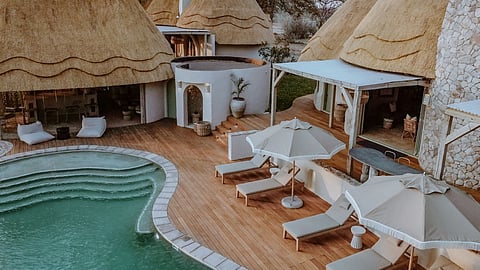
Like the main camp, Mpala Jena’s villas are decorated by celebrated interior designer Tracy Kelly, and her unique design sensibilities are seen in every corner of the space. The villa feels less like a safari lodge, often characterised by dark, moody interiors, and more a breezy retreat that transports you to Italy. The conical thatched huts draw inspiration from trulli—traditional dry-stone houses found in Puglia in southern Italy. Legend has it they were built to be quickly dismantled so peasants could evade the tax collector.
The outdoors, too, gives laidback beach vibes, with a lap pool, swings by the bar, hammocks between trees and cosy nooks for group hangouts. And while the exteriors exude Puglia, the interiors echo the colours of the Zambezi bush, with shades of sage, neutral tones inspired by local stones and terracotta accents. Local crafts are spotted in the macramé ottomans, rope-wrapped furniture and basket-woven light fittings, all handcrafted by Swazi artisans. Artworks on walls are framed with compressed leaves collected from the banks before they started building, and the same leaf pattern is embroidered on Suzani bedcovers. Attention has been paid to the smallest details, and it shows. Outdoor porches wrap around the rooms, but our favourite nook during our stay was a cosy couch with a netted window overlooking a watering hole frequented by zebras and impalas—the antelope the property is named after.
The villas come with all creature comforts, from freestanding bathtubs to canopied four-poster beds with Egyptian-cotton sheets, and spacious closets. But they attempt to tread lightly on the land. The villas are powered by solar energy, and water is pumped from a borehole and then filtered.
The food is brought in from the capital Harare, but the quality is top-notch, with fresh salads, soft-shell tacos for lunch, and freshly baked breads and quiche at teatime. And what the team can’t provide in ingredients, they more than make up for with their warmth and generosity. At dinnertime, our butler, Komazana Samson, curated a list of old-school Bollywood songs as he whipped up an old fashion. And our guide, Shepherd Siziba, who has been guiding in the area for years, went out of his way to track a lion even though it was the wet season.
But Mpala Jena is not the place for the thrill of spotting big cats (not that it’s impossible during the dry season). It is designed for slow safaris. Siziba, therefore, advises guests to complete their safaris in Kenya’s Masai Mara or South Africa’s Kruger National Park, as we did in Botswana’s private concessions, before coming to Mpala Jena.
At the property, our bodies forgot about 5 a.m. calls and settled into a new rhythm of lazy sunsets along the Zambezi. We learned to appreciate the smaller things in the wild—red-chested cuckoos that migrated all the way from Europe, and the amur falcon that made its journey all the way from China. Shepherd never found us a lion, and by then, we had stopped looking. The Zambezi, after all, has a way of making stillness feel like it’s enough.