
Subscribe
Subscribe
- Motoring
- Style
- Home & Design
- Travel
- Food & Drink
- Specials
- News & Tech
- Videos
Few Indian jewellery brands approach the idea of value as thoughtfully as MOI. Founded by Kunal Shah and Puja Shah, the Ahmedabad-based label is shaped by research-led design and cultural inquiry, with Puja Shah designing every piece. In contrast to India’s gold-heavy, bridal-first jewellery landscape, MOI focuses on meaning, context, and everyday wear, treating jewellery as something lived with rather than stored away.
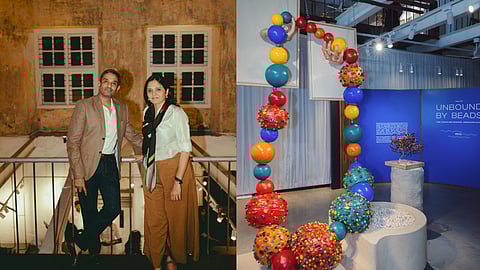
That philosophy takes form at the sixth edition of the Kochi-Muziris Biennale, curated by Nikhil Chopra and HH Art Spaces, where MOI presents Unbound by Beads. Developed through a year-long research project in the Kutch craft belt of Gujarat, the installation traces the movement of glass beads from 17th-century Venice along historic trade routes into the Indian aesthetic vocabulary. Once central to identity and lineage, these bead traditions have gradually been sidelined by narrow definitions of preciousness.
Set in the historic port city of Kochi, Unbound by Beads brings together historical artefacts and contemporary interpretations through the lens of Puja Shah’s design practice. Created in collaboration with contemporary Indian artists Emmanuel Tausing (of the Zachuong label) and Thian Hoi, the installation includes a large-scale sculptural intervention made from glass beads collected across MOI’s Collectibles line, alongside a video work centred on generational knowledge and maternal transmission of craft. Shown alongside works by leading international artists, the project invites a reconsideration of how value is created, remembered, and preserved today.
During an exclusive conversation with Robb Report India, Kunal Shah discusses why safeguarding India’s living craft traditions matters, how design can carry cultural memory, and why he believes true luxury lies in objects that bring delight.
Kunal Shah (KS): It was accidental. Puja was meant to study genetics at NYU in the late '90s, but I suggested design instead. She got into jewellery design at FIT, and the chairperson told her something quite poignant: "Your country India, has such a large legacy of jewellery, but no Indians come and study jewellery design." After finishing, she worked at the Metropolitan Museum of Art in the Asian art department. Being in New York, that exposure to museums, architecture, and objects going back thousands of years—all of that formed our worldview and everything we do today.
KS: When I turned 40, I wanted another career beyond running an industrial business. We created MOI, which means "me," with an extraordinary admiration for women. I see them as goddesses in spirit, balancing finances, relationships, hormones, home, and business. The idea was that when a woman is wearing all these hats, she should feel relief when she comes to our page. In India, everything is geared towards bridal jewellery. Where are the nicely designed, smaller price point products? Good design isn't about exposure or travel; our ancestors understood design intuitively. So we said: How do I create beautiful products that bring you delight? A nicely designed product, well-made, that survives and sits well on you. My jewellery should bring you delight. Only then will I be in business.

KS: We wanted people to question how value is created. For centuries, these beads were not decorative accessories but markers of identity, lineage, and belonging. Entire communities in Kutch built their cultural memory bead by bead, passing knowledge from mother to daughter. Today, that same craft is dismissed as insignificant because it doesn't involve gold or diamonds.
That's why the Kochi Biennale felt like the right platform. This was never meant to be seen as jewellery or historic artefact, but as a living cultural argument. "Unbound by Beads" is about restoring dignity to a living tradition and asking why we've forgotten how to recognise value beyond price. Presenting it within a contemporary art context allows the work to speak about identity, memory, and relevance in the present, rather than being confined to material worth or nostalgia.
KS: Because knowledge in these communities is inherited, not institutional. Women like Sita Ben have carried this craft for decades, memorising thousands of bead sequences without written instruction. That transfer of skill is intimate, generational, and deeply powerful. The mother's hand in the installation symbolises continuity. It asks what happens when that chain breaks and what we lose when traditions aren't valued enough to survive.
KS: Indian jewellery has historically been transactional and male-led, focused on bridal buying and resale value. MOI was built to challenge that. Puja designs from the ground up, informed by art history, museums, and lived culture rather than catalogues. This project is a natural extension of that thinking. It's not about adding another material to jewellery but about embedding history, research, and cultural context into design so the object carries meaning, not just material worth.
KS: Puja is obsessed with semi-precious gemstones: tourmalines, citrines, all these stones people don't typically think of. People say jewellery is an investment; they want emeralds. We say if emeralds are beautiful, let's use them, but there's a whole larger repertoire of stones available. She puts them together in forms and shapes that look good on you. We use craft clusters to make the jewellery. She does enamelling, extraordinary work on the craft side, but our story is design. When I say design, you think fashion, interiors, and architecture. Generally, you don't think of jewellery. I'm saying I want to talk about design. That's the formula.
KS: Puja's design in the collectible series, a set of tortoises we call Morgans. Morgan is becoming our mascot. Like turtles, they have long life, good luck, they're wisdom characters. It's part of our brand narrative: Morgan the archivist, Morgan the timekeeper, Morgan the wise. I'm obsessed with what Puja's done with those tortoise jewellery pieces. That's allowed us to create this fictional character in our life. My alter ego is Morgan. I'm an energy ball, but Morgan represents the other side.
KS: When I was in the US, eating khichdi that my mum made was luxury. Luxury to me is relative. If I'm working 18 hours, sleeping is luxury. Today, in any category, if care and attention are given to materials, craft, labour, and design, you generally have to pay more for it. That, for me, is luxury. We ensure our craftspeople are getting double what they would elsewhere, so they give time and attention.