
Subscribe
Subscribe
- Motoring
- Style
- Home & Design
- Travel
- Food & Drink
- Specials
- News & Tech
- Videos
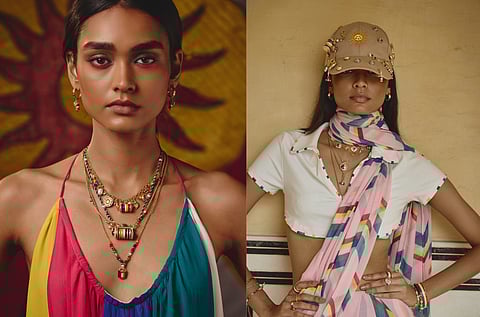
If you are all for pieces that tell a story and do more than just sparkle, Tribe Amrapali and The Palace Atelier’s new collection is for you. The two brands have collaborated for a stunning new line, celebrating Jaipur’s Pachranga Legacy.
One of Jaipur’s most striking symbols, the Pachranga flag, was first adopted by Raja Man Singh I in 1585 after his victory in Kabul. With its five vivid stripes, it continues to fly proudly above the City Palace and Jaigarh Fort. Inspired by this legacy, Tribe Amrapali and The Palace Atelier have created a jewellery collection that pays homage to Jaipur’s rich roots.
The line features statement necklaces, ornate earrings, bracelets, and rings, all featuring motifs symbolic of Jaipur’s regal identity. We sat down with Princess Gauravi Kumari and Akanksha Arora, co-founder of Tribe Amrapali at the launch, to talk about the creative process behind the collection and their shared love for craftsmanship.

GK: The Pachanga flag is a very important part of my history and my legacy. It was conceived by Raja Mann Singh. To me personally, it symbolises strength, hope, and unity in diversity. What inspired us was the shared vision, both Amrapali and we wanted to reinterpret the flag from a modern lens. To see the Pachanga flag take this form and to see it in the form of jewellery was very interesting, and I am happy to have been able to do it.
Both the organisations had a shared goal, and we wanted to honour the Pacharanga flag because it means so much to us, so much to the city and the people of Jaipur, so it felt like a very organic collaboration, it felt natural.
AA: We haven’t really collaborated with any other brand till now. Not only we took inspiration from the motifs of the palace, the frescos, and the architecture, but we dug into the archives to see some miniature painting references to see all of that. And of course, the pacharanga stripes.
AA: We have been working on this collection for over a year. Started with diving into the archives, going back and forth with the sketches and designs, and doing some research.
We wanted the collection to be unique in its own way and literally represent the motifs. We made a modern interpretation of everything just to make sure it is interpreted in the right way.
GK: I think the charm necklace and the charm bracelet. It has all the different elements. It has the Jaipur sun, the flower, all the different elements all in one. The flower one with the pearl is interesting too. We have tried to mix a lot of elements and there is a story that was going behind. We also tried to play with some of the modern motifs as well.
GK: I work very closely with craft, and I am very passionate about crafts. Craftsmanship to me means luxury. If somebody were to ask me, craft is equivalent to luxury and timeless, and precious. Looking at things through a modern lens. It lets you play with your creativity.
AA: I think craftsmanship is about detail, which maybe not everyone sees, but the wearer sees. All our pieces are double-sided, and we always look into the smallest details.
AA: Meenakari. We have used it in a very modern way for this collection, which is hand enamel. The colours are modern, but it is all traditional and hand-done.
I think everyone today is very proud of India and is wearing Indian brands. We are doing a very good job of making Indian products of good quality. People are even taking inspiration from India now, which earlier was always the reverse. The perspective is changing.