
Subscribe
Subscribe
- Motoring
- Style
- Home & Design
- Travel
- Food & Drink
- Specials
- News & Tech
- Videos
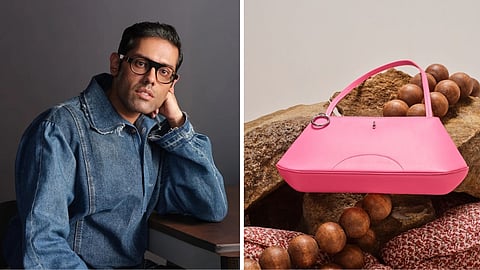
In an industry that thrives on aesthetics over ethics, Shivam Punjya, the founder of Behno, is weaving threads of conscious luxury in every creation. For this ethical fashion entrepreneur, the birth of Behno—which fittingly means “sisters” in Gujarati and Hindi—did not stem from a deeply personal and ethical calling.
“The name came about in multiple ways,” he explains while speaking to Robb Report India. Drawing from his close-knit family structure—where he lived under one roof with both his parents and their siblings, whom he affectionately calls his second set of mum and dad—and from the garment workers who would refer to each other with the suffix ben, Punjya’s brand was conceived as a sisterhood of community, compassion, and craft.
Interestingly, this refined understanding of fashion and ethical luxury was not innate in Punjya. In fact, his path to fashion was anything but typical. A health graduate from Duke University, he was conducting field research on women’s reproductive rights in Andhra Pradesh when he found himself immersed in the world of textile weavers. Around the same time, the 2013 Rana Plaza disaster, during which an eight-storied building housing garment factories collapsed, shook the global fashion conscience. The collision of these moments led to a realisation: there had to be a better, more dignified way of making clothes.
From that conviction emerged the Behno standard, a rigorous, self-imposed ethical code focused on garment worker welfare, social mobility, environmental accountability, and production transparency. “I’m not a garment worker, and I don’t pretend to be one,” Punjya confesses. “So, we built the Behno standard from ground up—through research, conversation, and partnerships with factories willing to grow with us.”
The six-pronged Behno standard encapsulates health, artisan growth, family planning, women’s rights, workplace satisfaction, and eco-consciousness. This standard extends to the sourcing stage as well, wherein all the tanneries associated with the brand are members of the Leather Working Group--“a consortium of stakeholders that develop and maintain rigid protocols to assess the environmental compliance and performance capabilities of leather manufacturers,” states the brand’s official website, further adding, “The Leather Working Group (LWG) works with leading technical experts and industry leaders to promote sustainability and transparency.” Though Behno launched a decade ago with ready-to-wear garments, it later pivoted into leather goods, a niche that came with its own challenges and rewards, particularly when an ethical eye envisions it.

To start, how does one make something as utilitarian and functional as handbags a statement piece? The answer lay in translating minimalist design sensibilities, without compromising on function or flair. Despite being based in California and New York, Behno has always proudly manufactured in India. This was a non-negotiable for Punjya, who recalls the initial stigma around the “Made in India” label. “We heard that it was low quality, hippy-dippy, and made in sweatshops,” he says. Challenging these stereotypes became the brand’s early mission. When a reputed department store pulled out after discovering the origin of production, it only reinforced Punjya’s resolve: “Design [industry] had always been [in India] ... It just hasn’t been given that recognition.”
“It's interesting because people don't always equate leather goods from India, but it's such a big part of our economy here. So I think it makes sense to transition and tell the ‘made in India’ story as well,” he explains. It wasn’t just about busting myths about manufacturing though; it was just as much about squashing the global perception of Indian designs.
While Behno’s designs are rooted in minimalism, Punjya is quick to reject reductive stereotypes about Indian aesthetics. “India has something for everybody. We're not all maximalist,” he says, debunking myths about Indian designs thriving on sequinned craftsmanship or rainbow-hued creations. “We live in that grey area between minimalism and maximalism, and kind of make it work for our style.”
“It is also very personal,” he continues, as though further reinforcing his individuality. “My philosophy on design has always been slightly more minimal.”
His personal experiences go beyond just aesthetic inspiration though. It is deeply ingrained in the functionality, too. The round zipper pulls on Behno’s bags, for instance, were inspired by Punjya’s sister who has Down Syndrome and found traditional bag hardware hard to grip. Other design elements—like the brand’s signature knots—pay homage to heritage and familial bonds.
While storytelling runs through each collection—most recently, a heartfelt tribute to his late grandmother (“She was able to leave her intangible in a very tangible form,” he says about his grandmother, who inspired the brand’s latest 380 collection)—Punjya knows that design alone won’t carry a brand. “You have to love the bag and make sure it has a home in your wardrobe,” he says. “That’s also responsible shopping.”
Striking a balance between responsibility and viability, Behno shows that conscious luxury isn’t an oxymoron. Its handbags sit at the intersection of transparency and timelessness. The ethical entrepreneur doesn't fear commercialisation, but neither does he worry about losses. “It’s a myth that being socially responsible means you can’t be profitable,” Punjya says.
The future of Behno drives home this statement.
Now, 10 years into its journey, Behno is coming home. With its first India store set to open in Mumbai later this year, the brand is closing the loop—manufacturing in India, designing for the world, and finally retailing where it all began. “The Indian customer doesn’t deserve last season’s product,” says Punjya. “We deserve what’s best; what’s current."
The store, much like the brand, promises to be anything but conventional. Punjya hints at a tactile, immersive retail experience that puts the spotlight on the full arc of craftsmanship—from ideation to final form. “We want people to feel the journey. To understand what it means to make something slowly, and well.”
Plans also include a return to ready-to-wear and a foray into homeware, all while maintaining Behno’s ethos of intentional growth. “We’re not here for the short term,” he says. “Profit and purpose are not mutually exclusive. It’s just a matter of choosing your partners, your pace, and your priorities.” And in that space lies the future of conscious luxury.