
Subscribe
Subscribe
- Motoring
- Style
- Home & Design
- Travel
- Food & Drink
- Specials
- News & Tech
- Videos
Few luxury brands have rewritten the rules of modern fashion quite like Golden Goose. Built on a philosophy of effortless Italian elegance, emotional authenticity and a near-cult dedication to craft, the Venice-born label has evolved into a global creative movement—one that invites its community to personalise and co-create long before it became the buzzword, and wear their shoes with pride.
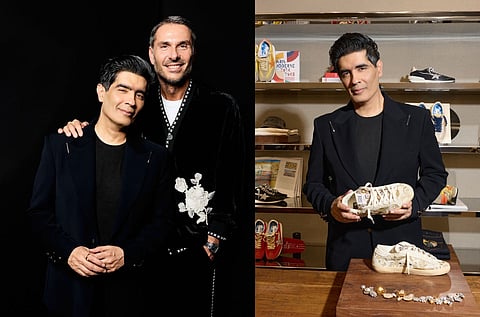
As Golden Goose deepens its presence in India with a flagship store at Phoenix Palladium, Mumbai, and unveils a special collaboration with couturier Manish Malhotra featuring two limited-edition sneakers, CEO Silvio Campara in a candid, free-flowing conversation with Robb Report India, opens up on key learnings about India as a market and why human connection, not algorithms, defines the future of luxury.
Born in Verona—“the city of love; Shakespeare dedicated quite important pages of Romeo and Juliet to Verona,” he says—his journey has taken him across California, China, Japan, and Korea before returning to Italy and eventually joining Golden Goose nearly 13 years ago. It’s this global perspective, rooted in Italian spirit, that shapes his view of the brand’s newest milestone: the Mumbai store that expresses the brand’s Italian roots and India’s quintessential design language. For Campara, the unmistakable star on Golden Goose sneakers finds its truest expression in an imperfect, broken portrait—“a symbol of imperfection,” he says.

Silvio: India is one of the few markets where women are still deeply proud of their traditional clothing. You’re not as open to foreign luxury clothing brands—and that’s amazing. Sneakers, however, are becoming part of your biggest occasions. That’s why our collaboration with Manish Malhotra today is incredible. We wanted someone who represents love for his people and love for the brand. Manish has loved Golden Goose for years, so it was a natural step to have him co-design the special sneakers. The women’s sneaker, crafted in white-cream suede, features delicate gold floral embroidery; the men’s version mirrors this intricate motif on a sleek black suede base.
Silvio: Our audience is already 37% Gen Z, and, with millennials included, it goes up to 85%. They don’t respond to old celebrity-driven language. We don’t create different products for India either. What’s tailored are the experiences. And yes, the centerpiece of our Mumbai store is its co-creation experience, where you can personalise your Golden Goose shoes. This is an integral part of the brand’s global retail strategy.
Silvio: The hardest part to answer is when you call me “luxury”—it’s a limited definition. Traditional luxury is exclusive, expensive, and for the few. That’s not us. We are inclusive. We never oblige you to buy; we ask you to do. You become the protagonist. We have 227 stores in 74 nations. Our success isn’t because we’re geniuses—it’s because we listen. We defined one clear message: be unique, be yourself, embrace imperfection. Our distressed, hand-finished sneakers—cut, scuffed, imperfect—express that idea. That clarity of message was the most important move I made. Boldness makes the message clear. For us, stores aren’t places just to sell; they’re media, places where love happens, where you truly engage with customers. If you’re really obsessed with your customer, you must be obsessed with offering experiences. According to me, old luxury is down 25% not because they changed things, but because they didn’t. In my opinion, empathy and creativity will save old luxury.
Silvio: Sneakers became the perfect symbol of culture rising from the bottom up. Young people reject top-down imposition; they embrace expression and cultural contamination. We recognised this early and executed well. The big shift began about a decade ago, when luxury stopped being only about the product and became about the experience attached to it. The memories you imprint on what you buy—that’s the new “AI of luxury.” It’s a return to the past, when word of mouth was human. Today, everything feels plastic; the human part will be the key again. And let’s be honest—it’s not luxury brands driving the market. It’s technology and culture.
Silvio: Technology has always reshaped behaviour—the engine, the printing press, the personal computer. AI is simply the next chapter, and yes, it scares people, but I’m excited by it. We’ve already partnered with Google on Gemini, and it feels natural. Co-creation through AI is normal for our demographic.