
Subscribe
Subscribe
- Motoring
- Style
- Home & Design
- Travel
- Food & Drink
- Specials
- News & Tech
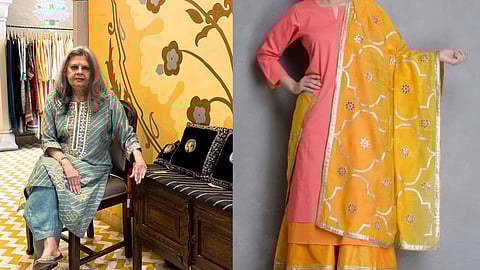
Benu Bhatnagar is a legend of a quieter kind. The kind who doesn’t rely on billboards or celebrity endorsements, but lets her work speak for itself. Since founding her label in Jaipur in 1997, Bhatnagar has emerged as one of India’s most respected revivalists of gota patti: a centuries-old Rajasthani embroidery technique that once used pure gold and silver.
One of the few remaining designers reviving old Indian craftsmanship into luxury fashion pieces, Benu’s gota patti creations have been worn by everyone from Rajasthani royalty to Delhi high society and even Michelle Obama.
Unlike the mass-produced versions you see today, her pieces are a masterclass in slow fashion and sustainable luxury. Her saris and salwar kameezes incorporate gota patti, lappa, and thappa with contemporary cuts and styles to appeal to modern sensibilities.
In an era where fashion is increasingly fast and logo-driven, Bhatnagar is a quiet, powerful voice for craftsmanship, community, and cultural memory. We sat down with the designer to talk about her journey, the changing face of luxury, and what keeps her rooted after nearly three decades in fashion.

Robb Report India: Gota patti is such a rich, historic craft—how did your journey with it begin? Was it heritage, curiosity, or something else that drew you in?
Benu Bhatnagar: Since I am from Jaipur, Rajasthan, I’ve grown up seeing beautiful gota patti outfits like poshaks, saris, and blouses all my life. As a young girl, they left quite an impression on me. I was always fascinated by how the gold and silver ribbons would look when shaped into patterns on brilliant colours like rani pink, emerald green, royal blue, leheriya, etc.
That fascination, along with curiosity, turned into my passion, and I started working with this amazing craft. A lot of my initial designs were inspired by my grandmother, mothers, and aunts, as well as poshaks, saris, and even hand fans that we had at home! The feeling is very nostalgic, it always takes me back to my childhood, and makes me very proud of being a custodian of sorts of this age-old craft.
RR: You started in 1997. Looking back over the last two decades, what has changed the most in your craft—and what hasn’t changed at all?
Benu: I believe that crafts that have lasted for hundreds of years, gone through the tough test of time, have a way of staying relevant through different periods. The craft has remained the same, the technique of making it is still the same, what has changed is the style one can present it in. [Today, I do] more Indo-Western outfits with a touch of gota patti in more contemporary designs. Even though the craft is centuries old, it has made its position clear and remains relevant today.
RR: You’re known for reviving traditional gota techniques and giving them a fresh, contemporary twist. What are some design choices you’ve made to keep the craft relevant for younger generations?
Benu: In the olden days, gotta patti was made with real silver and gold ribbons. They were metal threads woven together in different widths and then used to embellish the garments. The ones that were less than one inch were cut and folded into various shapes, like squares and diamonds. Since these were metallic threads, they would easily fold and stay in shape. These would then be stitched, like appliqué, by hand onto the garment in various traditional patterns.
The gota ribbons that were broader, like 6 inches or 12 inches, would be used as borders. Those are called lappa, and the ones with an embossed pattern are called thappa. Nowadays, real gold and silver gotta has been replaced by other metallic gotta since the prices of gold and silver have shot up. The younger generation, when it comes to traditional poshaks, still wants the traditional patterns, but for a more party wear look. [To achieve this,] I use more geometric patterns or mix gotta patti with other embroideries. The cuts and silhouettes have become more contemporary, and adding one or two motifs of gota makes the garment trendy and fashionable, appealing to the younger lot.
RR: What is your take on fast fashion?
Benu: I am a believer of heirloom fashion. For me, a sari or poshak that’s passed down from one generation to the next is a blessing, so fast fashion is not something I endorse. Sustainable fashion is the need of the hour, and that’s something we should all consciously work towards. The hoarding mentality, or instant shopping, is merely short-term gratification. A garment that has taken time and effort to create, is unique and one of a kind, has far better quality and beauty.
RR: Each of your garments feels like a work of art. How long does it typically take to create one of your bridal pieces, start to finish?
Benu: From planning, sketching, and sourcing the raw material, to embroidering and stitching, it can take a month, or even a couple of months, depending on the design and how dense the pattern is. Each piece is limited-edition and becomes an heirloom for the bride and her family.
RR: You currently work with 25 artisan families. How do you ensure continuity of skill across generations?
Benu: It is a huge challenge to keep the next generation involved in the same craft. The craftsmen who work for me are mostly young, and many of them do not want to learn this craft. They have only me to turn to if there is a situation in their families. For me, these 25-plus families are an extension of my own family. I keep encouraging them, supporting them and praising their good work to make them feel proud of what they are doing. It is indeed a matter of pride that they are continuing the legacy of this Jaipuri craft. And, honestly speaking, a big motivation is money. We pay our Karigars well and consciously work to provide a good and comfortable working environment.
They spend most of their day at the workshop, and I ensure a great work culture and comfort. We can only hope that their children will learn this craft and continue the legacy. It really is upon each one of us to ensure this craft flourishes and the younger lot of craftsmen find it an honour to be able to work on this craft.
RR: What does luxury mean to you?
Benu: For me, luxury is in the details, how the garment feels from the inside, not just what it looks like from the outside, and how comfortable the wearer is. I like to use equally expensive material on the inside without any compromise. I believe what touches your skin and makes you feel like you’re wearing something special is real luxury in fashion.
RR: There’s growing international appreciation for Indian crafts, yet still limited understanding. What’s one thing you wish more people knew about gota patti and your process?
Benu: Well, I hope more and more people talk about the craft, write about it, and spread the word. To keep the craft alive and the craftsmen proud of what they do, it is important to constantly engage people in bringing awareness about the crafts. Documentaries have a higher reach, and perhaps someone can take the initiative to document this process and show how intricate and detailed this work is. Many of my clients, after seeing the garment being made, have a deeper respect for the craft itself.
RR: You’ve dressed everyone, from Bollywood celebrities to global icons like Michelle Obama. How do you approach designing for such a diverse clientele while staying true to your aesthetic?
Benu: The clients come to you for your authenticity in dealing with them and being true to your craft. I am always personally involved in the designing, production, and delivery. Being available and answerable is very important, which I feel is the key to good work. Clients are confident when they see you being on top of things. Passion and talent is one thing, management and delivery is equally important. People come back to you because they know you are available, involved, and answerable.
RR: How much do your creations retail for?
Benu: My creations range from INR 3500 to Rs 3.5 lakh. The average price is between INR 10,000 and INR 25,000, depending on the work, style, and density of embroidery.
RR: Which boutiques / stores do you supply to?
Benu: In India, I supply to Ensemble, Ananda in the Himalayas, and a few standalone stores in Mumbai, Kolkata, and New Delhi.
RR: How do you think Indian fashion is perceived globally today, and what do you wish more people understood about it?
Benu: India is making a mark globally for a while. [High-profile] weddings like the Ambanis have shown the world that Indian fashion is all about traditional weaves and embroideries. [Recently], we’ve also seen many top celebrities in exquisite Indian outfits. Indian fashion is “trending” globally, and it’s a moment of great pride [for us]. Our celebrities always choose to wear Indian outfits when they represent India abroad. This should continue, so that more and more people are exposed to Indian fashion and start understanding our colourful, aesthetic, deeply rooted culture better.
RR: What’s next for your label? Are you exploring new silhouettes, collaborations, or perhaps passing the torch to the next generation?
Benu: I am always experimenting, always trying new cuts and silhouettes. Using these age-old techniques in new ways is something I enjoy the most. My son, daughter, and daughter-in-law support me and help me with collaborations and exhibitions of my creations. They are already quite involved and supportive of my work, always encouraging me to do better. Young energy and ideas are very important for growth and remaining relevant in today’s times.
RR: If you could design a gota patti piece for any historical figure—real or imagined—who would it be, and what would it look like?
Benu: I would love to design a shaded chiffon sari in pastel colours for Maharani Gayatri Devi of Jaipur. She is my forever muse, and the way she carried her saris was truly magical. I’ve had the privilege and honour of meeting her several times - she had such grace, style, and beauty. One simply couldn’t take their eyes off her!