
Subscribe
Subscribe
- Motoring
- Style
- Home & Design
- Travel
- Food & Drink
- Specials
- News & Tech
- Videos
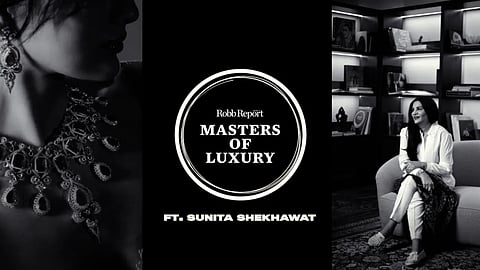
In episode 1 of Masters of Luxury, Robb Report India catches up with Sunita Shekhawat as she deep dives into India being the hot spot for jewellery craftsmanship, and the future of her brand.
When did your journey with jewellery begin?

I don’t come from a jewellery background. My father was in the Air Force, so we have travelled all over, and I have imbibed the culture of all the major cities in India. Then we finally moved to Jaipur. I think that was my calling—I went to Johri Bazaar and saw how jewellery is made, and I was fascinated. I did my course in jewellery making and gemology [after that].
You were one of the first in India to do ‘jewellery by appointment’. How did that happen?
The whole idea of by-appointment culture was to give people undivided time and attention. I still remember going to these fancy restaurants in Delhi and waiting in queues for the other families to finish lunch or dinner, and to me, [that did not feel right]. So, I [wanted to] give a different experience to my clients—to really experience the jewellery. Buying was always secondary but giving them that experience was more important to me.
How do you define luxury?
Luxury is about exceptional quality, exclusivity, and experience. Providing an experience, exclusive workmanship, and craftsmanship to me is luxury.
You work with over 100 karigars in Jaipur, specialising in Meenakari. Where do they come from?
There were around 16 enamel centres in the country: Lahore [when it was a part of India], Amritsar, Lucknow, Murshidabad, Bikaner, and Jaipur. Jaipur flourished with the influence of the Mughal dynasty. And certain karigars, about 50 of them, were moved to Jaipur during the Mughal period. We still have some of those families working for us. From that 50, probably by now, that number has become 500 or maybe 1,000. And yes, we have some karigars [working with us] who belong to that Mughal descent.
Tell us about the Museum of Meenakari Heritage (MoMH) in Jaipur.
This is my tribute to the city, which has given me so much. Jaipur has been an art and craft centre. There were 36 karkhanas in Jaipur, and the royal family has patronised all of them. Of course, Meenakari was one of them. And my way of giving back to the city was opening a museum dedicated to the craft of Meenakari.
You are launching the first range of collectables from the House of Sunita Shekhawat. How did that happen?
At the House of Sunita Shekhawat, we are trying to blur the line between object, a jewellery object, and a piece of jewellery. The whole idea came when we were working closely with Nita Ambani for the wedding [of Radhika and Anant Ambani]. She encouraged me to make these meenakari jewel boxes for her personal collection. And thanks to her patronage, we are here after one-and-a-half-year launching the collectables range.
It's often said that jewellery is a very personal thing. And it should tell a story about the person who's wearing it. Who wears Sunita Shekhawat?
She is someone with an eye to detail, who understands the material and can keep the jewellery well. Even if you have all the resources of the world, one should know how to value and take care of an expensive piece of jewellery and craft. One must value what one purchases.
We spoke about craftsmanship, artisans, karigari. What is your take on conscious luxury?
[I think] jewellery is the most sustainable product. [You might be wearing a piece] that belongs to your mother, which has been around for generations. Sustainability is also related to ethical practices. [In jewellery, it’s about factors like] mining, promoting the art and craft, dealing with the artisans, keeping them motivated. There are no ‘latest trend’ in jewellery, there’s no seasonal collection. [Your jewellery stays] with you for decades, even generations. [What can be a more] sustainable piece?
What’s next from the House of Sunita Shekhawat?
We have been thinking of two things. First, we are planning to set up an atelier on the craft of Meenakari by 2026, where I want to have women artisans doing this kind of work with the male artisans. Second, we just want to show to the world that India still has artisans and craftsmanship, which was done in the 15th or 16th centuries. So, the museum is testimonial to it, that India still has those artisans.