
Subscribe
Subscribe
- Motoring
- Style
- Home & Design
- Travel
- Food & Drink
- Specials
- News & Tech
- Videos
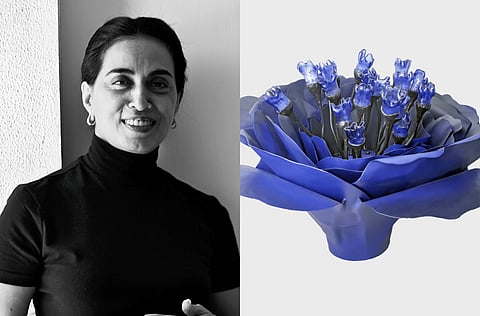
There is a quiet poetry in the meeting of fire, glass, clay, and light, a dialogue that speaks of tradition and innovation, of craft and contemplation. Across Indian studios and galleries, artists are now reshaping how we, as an audience, perceive material and meaning, blending instinct with intellect and memory with modernity. Among them, glass artist Hemi Bawa, ceramicist and scholar Dr Kristine Michael, and curator Ashwini Pai Bahadur stand out, exploring how creation, at its core, remains a deeply human act.
From her early days as a painter at Triveni Kala Sangam under Rameshwar Broota to becoming one of India’s foremost glass artists, Hemi Bawa’s journey has been shaped by curiosity, courage, and intuition. What began as a painter’s pursuit gradually evolved into something far more profound.

“I began with painting and later started working with clay,” she recalls. “One day, I placed some clay in a furnace and sprinkled glass over it. The result completely fascinated me. That single experiment opened an entirely new direction in my work.” A visit to Europe soon after introduced her to cast glass, a medium whose rugged texture and quiet strength resonated deeply with her. From that moment, there was no turning back.
Her Coca-Cola sculpture for the 1996 Atlanta Olympics brought international recognition and renewed confidence. “It gave me confidence in my instincts,” she says. Working with cast glass is a meticulous process that demands patience and precision; yet, for Hemi, it is as much about emotion as it is about technique. “When I started, there was no infrastructure for cast glass in India. I had to import a small furnace from England and teach myself everything through trial and error. Over time, I realised that both intuition and technique are equally important. The material has its own temperament, and I have learned to let it surprise me.”
Her practice extends beyond glass, encompassing aluminium, fibreglass, copper, and even recycled materials such as windshields and shower glass. “The idea always leads me to the material,” she explains. “For larger forms, I turn to fibreglass. For warmth and contrast, copper is my medium. Its changing patina gives each piece a sense of life. I also enjoy using recycled materials to make the process more sustainable. Every medium has its own personality, and I choose what best expresses the feeling I wish to convey.”
Today, she continues to explore the dialogue between glass and copper. “Copper brings warmth while glass offers translucence. Together, they create a conversation between fragility and strength,” she says.
To understand Hemi’s work is to understand the delicate intersection of traditional craft and contemporary art. Ceramic and glass artist, curator, and scholar Dr Kristine Michael observes that this boundary has always been fluid. “The line between craft and contemporary art is constantly shifting and ideally dissolving,” she explains. “Artists like Hemi carry forward the artisanal language of glassmaking into new conceptual and aesthetic spaces. Craft is not secondary. It is the foundation from which new ideas and interpretations emerge.”
Dr Michael, who has spent years curating exhibitions that highlight ceramics and glass, sees her work as a bridge between scholarship and practice. “Art history has not given enough emphasis to these mediums, but their time will come. Curation is an extension of my writing and research. It allows me to bring these materials to audiences who might not have encountered them in this way before.”
Curator and art consultant Ashwini Pai Bahadur observes a parallel shift in the wider Indian art scene. “The line between traditional craft and contemporary art is becoming more porous than ever,” she says. “Craft is no longer just heritage. It is a living, evolving practice. Many contemporary artists collaborate with artisans, adapting indigenous skills into installations and fine art. This exchange keeps traditions relevant while grounding modern art in cultural memory.”
She also notes a growing focus on material-led practices and sustainability. “Artists and collectors are rediscovering the beauty of tactile mediums such as glass, ceramics, and textiles. There is a renewed appreciation for slow, sustainable methods using natural dyes or recycled materials. Collaborations between craftspersons, architects, and artists are creating immersive experiences that go beyond galleries.”
According to her, India’s art market is entering a transformative phase. “Younger collectors are curious and open-minded, drawn to both innovation and heritage. The ecosystem is diversifying, and with more institutional support and international attention, India is emerging as a global art destination. The future lies in practices that are grounded in culture yet forward-looking in vision.”
Through the perspectives of Hemi Bawa, Dr Kristine Michael, and Ashwini Pai Bahadur, it becomes clear that the story of Indian art today is about resilience, experimentation, and emotion. It is about discovering beauty in process, meaning in material, and continuity in change.
As Hemi reflects, “Glass taught me patience. It taught me to trust the process, to let the material reveal what it wants to become.”
Perhaps that is the defining spirit of this new generation of Indian artists: a quiet confidence that art, like glass, is not only about form or finish, but about light passing through time.