
Subscribe
Subscribe
- Motoring
- Style
- Home & Design
- Travel
- Food & Drink
- Specials
- News & Tech
- Videos
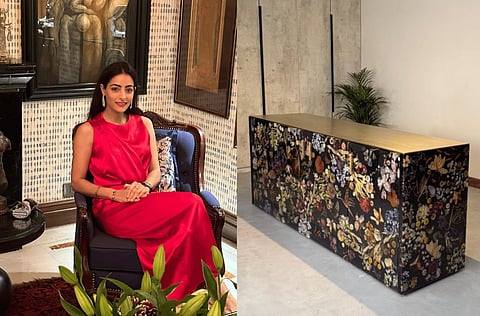
Resin artist Juhina Sodhi has carved a space for herself in contemporary luxury art. Her work transforms delicate flowers and botanicals into sculptural pieces. Every creation is a study of light, depth, and time, inviting viewers to pause and appreciate beauty suspended in a moment. Sodhi’s work strikes a delicate balance between fragility and permanence. Through her resin art, she preserves fleeting moments of nature and transforms them into pieces that linger in memory, inviting you to slow down, reflect, and find beauty in stillness.
Her family started using resin to preserve wild animals. Today, she has taken that legacy and reimagined it entirely, transforming delicate flowers and botanicals into sculptural furniture and art pieces. Her creations have adorned spaces at the Mandarin Hotel in London, and Hilton Royal Orchard in Singapore. She has even collaborated with luxury names such as DIOR (Munich), and Cartier.
In a conversation with Robb Report India, Sodhi opens up about moving from oil painting to resin, the painstaking process of preserving nature, and her view of luxury in art today.

Robb Report India: What inspired your transition from oil painting to resin art?
Sodhi: My journey with resin grew out of my love for flowers and their fleeting beauty. Growing up in India, I was struck by the wastage of flowers after weddings and events, often discarded in truckloads within minutes. I tried pressing and drying them, but the flowers never kept their form or colour. Then I stumbled upon taxidermy and thought, if we can preserve animal skins for decades, why not flowers? Plants, of course, are far more delicate after chemical treatment, which is what eventually led me to resin. Natural resin can preserve fossils, but it isn’t strong enough, so I turned to polyurethane. Bringing these organic and synthetic elements together has been a long but rewarding journey.
RR India: What is your process for selecting and embedding flowers in resin?
Sodhi: It depends on the project and the colour palette—sometimes tropical, sometimes wintry, sometimes floral. Preservation takes four- to eight- weeks. First, the water is extracted from the flowers and replaced with a resin-compatible solution. Then they’re chemically treated to hold their form. Some plants don’t react well, but apart from cacti, almost everything survives. Once preserved, the flowers go layer by layer into resin, making it feel as though time has gently paused around them.
RR India: What technical hurdles do you face while working with resin, and how do you overcome them?
Sodhi: Resin is a bit temperamental! Temperature, humidity, dust, and even tiny particles in the air can ruin a pour. Below 22 degrees Celscius, it doesn’t cure properly; above 30 degrees Celscius, it risks overheating. Dust or microbubbles can sneak in between layers, and delicate flowers can break. I maintain a controlled studio environment, wear gloves and filtered masks, and pour slowly, layer by layer. It often feels like working in a high-security lab, but that attention to detail is what makes it perfect.
RR India: How would you define your style in resin art, and what sets your creations apart?
Sodhi: I like precision rather than drama. My pieces focus on light, transparency, and balance. I leave space within the work so it can breathe, letting viewers find their own points of focus. There is a tension between structure and fluidity, between what is visible and what remains subtle. That is what creates calm and reflection.
RR India: You have previously collaborated with Dior. Could you share what that experience was like and how it influenced your work?
Sodhi: Collaborating with Dior was incredible. A console in Munich demanded Japanese-level precision, a mirror-like finish, and rare flowers. My studio had over 700 boxes of preserved flowers for just that piece. I’ve worked with other luxury brands too, but NDAs prevent me from naming them!
The project that really moved me, though, was for Tata Memorial Hospital. I painted a Tirupati Balaji and encased flowers from the temple garland. Seeing patients and families pray and find hope in front of it was profoundly emotional. That reminded me why art matters beyond aesthetics—because it can heal and inspire.
RR India: How do you create large-scale projects such as the floral resin installation at Hilton Orchard Street in Singapore?
Sodhi: I have done installations for Hilton Orchard Singapore, The Fullerton Waterboat House, Pullman Hotel Malaysia, Kings Royal Winter Palace Bhutan, Jaypee Greens Golf Delhi, Mitsubishi HQ Japan, and select UHNI residences. These projects take four- to six-months. Every piece is built in my studio and measured down to the millimetre before shipping. For large works, I train a small team to assist with polishing and finishing.
RR India: What lessons do you aim to impart to aspiring resin artists?
Sodhi: Luxury isn’t about price; it’s about rarity and novelty. If hundreds of people own the same piece, it loses its uniqueness. True luxury is having something rare and thoughtfully created, like a Kashmiri sapphire or Colombian emerald.
RR India: Looking ahead, are there any upcoming projects or collaborations you are particularly excited about?
Sodhi: Japanese art fascinates me, especially anime forms. Takashi Murakami is a big influence, and I am exploring how that aesthetic might shape my upcoming projects.
I am finishing my largest resin-flora wall ever, 44 feet by 10 feet and weighing 1,100 kilograms, with tropical flowers that have leaves up to three feet in size, for Pullman Hotel Malaysia. Collecting and sourcing the flora took months. It is a milestone and a source of pride that global brands are turning to Indian artists for such statement pieces.