
Subscribe
Subscribe
- Motoring
- Style
- Home & Design
- Travel
- Food & Drink
- Specials
- News & Tech
- Videos
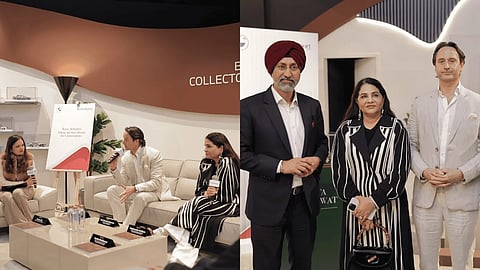
At the India Art Fair, a collaboration between Robb Report India and BMW explored how art shapes the objects we live with—across automobiles, fashion, craft, and design. Hosted at the BMW Collectors Lounge on 5 February, the showcase moved beyond the gallery format, positioning art as something shaped by process, heritage, and intent.

The event featured works by jewellery designer Sunita Shekhawat, hotelier and 16th-generation descendant of the Holkar dynasty Yeshwant Rao Holkar, and fashion designer Raghavendra Rathore, each offering a distinct perspective on craft and legacy.
At the centre of the lounge was an exclusive showcase of the BMW Concept Speedtop, a design-forward concept reflecting BMW’s ongoing dialogue between art and engineering. Defined by its sculptural form, signature kidney grille, and a roof gradient shifting—from Floating Sunstone Maroon to Floating Sundown Silver—the car was an ode to the evening’s exploration of craftsmanship and design. Mr. Hardeep Singh Brar, President and CEO, BMW Group India, said, “BMW Group India’s decade-long partnership with India Art Fair reflects our unwavering belief that culture, creativity, and innovation are inseparable pillars of progress.
The artworks surrounding it shifted the focus from innovation to inheritance. One of the most significant pieces, presented by Yeshwant Rao Holkar, was a rare archival photograph of Maharani Chandravati Bai Sahib Holkar, dating to the early 20th century. Preserved in its original vintage frame and held within a private royal collection, the photograph has never existed in the public domain.
Displayed alongside it was the ‘Chandravati’ sari, a contemporary recreation of the sari worn by the maharani herself. Handwoven in a cotton–silk blend (neem reshmi) and embellished with 24-carat gold zari, the textile comprises 111 lines of booti and 2,109 handwoven rui phool motifs, requiring over 100 hours of artisan labour. Its rarity lies in a faithful translation of archival memory using endangered techniques practised by master artisans.
The Listening Heart, a privately held kinetic artwork created in 2020 and presented by Raghavendra Rathore, represented a contemporary approach to art. Never publicly displayed before, the wall-mounted work featured a monochromatic portrait emerging from a deep black surface, framed in bronze-textured wood. Embedded circuitry activated subtle movement and faint pulses of light—an experience sensed rather than seen.
Completing the presentation were enamel boxes by Sunita Shekhawat, inspired by the Ottoman era and crafted using the rare champlevé enamel technique. Conceived as contemporary collectables, the pieces foregrounded patience, precision, and material integrity.
If the exhibition explored art through objects, the panel turned the focus to process. The conversation was about what gives art its value—time, skill, intent, and responsibility. Bringing together people whose practices span media, food, fashion, and jewellery, the panel reflected a shared belief that good design is lived with and experienced.
The discussion featured Avarn Jain, Chairperson of RPSG Lifestyle Media, alongside Chef Manish Mehrotra, Yeshwant Rao Holkar, Raghavendra Rathore, and Sunita Shekhawat.
When asked what rarity means today, Holkar pointed to the pace of modern life. “The world moves very quickly,” he said. “Everything is available at the touch of a button. Things that require effort are what feel rare today.”
For Sunita Shekhawat, rarity is tied closely to making. “For me, anything handmade is rare,” she said. “If it’s made with precision and supports five or ten families, that is rare. I’ve worked with artisans for over 30 years, and each one brings a different sense of design and quality. That individuality is what makes the work special.”
Jain went on to ask the panel what could never be compromised in the creation of art. “Intent,” said Rathore. “And honesty. Without that, it’s just craft; it’s not art. There has to be context, depth, and some sense of giving back, whether through heritage or culture. Being true to what you create is the essence.”
For Chef Manish Mehrotra, rarity lies in the overlooked. “Indian food is vast. We are still discovering it,” he said. “For me, rarity is something simple that people don’t usually pay attention to, but that can be celebrated. A pinch of hing or a fistful of lentils. These are ingredients that support many lives and end up on our plates every day. That, to me, is rare.”
2026 is the year BMW Group India and India Art Fair celebrate ten years of partnership —a milestone that underscores their shared commitment to creativity and innovation at the intersection of art, design, and technology.