
Subscribe
Subscribe
- Motoring
- Style
- Home & Design
- Travel
- Food & Drink
- Specials
- News & Tech
- Videos
Delhi's iconic Connaught Place has no dearth of restaurants, particularly those serving Punjabi cuisine. So, when I heard of Chef Amninder Sandhu's upcoming Punjabi restaurant, Kikli, I expected the usual butter chicken and dal makhani of the world.
But I'm to blame. With Sandhu’s meritorious culinary career thus far—having won a National Award for Best Lady Chef, starring on The Final Table on Netflix, and being the brains behind Bawri in Mumbai—I should have known “regular” was definitely off the table.

"There are a lot of Punjabi restaurants, but we wanted to bring the lesser-known flavours of the state," says Sandhu candidly. The first dish, Plum Bajra Papdi, promises just that.
Here, bajra, a pearl millet signature to the western state, is used to make the crunchy papdi, and is loaded with spiced potatoes. A creamy curd covers the creation, with a butter-soft caramelised fig doubling as a garnish.
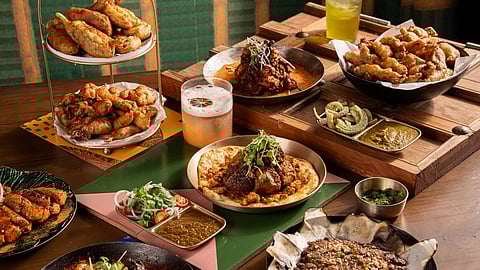
The Satpura is a reinvention of the classic samosa. Made with seven layers of delicate, crisp pastry, it arrives topped with khatte-meethe aloo launji and finished with a drizzle of tamarind chutney. The balance of textures—flaky, soft, tangy, spiced—is calibrated with restraint. The melt-in-the-mouth Khumba Chapli Kebab offers a mushroom-forward patty spiced with traditional chapli kebab seasonings. The Bun Kebab, glistening with a frothy egg varnish, is loaded with spiced vegetables—just the way I like it.
But it’s the accompanying chutneys that steal the limelight, particularly the green chilli one. It was just the right amount of tangy and spicy (as compared to the light green curd versions plaguing the Indian culinary scene currently).
The main course takes me straight to a Punjabi house, where micro-dining or small portions don’t exist. Served in hearty proportions, the kadhai paneer is addictive. It is a robust, full-bodied rendition of the classic, served in an oversized iron ladle that nods to traditional Punjabi kitchens. The paneer is soft and coated in a rich, spice-laden masala that pulls no punches. Similarly, the Kathal Katakat plays on the street-side katakat technique, named after the rhythmic sound of two spatulas clanging on a griddle. This version replaces offal with tender jackfruit that is tossed in a smoky, charred onion-tomato masala.
The Chhappanja Tinda is a pleasant surprise. The hollowed-out summer squash is tender to bite, with bursts of paneer, cashew, and spinach forming the stuffing. The curry, too, has me licking my fingers!
For desserts, the nod to traditions continues. I dig into a protein-filled, rightly balanced Dodah; scoop up the subtle rabdi with the massive, yet crunchy Jabeli (picture a thicker, syrupy sibling of jalebi); and polish off the Mawa Barfi.
I would be amiss not to give a special mention to the bread section—or rotiya, as Kikli calls it. While the usual Punjabi staples like missi, makki, and phulkas find a spot on the menu, consider biting into the lesser-known Toonhi Roti and Mushki Roti instead. While the former is dubbed the Punjabi cousin of Sindhi koki (a thick, spiced flatbread made primarily from wholewheat flour, onions, green chillies, coriander leaves, and pomegranate seeds), the latter is a naturally fermented, rare, hyper-local Punjabi flatbread, now nearly forgotten outside traditional rural homes. “I could eat these rotis for breakfast!” I tell Chef Sandhu. She agrees, confessing that she often bites into these rotis between service!
True to Punjabi stereotypes, the cocktails come in ‘Patiala sizes’. Doused in copious amounts of alcohol, the drinks, while potent, are balanced without making one feel overly intoxicated. The gin-based Brine Baazi has an oddly satisfying kick of onion brine—an ode to Punjab’s sirka pyaaz (vinegar-soaked shallots).
The Coffee Shoffee is another interesting fusion, wherein a deliciously strong, blended homemade coffee liqueur is meant to be chased down with a lager beer. Savoured as a shot, the bitterness of the coffee is almost instantly cut by the freshness of the beer, making for a refreshing mouthfeel.
If you prefer your drinks non-spiked, the lassi is a must (although a vodka version is available, too!).
Located in the bustling K Block of Connaught Place in Delhi, Kikli is unassuming at first. A narrow, almost dark alleyway greets you. Here, a line of souvenirs (which, I’m told, are up for sale) and wall projections of Sandhu’s research explorations across Punjab surround you on either side. Beyond this, though, a whole new world opens. A massive courtyard takes the centre, with an indoor bar on the right and an open kitchen on the left. Picture patio-style seating, complete with potted plants and orange interiors. The sultry monsoon weather during my visit added to the charm..
Walk past this, and another sprawling space reveals itself. The earthy-toned chandeliers, made of cane and hay, coupled with multi-coloured sofas, personify the vibrant region. In fact, at the bar, one can spot Phulkari-inspired artworks and motifs on the wall, further paying homage to Punjab’s culture. My favourite part of the ambience? The music.
Ditching the usual instrumental tunes one hears at most culinary establishments in India, Kikli has soulful Punjabi folk songs echoing. Now and then, Jagjit Singh lends his voice through the speakers, too. “I’ve curated the playlist myself,” reveals Sandhu rather proudly. "During the day, we have more mellow folk and traditional songs. For the dinner service, it picks up the pace,” she adds, while clarifying it is always rooted in the tunes of the state.
Chef Amninder Sandhu reaches beyond the familiar tropes of Punjabi cuisine to spotlight the brilliance of domestic culinary traditions long overshadowed by restaurant-style gravies and pan-Indian clichés. Head here if you’re looking for the warmth of eating at a local’s home (the ever-smiling staff will make you feel at ease at once!)—but amped up with flair and finesse.