
Subscribe
Subscribe
- Motoring
- Style
- Home & Design
- Travel
- Food & Drink
- Specials
- News & Tech
- Videos
The romance of the Orient Express has always centred on the journey itself, with its storied rail carriages transforming travel between cities into an experience to be savoured. Now, as the brand prepares to introduce the world’s largest sailing yachts, that same philosophy is setting sail.
Orient Express has unveiled its 2027 itinerary collection, expanding well beyond the Mediterranean routes planned for its inaugural season. The Accor-owned brand will deploy both the Corinthian and Olympian sailing yachts across new territories, including Greece, Turkey, the United Kingdom, and Scandinavia.
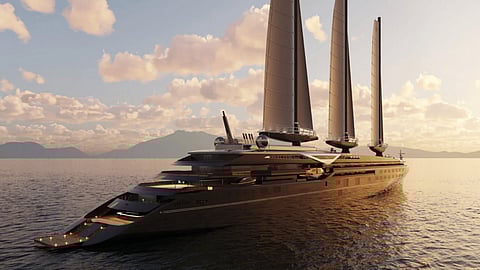
In June next year, the 220-metre Corinthian will enter service, earning the distinction of being the largest sailing yacht in the world. Her 721-foot sister ship, Olympian, will follow in 2027. The inaugural season spans the Côte d’Azur, the Italian Riviera, the Adriatic, and the Caribbean. The following year shifts focus to British waters, Norwegian fjords, Danish straits, and the scattered islands of the Aegean.
Mediterranean itineraries include a voyage beginning in Piraeus, sailing through the Aegean and the Sporades before reaching Istanbul, as well as another that starts in Valletta, threads through the Ionian Sea, and concludes in Piraeus. Northern routes present three options: a sailing that departs London and follows England’s south coast, calling at Torquay and Cowes before reaching Saint-Malo and Honfleur; a journey tracing Britain’s eastern coastline north to Edinburgh before continuing into Norway and Denmark; and an itinerary beginning in Copenhagen that follows the Norwegian coast, continues through Scotland, and ends in London.

Both yachts are equipped with the SolidSail propulsion system developed in partnership with Chantiers de l’Atlantique. Three masts rising over 100 metres support rigid sails with a combined surface area of nearly 50,000 square feet. The masts tilt and rotate to maximise wind capture, allowing the yachts to sail under wind power alone in favourable conditions, significantly reducing fuel consumption and emissions.
Routes are planned around seasonal wind patterns to maximise sail propulsion. Additional environmental features include AI-based detection systems designed to prevent marine mammal collisions, as well as dynamic positioning technology that eliminates the need to drop anchor, helping protect seabeds.
Each yacht accommodates just 54 suites arranged across four decks. Every suite offers either a private terrace or panoramic windows. The interiors have been conceived by artistic director Maxime d’Angeac, drawing inspiration from 1920s Art Deco and the golden age of ocean liners. French artisans have executed the details, with blown-glass light fittings, bespoke metalwork, and hand-finished wood surfaces throughout.
The culinary programme is overseen by multi-Michelin-starred chef Yannick Alléno and spans five restaurants. La Table de L’Orient-Express presents refined fine dining, L’Encre focuses on seafood-led menus, and La Piscine offers relaxed poolside fare. Eight bars are spread across the yachts, including a speakeasy inspired by the Roaring Twenties.
Wellness is anchored by Le Spa by Guerlain. Guests have access to two pools: a 54-foot lap pool positioned between the masts and an infinity pool at the stern. Additional facilities include a 115-seat Art Deco cabaret, a 24-seat cinema, a music recording studio, and a library housing 1,500 volumes. A stern marina provides direct access to water sports equipment.
Shore experiences prioritise cultural access and exclusivity. While specific excursions for 2027 have yet to be announced, previous disclosures suggest private access to archaeological sites such as Pompeii, exclusive museum visits followed by chef-led dinners, vintage car rallies to Michelin-starred restaurants, and driving experiences on racing circuits.
The yachts predominantly anchor rather than dock, allowing for extended stays at each destination. This slower pace of travel encourages deeper immersion, with routes favouring preserved coastlines and culturally significant ports while avoiding heavily overcrowded destinations.