
- Motoring
- Style
- Home & Design
- Travel
- Food & Drink
- Specials
- News & Tech
- Videos
Holiday trends are constantly evolving: be it intergenerational escapes, lesser-known destinations, spacations, or pickleball getaways. While some travellers seek the comfort of returning to familiar destinations, others are drawn to the thrill of discovering places less explored.
Whatever your travel style, we at Robb Report India have made it easier for you with a list of the 50 Greatest Places to Explore, paired with luxury properties worth-their salt. Curated with recommendations from RR Circle members, insights from a panel of over 30-plus experts across travel, hospitality, and other fields along with our editorial team, this is your guide to the destinations worth the journey.
Ready to explore? Let’s checkin.

HIMACHAL PRADESH, INDIA
High in the trans-Himalayas, Spiti is a remote cold-desert valley where ancient monasteries perch on ochre cliffs, prayer flags flutter in the wind, roads trace improbable lines along sheer rock faces; and villages appear almost suspended in the landscape. “Reaching it is part of the story,” says Loveleen Multani Arun. “Mountain passes close for months at a time, roads are carved into sheer rock, and long hours of travel filter out the casual visitor.” Life here still moves to its own rhythm, with centuries-old rituals and village traditions. The valley is a haven for stargazing: the Milky Way stretches brilliantly across the sky. While, the winters provide an opportunity to spot the elusive snow leopard.
WHERE TO STAY
Doksa calls itself an eco-conscious boutique farm stay. Set in Mane village, amid pea fields and rugged Himalayan terrain, it has spacious rooms designed to make the most of the landscape, with floor-to-ceiling windows. While some rooms get views of Manirang from two sides, few others look across the pea fields.
The meals are homely, seasonal and rooted in place, with vegetables drawn from Doksa’s kitchen garden and farms across Spiti, Himachal, Punjab and Madhya Pradesh, and picnic lunches are set up beside the bubbling Spiti River.
JAPAN
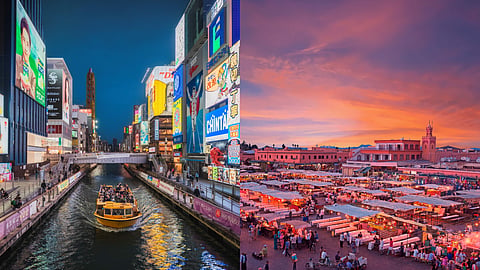
This city often gets overlooked in favour of its popular siblings like Tokyo and Kyoto. But Osaka is that diva that needs a show of its own. It’s culturally rich, bustling, vibrant, with great street food, gourmet dining, and a plethora of shops. Get lost in the Umeda Dungeon, a network of underground, interconnected shopping malls under train stations. For a retro vibe, head to the Shinsekai and Dotonbori areas that have bright lights, old style game parlours, fun hoardings, food stalls that specialise in kushikatsu, takoyaki, and okonomiyaki among others.
WHERE TO STAY
The Four Seasons Hotel Osaka is a fusion between modern comforts and traditional aesthetics. While most of the floors have contemporary-styled rooms, the 28th floor treats guests to a traditional ryokan experience. Each room has tatami flooring, futon bedding, washi-clad walls, sliding doors and Japanese bathing. The Sabo lounge lets guests participate in matcha preparation, calligraphy and origami. Try the Japanese afternoon tea and evening aperitif rituals.
This one Michelin Key hotel also has some great dining options, and Bar Bota on the 37th floor not only gives sweeping views of the city but also presents a menu rich with fruits, flowers, leaves, grains and seeds, layered with Japanese ingredients.
UAE
Ras Al Khaimah offers a great mix of adventure and culture. Be it the world’s longest zipline or hot-air-balloon rides, beaches and parks, along with historic sites. Do not miss the Suwaidi Pearl Farm in Al Rams, where the UAE’s pearling heritage comes alive. A traditional boat takes you to the floating farm, where you’ll learn about pearl diving, and how pearls are farmed today. The highlight? Opening an oyster yourself, hoping to find a pearl that you can take home.
WHERE TO STAY
Set across 1,235 acres of protected wilderness, The Ritz-Carlton Ras Al Khaimah, Al Wadi Desert gets you up close to freely roaming Arabian oryx and gazelles. Its 109 suites and tented villas are super luxe, but the signature two-bedroom villas dial up the privacy considerably. Spread over a whopping 900 square metres, these are your private desert hideaways, complete with temperature-controlled pools and huge terraces opening onto the dunes.
MEGHALAYA, INDIA
Shillong’s misty green valleys and spectacular waterfalls are only the beginning. For Rohit Khattar, founder and chairman of Old World Hospitality, it was the “fun music scene, vibrant cafes” and his first taste of Khasi cuisine that made the trip memorable. “I especially enjoyed the classic Khasi pork dishes: dohneiiong and jadoh,” he says—two delicious reasons for foodies to make this trip.
Known as the ‘Scotland of the East’, Shillong pairs lush hills and colonial charm with a distinctly local pulse.
WHERE TO STAY
Khattar’s pick for a stay is Ri Kynjai, a retreat perched above Umiam Lake. This tranquil retreat blends Khasi heritage with the beauty of Meghalaya’s landscape. Its cottages take their cues from traditional Khasi huts, with distinctive upturned roofs inspired by the region’s seafaring past.
MOROCCO
Marrakech is Morocco at its most colourful and chaotic. The walled Medina at its heart has a maze of narrow lanes, bustling souks, grand palaces and lush gardens. Get lost in the souks, where rugs, lanterns, leather, spices and ceramics vie for attention—and haggling is half the fun.
The Palace of Bahia brings the bling, with intricate mosaic work, marble, carved wood and colourful courtyards; go early to dodge the crowds. Then escape the madness at Jardin Majorelle, Jacques Majorelle’s vivid cobalt-blue garden, where exotic plants and shaded paths offer a welcome breather. Creation of this started in 1923 and was later bought by Yves Saint Laurent and Pierre Bergé. It’s now also home to the Islamic Art Museum.
Moroccan food is a delicious mash-up of history: Amazigh roots, Arab spices, Andalusian finesse, Jewish preserving traditions, French touches and flavours brought up through the trans-Saharan trade routes. The result? A brilliant, unique and highly satiating cuisine that suits varied palates.
WHERE TO STAY
El Fenn is a boutique hotel that feels more like a stylish friend’s house—with three pools, a 1,300-square-metre rooftop, two restaurants, cocktail bars and a spa. Its 41 rooms and suites are all different: hot-pink walls in one, teal in another, hand-stitched camel leather floors, lime plaster and Moroccan carved plasterwork alongside mid-century furniture. Add oversized tubs, soft cotton sheets, and a few resident tortoises, and it makes for one of the top choices to stay at this historic city.
ABU DHABI
Saadiyat Island has evolved from a stretch of sand into one of the Emirate’s most talked-about destinations. It’s where culture, contemporary architecture, beach life and nature come together.
The big draw is the Saadiyat Cultural District, where cultural heavyweights including Louvre Abu Dhabi, teamLab Phenomena Abu Dhabi, Zayed National Museum, Natural History Museum and Guggenheim Abu Dhabi have put the island firmly on the global arts map. The buildings, designed by some of the biggest names in contemporary architecture, are worth the detour.
Kai Beach is ideal for slow days by the sea, while Saadiyat Beach Club adds pools, dining and a livelier atmosphere. Golfers can tee off at Saadiyat Beach Golf Club, whose championship course runs along the Arabian Gulf. In short, this island is your playground for fun, adventure, and everything in between.
WHERE TO STAY
Jumeirah Saadiyat Island is a luxe address for easy-going days by the sea. Think bright, modern rooms with big ocean views, suites with floor-to-ceiling glass, and villas with private pools.
There’s plenty to keep you busy, too. Seven restaurants and bars cover everything from long lunches to evening drinks, while the 2,700-square-metre spa has 15 treatment rooms. Add three outdoor pools and you’ve got the kind of resort where the hardest decision is whether to hit the beach, the pool or the bar.
RAJASTHAN, INDIA
“On cool winter mornings in Ranthambore, mist hangs over the lake and langurs prance along the old stone gates as you pass through them. You know at once that you have entered a storybook,” says Indian author Siddharth Dhanvant Shanghvi. India has many tiger reserves, each with its merits, but Ranthambore is a stage, a fairy tale, and every return deepens its mystery. “I never leave knowing it better. I leave as though I have moved through a hall of mirrors and smoke,” he says.
WHERE TO STAY
“Aman-i-Khás keeps faith with the spell. Its white tents seem dreamt rather than pitched. Tea comes in the hour before dawn, and then you set out with guides who read pugmarks and alarm calls like a private script; their patience led us to the tiger more than once,” says Shanghvi. He recalls his time there and adds, “That evening, on a machan above the forest, vegetables from the farm were roasted over a wood fire. The hospitality is classic Aman: intimate, understated, refined.”
SAUDI ARABIA
The Red Sea on Saudi Arabia’s west coast is now among the country’s flagship Vision 2030 projects. Spread over 28,000 square kilometres of desert, islands, and coral reefs, the destination is built around the idea of regenerative tourism, with the number of visitors capped, and 75 per cent of its islands left untouched. It’s this exclusivity that lends itself to a holiday seeped in privacy. Ochre dunes, striated cliffs, and wind-burnished rock give way to turquoise lagoons.
That dual landscape shapes how you spend your days here, split between the water and the wadis. Go kayaking, or scuba dive among corals or hop between islands by boat to find deserted beaches and mangrove ecosystems. Inland, hike or rock-climb through the canyons, join a guided nature walk through Wadi Khuf and stay out after dark for a stargazing session.
WHERE TO STAY
Recognised with a Michelin Key, The St. Regis Red Sea Resort sits on a private island in the Ummahat archipelago. Designed by Kengo Kuma, the 90 villas here take inspiration from curves of the surrounding dunes and waves: Dune Villas open straight onto white sand, while the overwater Coral Villas spiral out over the reef. Each comes with a private pool, a sundeck and the brand’s signature butler service.
NEPAL
While this city serves as the base camp for Mount Everest, there is more to it than just being a launchpad for mountaineers. Capital of Nepal, Kathmandu is scenic with heritage sites and religious places like the Boudhanath Stupa, Monkey Temple, Patan Durbar, Malla Palace among others. But what this city also offers is nightlife, which not many are aware of. Neighbourhoods like Thamel and Patan have a gamut of options from jazz and lounge bars to clubs.
WHERE TO STAY
Dwarika’s Hotel is often called a living museum and known for its contributions to heritage conservation. It showcases Nepal’s ancient Newari architecture.
The interiors of the hotel, right from its antique wooden pillars, intricate sculpted wooden windows, handmade terracotta tiles, decorative bricks to the linen and furnishings, highlight the different artistic traditions of the Valley. The swimming pool replicates a royal bath from the 12th century.
DUBAI
Hatta is a mountain village tucked into the Hajar Mountains. The skyscrapers give way to rocky terrain, date farms and wadis, as well as a turquoise lake formed by Hatta Dam, making it the Emirate’s go-to escape for adventure. It opens to visitors through the cooler months, when the region’s trails, campsites and adventure parks come alive.
Head to Wadi Hub to roll downhill in a giant zorbing ball, go off-roading or walk through Hatta Heritage Village.
WHERE TO STAY
Caravan Hatta by Our Habitas brings glamping to the Hajar Mountains, with 50 Airstream caravans parked above Hatta Dam.
Inside, they feel more like a boutique hotel room than a campsite: earthy tones, rattan and raw wood, and a private deck where mornings start with the mountains in full view. In the evenings, laze in the infinity pool, and view the star-filled skies from the observatory.
MADHYA PRADESH, INDIA
Maheshwar takes travellers back in time—and justifiably so. In the 18th century, the city rose to prominence as the capital of Ahilyabai Holkar’s empire. Stone ghats lined with temples run down to the river.
While here, walk along Ahilya Ghat at dawn or dusk, when pilgrims gather for prayers, and take a boat out on the Narmada to see the fort and temple spires reflect in the water. Explore the Rajwada, the queen’s former residence, and the intricately carved Ahilyeshwar Temple. Then visit the Rehwa Society, where you can watch weavers at work on the town’s signature Maheshwari saris.
WHERE TO STAY
Ahilya Fort, is the former home of Ahilyabai Holkar. In 2000, her descendant Richard Holkar turned it into a hotel. Its 19 rooms are spread across six 18th-century buildings set among courtyards and gardens. But unlike conventional hotels, this stay comes sans in-room TVs and phones. Designed to nudge visitors to truly immerse in the destination, Ahilya Fort promises curated experiences right down to the dining table.
GUJRAT, INDIA
Little more than a century ago, only about a dozen Asiatic lions were left in India, all of them in the Gir forest of Gujarat. The Nawab of Junagadh banned hunting on his private grounds. That helped up the numbers: the 2025 census counted 891 lions across Saurashtra, and Gir remains the only place in the world where they live in the wild. The dry teak and acacia forest, spread over more than 1,400 square kilometres, is also home to leopards, striped hyenas and over 300 species of birds.
The park ordinarily opens to visitors in October and closes for the monsoon in mid-June, and the best time to see lions is on an early-morning jeep safari out of Sasan Gir. If safari permits are sold out, Devalia Safari Park offers a shorter drive within a fenced section of the forest.
WHERE TO STAY
Set on former farmland on the edge of the forest, Aramness is laid out like a traditional Saurashtra village, with its 18 kothis designed as a nod to the region’s Siddi and Maldhari communities. Want a luxe upgrade? Each comes with their own private pool, with a larger 20-metre infinity pool on-site. Stays are all-inclusive: meals, drinks, and twice-daily wildlife activities are covered, so mornings and afternoons go to jeep safaris into Gir, with walking safaris led by the lodge’s naturalists in between.
NAMIBIA
Sossusvlei is home to some of the world’s highest dunes, including the iconic Big Daddy and Dune 45, which rise close to 400 metres. Climb their slopes for killer views, hike partway and slide back down.
Nearby Deadvlei, with its ancient, skeletal camelthorn trees set against the red sands, is the kind of scene that makes you stop; leaving the spectacular scenery etched in your mind forever. “The sheer scale of the desert, the silence, the vast skies, and the feeling of being completely immersed in nature is unlike anywhere else on Earth,” says Taruna Seth, founder and navigator-in-chief, Encompass Experiences.
WHERE TO STAY
Spread across 12,715 hectares of protected wilderness, &BEYOND Sossusvlei Private Desert Reserve sits between NamibRand Nature Reserve and Namib-Naukluft National Park, within the Namib Sand Sea—the world’s oldest desert and a UNESCO World Heritage Site. Sculpted from stone, glass and light, Sossusvlei Desert Lodge is designed to disappear into the landscape rather than dominate it.
KARNATAKA, INDIA
Drive about five hours from Bengaluru into the Western Ghats, and the hills of Kodagu come into view. Here, plantations of Arabica and Robusta grow on silver oak, with pepper vines climbing the trunks. The mist rarely lifts before mid-morning, which explains why the region is fondly called the Scotland of India. Beyond the estates, this is the land of the Kodava community, with its own martial traditions and cuisine, and of Talakaveri, where the river Kaveri begins.
Mornings are best spent on plantation walks, following the bean from plant to cup, or on the trail up Tadiandamol, the district’s highest peak. By afternoon, head to the Kaveri’s banks at Dubare Elephant Camp, or to the gold-roofed halls of Namdroling Monastery in Bylakuppe.
WHERE TO STAY
The Leela Coorg Forest Sanctuary, a 76-acre estate is all villas. The larger ones have temperature-controlled infinity pools that look out over the valley. Coffee is the draw here: guests can follow the Arabica and Robusta grown on the property from cherry to cup. Dining ranges from Kodava akki roti with kadala curry at Luma, the all-day restaurant, to Pan-Asian plates at Zen, set over the lake.
NEW ZEALAND
“Everyone thinks of Queenstown when they think ‘luxury New Zealand’, and Taupō gets skipped entirely; which is a mistake!” says Karan Bhangay, co-founder, Indulge. Sitting on the Waikato River, Taupō has volcanoes, geothermal landscapes and a spectacularly oversized lake, making it a nature-lover’s dream.
Every summer sees its glassy blue waters come alive with boating, fishing and freshwater adventures, while the surrounding forests invite hikers and mountain bikers for a different kind of adventure. Then there’s the massive Huka Falls that roars with more than 220,000 litres of water falling over every second. Add a Māori cultural experience at Lake Aniwhenua and Taupō becomes an extraordinary addition to your New Zealand itinerary.
WHERE TO STAY
Huka Lodge has been quite the benchmark for New Zealand luxury for more than a century. Spread across 17 acres on the emerald Waikato River, the lodge began as a simple fishing camp, its white canvas tents pitched beside some of the country’s richest trout waters.
Today, the tents have given way to an elegant estate of rolling lawns, manicured gardens and exquisite dining spots, but the river remains central to the experience. Nearby Lake Taupō brings water adventures, framed by forest, volcanic landscapes and pumice beaches.
LADAKH, INDIA
The flight to Leh is one that keeps you glued to the window, with the aircraft soaring over majestic, snow-capped mountain ranges. Once you’ve acclimatised, a must for the first 48 hours—head to Leh Market. Sea buckthorn, one of Ladakh’s prized local offerings, comes in almost every form imaginable, from oils and juices to preserves and other products. The market is dotted with cafes and eateries serving everything from momos and thukpa to fresh jalebis.
WHERE TO STAY
The Grand Dragon Ladakh offers a more luxe take on the Ladakh experience. Founded in 2007 as a family-run business by brothers Ghulam Mustafa and Ghulam Mohiuddin, the hotel’s art and decor pay homage to Ladakh with hand-painted artworks throughout the property. All these works have been created by Mustafa and his son, Anjum Qadir. The rooms, dressed in rich colours, are inviting. The culinary offerings complete the experience. Expect lavish spreads for breakfast, lunch and dinner.