
- Motoring
- Style
- Home & Design
- Travel
- Food & Drink
- Specials
- News & Tech
- Videos
The best escapes are often the ones that carry us furthest from the familiar. Whether it is waking to the vast red-rock formations of Utah, watching the Indian Ocean unfold from an overwater villa or encountering the wilderness of the Serengeti, certain destinations offer more than a change of scenery: they offer a different way of seeing the world.
For this edition of RR Recommended, Karan Bhangay, co-founder of Indulge Global and RR Travel Circle Member of the Month, shares five retreats that have stayed with him. Spanning remote islands, dramatic landscapes and wilderness reserves, his selection favours properties where a strong sense of place matters as much as the stay itself. From barefoot luxury in Indonesia to a community-led inn on Canada's rugged coastline, these are journeys as rewarding as the destinations they lead to.

Few places let architecture yield so fully to its setting. Set across more than 900 acres of the Colorado Plateau in Southern Utah, Amangiri takes its cues from the desert. Its 34 modernist suites, the Aman Spa and a dramatic pool, all held within a ring of towering mesas, form a retreat that seems to grow out of the land itself. For a different vantage point, Camp Sarika, the property’s satellite camp, offers 10 tented pavilions that place guests closer to the region’s raw, rugged terrain. Together, the two pair the hush of a desert sanctuary with the lure of discovery. Full-board dining at both draws on the flavours of the American Southwest and beyond. Here, the desert is met on its own terms, with comfort serving as a gentler way into the wild.
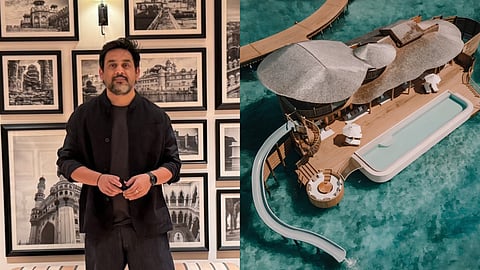
At Soneva Jani, the Indian Ocean sets the rhythm and tone of every stay. Within a vast Maldivian lagoon, the resort pairs the ease of unhurried island living with a distinctly playful spirit. Its overwater villas are shaped around the seascape, with generous interiors that open toward the water and unbroken horizons. Some come with slides that drop straight into the lagoon, making the passage from villa to ocean a pleasure in itself. Ashore, days can be shared between padel, tennis and Soneva Soul, the resort's wellness sanctuary. As evening settles in, activity gives way to stillness, and the night sky offers its own reason to stay a while. That balance is what sets Soneva Jani apart.
Luxury at NIHI Sumba has an untamed streak. On the remote south-western coast of Sumba Island, about an hour's flight east of Bali, the 567-acre retreat was conceived around the idea of living on the "edge of wildness". It opened in 1988 as Nihiwatu, then was acquired and reimagined in 2012 by entrepreneur Chris Burch and hotelier James McBride. Today, its 27 private villas, each with an infinity pool and open-air veranda, look out over the Indian Ocean, while tropical jungle and rice fields spread behind. The experiences are just as unique as guests can ride the resort's resident horses along the beach, swim alongside them in the surf, or take on Occy's Left, a celebrated break that admits no more than 15 surfers at a time. Beyond the resort's boundaries, its ties to the Sumba Foundation extend its reach, supporting local communities through healthcare, education and clean-water programmes.
A safari at Singita Sasakwa Lodge starts with a shift in perspective. Perched on Sasakwa Hill within the 350,000-acre Singita Grumeti Reserve, the Edwardian manor-style lodge gazes out across the Serengeti ecosystem, setting the wilderness firmly at the heart of the stay. Accommodation runs from intimate one-bedroom cottages to larger villas and the multi-level Hillside Suite, each with a private infinity pool, fireplace and veranda. Yet the architecture is only part of the story. Morning and evening game drives, guided bush walks and night safaris offer different ways to encounter the reserve's wildlife, while hot-air balloon flights open up the landscape from above. The lodge's conservation work, carried out through the Grumeti Fund, ties the experience to wider efforts to protect local wildlife, among them elephants, buffalo and eastern black rhinos.
Fogo Island Inn feels like the edge of the known world. Rising on stilts above the rugged shoreline of a small island off Newfoundland’s northeast coast, it looks out to the North Atlantic, where icebergs drift past in spring. Its 29 suites, designed by Newfoundland-born architect Todd Saunders, pair stark modern lines with quiet comfort, while handmade quilts, furniture and textiles carry the island’s craft traditions indoors. Rooftop saunas, a cinema, a library and artist studios add to the pleasure of staying in. Conceived by Fogo Island native Zita Cobb and run through the Shorefast Foundation, the inn operates as a social business, with its proceeds reinvested in the island’s community. Here, luxury is measured less by excess than by belonging.