
Subscribe
Subscribe
- Motoring
- Style
- Home & Design
- Travel
- Food & Drink
- Specials
- News & Tech
- Videos
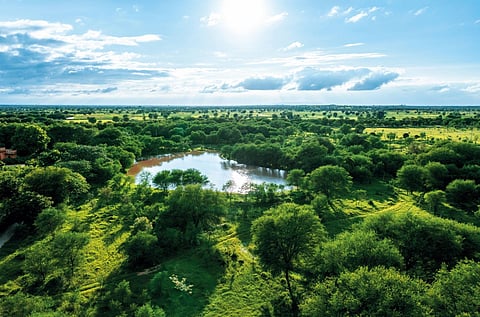
Imagine 500 acres of oncebarren land being slowly resuscitated through indigenous knowledge systems and artificial intelligence to create a living and breathing space that can accommodate up to 8,500 people. Located 36 kilometres from the city centre of Jaipur is Dhun—a reimagined space for living, learning, and recreation.
“What’s special to me is the possibility that Dhun can serve as a model for other landscapes. Nearly one-fifth of the earth’s land is barren. If we can turn a desert into a thriving multi-generational community, why not elsewhere?” says Manvendra Singh Shekhawat, entrepreneur and innovator who supports regenerative living.
Since 2013, he and his team have been working towards creating a settlement that they hope is less a “burden” and more a “living inheritance” for generations to come. Shekhawat is known for his luxury hospitality ventures including the heritage hotel Narendra Bhawan Bikaner—once the residence of Maharaja Narendra Singh, the last maharaja of the city—and Suryagarh Jaisalmer.

Dhun’s water system harvests almost 550 million litres of rainwater annually, thanks to the chauka system, a traditional rainwater harvesting method in which interconnected rectangular pits or chaukas collect the rainwater runoff. This system ensures that water is available throughout the year. With water came Dhun’s first residents—180 plus species of fauna claiming the length and breadth of the estate. Quails, owls, peacocks, partridges, mongoose, jackals, and horses follow. The Tharparkar, a cattle breed found mainly across the Thar belt, known to produce quality milk even in harsh, arid climates can also be found grazing here.
The next step was rewilding the land. This conservation approach emphasises on the restoration of self-sustaining ecosystems by allowing nature to take over with minimal human interference. The soil is nourished using manure made by combining animal waste, farm residue, and ash. No artificial fertilisers have been used on the Dhun turf, and the team is committed to ensuring it stays that way. Indian gooseberry, lemons, oranges, figs, and mangoes are among the produce cultivated here.
The spine of Dhun is a biosphere reserve with indigenous trees. Since 2016, the team has planted 1,00,000 trees across the estate and 2,00,000 on the periphery to cool the air.
Manisha Sharma, principal urban planner at Dhun Life, says, “The estate has three primary entrances where outside mobility transitions into Dhun’s own system. Beyond these points, private vehicles are restricted, and residents [can] enjoy short walks, or use shared, app-based, or autonomous vehicles. Dhun is designed to be a complete neighbourhood with amenities located within a short distance, so walking is the preferred choice.”
There are four types of houses: four to five-BHK villas with ground, plus one floor organised around a central courtyard with rooms opening into it; two to three-BHK townhouses built in a row, sharing side walls, inspired by traditional settlements, and a front yard that opens onto an active pedestrian street, while the backyard faces the bio-reserve; one and two-BHK pods, tucked within the clusters of existing trees; and lastly, one- to two-bed studio units built around a central courtyard that will house commercial properties on the ground floor. Together, they will become one neighbourhood.
Interestingly, most of the building materials are from within 50km of the estate. “The most precious is the soil excavated onsite, stabilised into blocks for construction, along with mud, regional stone, and lime as a nod to ancestral knowledge systems,” says Sharma. Dhun uses thick walls for thermal insulation, which reduces cooling loads by 20 to 30 per cent, and lends to more resilient structures.
“Dhun is a prototype for a new paradigm of settlement— synthesising civilisational breakthroughs from material sciences to political sciences, from regenerative ecology to algorithmic governance,” says Shekhawat.
A stone’s throw from the neighbourhood, is a climateresponsive farm that feeds the Dhun kitchens. Sustainable agricultural practices reduce and withstand climate change. The water channels, bioswales, and reservoirs form the backbone of the design, supporting biodiversity while making the settlement more resilient to repeated monsoon cycles followed by dry spells.
The farm has over 60 types of vegetation including amla, sapodilla, mulberry, Indian jujube, lemon, taro root, cucumber, turmeric, okra, papaya, berries, gourds, and mangoes.
The Dhun school—which will challenge traditional curriculums— is also underway. Programmes will be designed to encourage students to explore their relationship with and contributions to the planet, community, and self. Currently, kids are growing vegetables, building rafts and primitive electric vehicles to commute to school, and making solar street lights to combat power shortage in their villages at a makeshift school. The School of Pursuits and Passions is for adult learners. It hosts seasonal workshops, artist residencies, as well as short and long-term programmes, ranging from culinary arts to theatre and wellness.
There will soon be a 24-room farmstay, located close to the first residential neighbourhood, where one can stay anywhere from a few days up to a few months. It will be home to an organic restaurant, pool, openair gym, an outdoor yoga space. You can also walk through the grasslands and take a guided tour to explore the diverse vegetation.
Stay options also include a community tent featuring two double beds, six day beds, and a sitout overlooking a farm. There are also five private tents that are often occupied by weekend-programme learners and workshop attendees.
I was hosted at the family haveli for a night. For breakfast, I could choose from stuffed parathas, spongy khaman, eggs to order, flowerinfused butter, idli-sambar, and porridge. Lunch included a Thai cucumber salad and crispy tofu, gourd preparations, and okra with soft ragi rotis, rice, and besan halwa.
The family haveli is bedecked with engraved wooden artefacts, vintage period sockets and electrical switches called khatke, haveli doors as tabletops, and relics signature to Rajasthan. The team has sourced entire facades of havelis, most 70- to 350- years old, from across Rajasthan, Uttar Pradesh, and Madhya Pradesh. “The havelis will be integrated into common gathering areas, stepwells, and seating courts in the bioreserve and cultural spaces within the community hubs. One of Dhun’s investors was so deeply moved by the idea that they offered to bring elements from their own ancestral haveli in Bikaner into their home at the first residential neighbourhood of Dhun!” says Sharma “We have 63 historic mansions, and rather than turning them into monuments, we’re restoring them as living cultural anchors—studios, residencies, and performance spaces,” says Shekhawat. An expanse will hold the frescoed buildings from the Shekhawati region, sandstone pink walls from Dholpur, mehraabs or undulating arches from Jodhpur, and the golden sandstone havelis from Jaisalmer.
Dhun is the new way to live—drawing ample from the past and just enough from the present, championing traditional knowledge systems passed down generations, as well as artificial intelligence to build communities that are in harmony with nature—and not in conflict with it.