
Subscribe
Subscribe
- Motoring
- Style
- Home & Design
- Travel
- Food & Drink
- Specials
- News & Tech
- Videos
“Growing up, my father would often say, ‘Munda bada tor lag raha hai, mundi badi tory lag rahi hai,’” says Jasmeet Raj Nagrath at his studio-cum-workshop in Gurugram. “In Punjabi, it translates to ‘the man is extremely confident, speaks well, and carries himself well; the woman, too, is confident, strong, and self-actualised.’ Tora & Tory is just that: the ideal man and the ideal woman.” He named his jewellery brand after the phrase because it’s designed for everyone, regardless of gender.

The philosophy traces back to a childhood incident. While island hopping at age 12, Nagrath’s boat capsized against a coral reef and he slashed his hand. “Before my instructor pulled me up, I noticed the blood swirling in the water and the light shining through it. It sounds grotesque, but it looked so pretty.” Over the next four days, he filled a notebook with everything he observed: patterns, waves, colours, textures. That diary, rediscovered around 2017, became the blueprint for Gyre, the brand’s debut collection, named after a spiral or vortex.
His newer collections shift gears. One draws from shields and suits of armour of pre-1980s armies. “I connected [the motifs] to relationships,” Nagrath explains. “Everyone has their guard up, so they don’t let anyone in. But when you get to know someone, small gaps and cracks start opening up because they start trusting you.” This inward-looking approach sets the tone for most of Tora & Tory’s jewellery that goes beyond ornamentation. “Jewellery is the truest form of self-expression,” says Nagrath about the seasonal collections that are defined by the emotion he has felt most during the time.
Tora & Tory releases at most three collections a year, each limited in its run. Once a piece sells and a collection closes, it is never remade. Every piece is built to be cherished for decades, passed down over generations, with the brand providing lifelong service and repair.
Each piece starts as an idea that is then translated into a detailed drawing. “Like anything else, it starts with a sketch,” explains Nagrath. No computers or machines are used at any stage of initial design. “It’s all drawn by hand,” he adds.
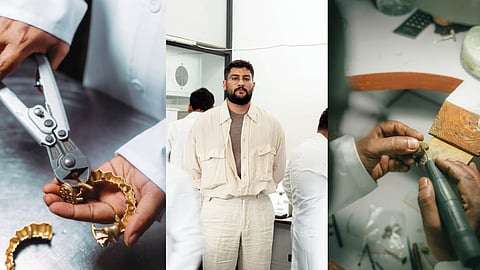
Next, the design moves into production with his kaarigar, Hari Om, who carves each piece from solid wax exactly as envisioned. This hand-carved wax model allows Nagrath to visualise the piece in three dimensions and refine every detail.
The wax model is coated with a white investment material (a heat-resistant, plaster-like substance that is used in the casting process) that is heated until the wax completely melts and burns away, leaving behind a hollow cavity. Molten bronze is then poured into the cavity, creating the structure and detail of the piece.
Once the bronze cools and solidifies, the shell is broken away. A chemical solution is applied to clean away any remaining investment residue, then compressed air flushes the cavity, revealing the raw bronze casting beneath.
The sprue—the metal rod that channeled the molten bronze—is cut away from the casting. What remains is the rough bronze form, ready for hand finishing.
Rotary grinding tools remove imperfections and clean the surface. Hand-filing refines edges and shapes. Polishing wheels create the desired texture. “We don’t utilise any automation here, mainly due to the fact that it gives us the most amount of control. Of course, the downside is that you end up with less volume. But the quality is just different,” says Nagrath.
Every natural gemstone is then set by hand using Tora & Tory’s proprietary Cliff Setting technique, which makes stones appear as if emerging from the bronze. Depending on the piece and the complexity of the Cliff Setting, a single stone setting motif can take 10 to 25 days to complete.
The piece is cushioned in brand-colour foam and encased in a box that is secured using a wooden pin.
The final step of production, though, is extra special. Each box bears the signatures of every kaarigar who worked on the piece—a record of the hands that brought it to life.