
- Motoring
- Style
- Home & Design
- Travel
- Food & Drink
- Specials
- News & Tech
- Videos
From the Louvre in Paris to the Smithsonian Institution in Washington DC, Indian artefacts have found honourable spaces in museums across the world. While most of them may be vestiges of the past, The Museum of Fine Arts, Houston, as part of its permanent collection, has acquired a piece of contemporary jewellery a sandstone brooch created by Indian jewellery label Bhagat.
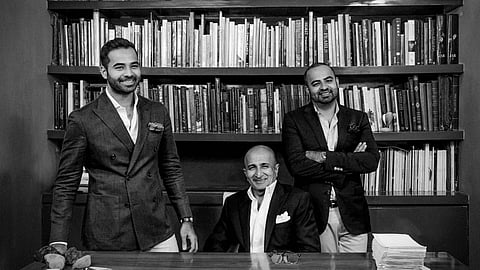
Bhagat family jewellery house was started in 1877 in Bombay. In 1991, Viren Bhagat, the fourth generation entrepreneur, set up the current boutique in Mumbai and gave the jewellery an Indian heart with a global appeal. Now, he runs this empire with his sons Varun and Jay, the fifth generation in the business. Calling this one-of-a kind brooch merely jewellery may be blasphemous as this original masterpiece integrates art, history, and features Bhagat’s minimalist aesthetic and perfectionist craftsmanship with influences of Indian Mughal Era architecture along with European Art Deco jewellery design. This has been a labour of love for over 11 months. With time being one of the greatest luxuries today, the brand is of the opinion that something hand-crafted painstakingly over a long period of time is true luxury.

Through this brooch, Bhagat pays homage to Indian heritage by incorporating red sandstone, sourced from Rajasthan, for the very first time. Carved by hand in the form of a Mughal-style arch, the pinkish-red stone has a line of diamond-set platinum forming a flower motif on the face. The scalloped floral motif is repeated in the cutout on the brooch’s hand-brushed 18-carat yellow gold on the other side.
Known to breathe creativity into every precious gem he works with be it Burmese rubies, Golconda diamonds or natural pearls Viren, despite a departure from using the usual metals in this ornament, has proved that even non-precious materials like sandstone take on a luxurious form when uplifted using innovative design. Even though inspired by India, his jewellery has never been traditional. Be it the lapis lazuli bangles with a star shaped cutout in the centre or the tuille-like natural pearl and diamond feather brooch, the avant-garde designs ensure they are on most collector’s lists.
Bhagat creates only 50 to 60 pieces a year because the founder does not wish to produce more and dilute what they do. The scarcity, understandably, is not to create demand but is attributed to rarity, as rare materials are getting harder to find each year.
Evidently, the creations are no stranger to recognition and laurels. Auction houses of repute sell their jewellery. And prior to The Museum of Fine Arts, Houston, the Museum of Fine Arts, Boston, acquired the Jali Brooch for permanent display in its Kaplan Jewelry Gallery in 2024 and the following year, London’s Victoria and Albert Museum included the Feather Brooch in its permanent jewellery collection. The MET, The Miho, The Palace Museum in Beijing, The Kremlin, and The Grand Palais have over the years showcased Bhagat’s work as part of Al Thani Collection exhibitions.
Often called the ‘Cartier of India’, Bhagat takes pride in being celebrated on the global stage. Ever since the brand’s inception, Bhagat always did what he felt was right for the brand. This helped create their own identity, rather than following what everyone else was doing. Contrary to popular practice, Viren is known to make jewellery to please himself. In a world that kowtows to the customer (something he saw his father do and knew he would never be able to do it), this thought process surprisingly didn’t vote him out of favour in the luxury market. If anything, he has a steady legion of clients undeterred by geography and price tags, awaiting the next drop from the master jeweller.