
Subscribe
Subscribe
- Motoring
- Style
- Home & Design
- Travel
- Food & Drink
- Specials
- News & Tech
- Videos
For generations, diamonds have been the default language of permanence. They anchored trousseaux, marked milestones, and held their value in lockers across continents. If you wanted certainty, you bought a diamond. While that certainty still very much exists, it is no longer exclusive to diamonds.
The global jewellery market is going through a subtle change. As lab-grown diamonds flood the market and visual sameness becomes unavoidable, collectors and investors are beginning to ask a different question: what still feels genuinely rare? The answer, increasingly, lies in colour.
Coloured stones — once seen as ornamental or ceremonial — are now being reassessed through a more serious lens: one that values origin, untreated status, scarcity, and lineage over sheer size.
“Large natural diamonds still hold their place as safe investments,” says jeweller Poonam Soni. “But today, when lab-grown diamonds can replicate the look so closely, serious buyers are seeking something that cannot be duplicated. That’s where coloured stones come in.” Below are three stones she believes sit at the very top of today’s jewellery investment hierarchy.

If there is one coloured stone that consistently commands respect across markets, it is the Colombian emerald.
“Coloured stones definitely have an edge today over natural diamonds. You can differentiate between the two, and hence, women who used to show their status through large natural diamonds are now rubbing shoulders with those wearing similar eye-catching lab-grown pieces at a much lesser price. This has driven the desire to buy something rare and asset-worthy, making large-sized natural emeralds the first choice,” says Soni.
“Among emeralds, the classic Colombian stone rules - especially those with little to no oil treatment. Unlike diamonds, where perfection is engineered, emeralds are valued for their natural character.”
As access to Colombia’s historic mines diminishes, these stones are becoming structurally scarce. Size matters here — but origin matters more. A smaller Colombian emerald can often outperform a larger stone from another region.
For investors, emeralds also offer flexibility. They sit comfortably in both statement jewellery and discreet, portable forms — an advantage that has long made gemstones attractive to those thinking beyond borders.
These are increasingly being called the fastest appreciating asset. Pigeon-blood rubies from Myanmar are among the rarest gemstones in the world, prized for their saturated red hue and limited availability. Over the last three decades, their appreciation has been as high as nearly 1,000 percent, according to some estimates. “These rubies are no longer just collector pieces,” says Soni. “They are growth assets.”
Their investment appeal is reinforced by auction performance. The most famous example remains the Sunrise Ruby, a 25.5-carat pigeon-blood Burmese ruby that sold for over $1 million per carat — a figure that rivals, and in some cases surpasses, top-tier diamonds.
Unlike diamonds, whose supply is carefully managed, Burmese rubies are constrained by geography and geopolitics. Their scarcity is real, not manufactured — a key reason investors are increasingly drawn to them.
Mined briefly in the late 19th and early 20th centuries, the original sources of Kashmir sapphires are now nearly exhausted. What remains in circulation is finite — and fiercely protected by collectors.
“Kashmir sapphires are about lineage,” says Soni. “You’re not buying a stone that can be replaced.”
Their distinctive velvety blue colour, combined with extreme rarity, makes them one of the most stable and coveted coloured stones in the world. While sapphires in general are widely available, true Kashmir stones are not, which makes them particularly attractive to investors and collectors.
The blue sapphire is not so popular in India due to its astrological stigma, which is why it is generally replaced by the cheaper Tanzanite or Pale Blue Aquamarine,” explains Soni.
This shift does not signal the end of diamonds as investment pieces. Natural diamonds remain safe, tested assets, particularly when acquired as sets or in rare fancy colours such as pinks and blues. Many serious portfolios now hold both diamonds for stability and coloured stones for growth.
Beyond the three stones we’ve established above, seasoned collectors are beginning to look further down the spectrum — toward stones that remain undervalued precisely because they have not yet been mythologised.
Spinel, in particular, is seeing renewed interest. Long mistaken for ruby or sapphire in historic jewels, fine spinels are now being recognised in their own right for their clarity, saturated colour and increasing scarcity. “Some spinel mines are already depleted or inaccessible,” notes Soni. “When availability drops against growing awareness, prices follow.”
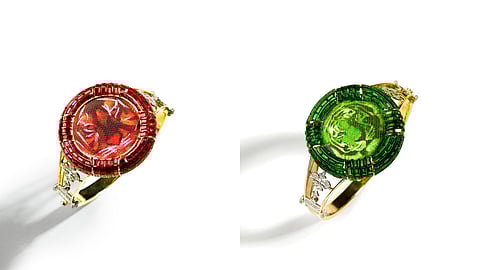
Another stone recently gaining ground is tsavorite, a vivid green stone that’s often described as the emerald of the 21st century. “We like tsavorite a lot, as it requires zero oiling,” says Soni. With its naturally clean appearance, it appeals to a generation that values transparency and geological honesty.