
Subscribe
Subscribe
- Motoring
- Style
- Home & Design
- Travel
- Food & Drink
- Specials
- News & Tech
- Videos
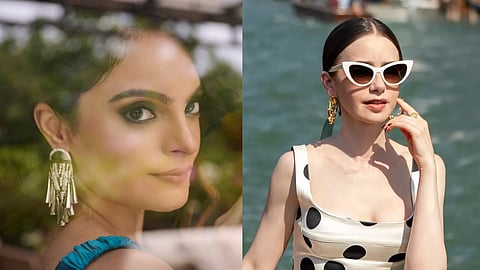
Two things that stood out in Season 5 of Emily in Paris were the makeup and jewellery. In fact, two of Lily Collins' striking earpieces were crafted by designer Ridhi Asrani, one being the Amalaka hoops (which also featured on And Just Like That... on Sarita Choudhury (who played Seema Patel) previously), and the second were the Karnika hoops. Costume designer Marylin Fitoussi was going for an Audrey Hepburn-esque vibe for the first look. These pieces are from the designer's debut collection.
Her jewellery amalgamates the old with the contemporary, crafting pieces that channel a goddess energy. Think heavy metal with crystal accents. Incorporating elements from the swinging '70s and the maximalist '80s, the brand crafts designs that reconcile the traditional with the modern.

A GIA graduate in fine jewellery design, Ridhi creates pieces that are statement making, conversation starters and help one seamlessly transition from a disco floor to an Indian wedding. One couldn't help but ask the designer if she sees Emily in Paris Season 5 as a key milestone in your career. "Absolutely. Emily in Paris is more than a show—it’s a global cultural moment that celebrates fashion as a language. Seeing Amalaka and Karnika hoops on a character like Emily Cooper felt like a full-circle moment: Indian design entering a global pop-luxury conversation effortlessly. It validated my belief that jewellery rooted in heritage can still feel modern, cinematic, and internationally relevant," she quips.
Robb Report India chats with the designer about the story behind the Emily in Paris hoops, hot trends for 2026, and more.
Ridhi Asrani: Amalaka is our take on a classic thick hoop that is as yin as it is yang. Inspired by the distinctive, ribbed stone disc found at the peak of the spire in Indian temples and caressed by pearls and crystals at every juncture, it is a homage to the thick hoop from the 80’s pop stars like Sade. Karnika is a marriage between a huggie and a big hoop, laced with tiny crystals, and it has detailed floral carvings, again taking inspiration from Indian temple architecture. It is a super lightweight hoop that is maximal in a minimal way.
RA: Each collection begins with an emotion or a memory. I draw deeply from Indian iconography, architecture, and my personal spiritual journey, but I design for a woman who lives globally — someone who might wear the same earrings in Mumbai, Milan, or Paris. The balance comes from restraint: letting heritage lead, while form, scale, and styling keep it contemporary.
RA: Visibility matters, but context matters more. Sarita Choudhury’s character represents a confident, self-possessed woman—someone who chooses jewellery as an extension of her identity. When the right personalities wear the brand organically, it strengthens the narrative rather than just amplifying reach. That kind of alignment is invaluable.
RA: We’ll see a move toward bold permanence—investment pieces that feel timeless but expressive. Sculptural gold, statement hoops, talismanic motifs, and jewellery that carries emotional or symbolic meaning. I also see a continued blur between day and night jewellery—pieces designed to be worn by mood, not occasion-bound.
RA: My muse is always a woman who is deeply feminine yet powerful—sensual, confident, and in her power and fullest expression. Someone who doesn’t ask for attention but commands it. I create pieces around a woman from yesteryears, usually like Cher or Diana Ross, imagining what they’d be if their essence were a piece of jewellery. Dream names change, but I’m drawn to women like Simone Ashley, Dua Lipa, Priyanka Chopra, or even someone like Zendaya—women who carry strength and softness simultaneously.
RA: Consumers today are far more intentional. They’re investing less in fast, trend-led jewellery and more in pieces that feel personal and enduring. There’s a desire for story, craftsmanship, and emotional resonance—jewellery that feels like it belongs to you, not just the season.
RA: I believe high jewellery should be lived in, not locked away. Jewellery gains character through wear. I admire designers who balance artistry with wearability—someone like Repossi for architectural restraint, Ana Khouri for liquid sensuality, and Fernando Jorge for sculptural marvel. Then there are traditional Indian houses that understand scale and symbolism deeply, such as Amrapali.