
Subscribe
Subscribe
- Motoring
- Style
- Home & Design
- Travel
- Food & Drink
- Specials
- News & Tech
- Videos
Few contemporary designers have championed India’s handloom heritage on the global stage as passionately as Vaishali S. Hailing from Vidisha in Madhya Pradesh, the self-taught couturier has built an eponymous label rooted in the country’s classic weaves—transforming them into sculptural, couture-worthy creations that have graced runways from Mumbai to Paris. Guided by a philosophy that marries age-old craftsmanship with a mindful design process, Shadangule's work celebrates the beauty of fabric, its artistry, legacy, and the many human stories woven into every thread.
Your label was born out of a deep love for India’s classic weaves. What, in your view, makes these textiles timeless and the epitome of understated luxury?
First of all, their beauty. Beyond that, Indian weaves are the last witnesses of high-quality workmanship handed over generations and made out of pure artistic skills. Every one is unique, and you can judge the different moods of a weaver while doing a similar piece. Bespoke, workmanship, heritage, limited production—these are all definitions of the highest understated luxury.
Every creation of yours is a tribute to India’s heritage. What drives this passion?

The beauty of the pieces, the amount of work, the skills needed, and the dedication that goes into making it. I'm often in awe of the weavers as they tie thousands of threads on the loom and start their rhythmical, meditative processes of creation.
Your interpretations of India’s classic weaves have reached Paris. What does it mean to you to represent Indian craftsmanship on a global stage?
First and foremost, it means showing to the world an amazing art while also giving a tribute to the artisans that have created it. It means showing to the world that the art form belongs from India, and not in the other countries as most international designers do. It means helping the world appreciate this work as art, and help them understand that this Indian weave is made by hand through hundreds of hours of work using unique skills that have passed down from generations. It means putting India back on the top of fashion world—where it has been for centuries.
You often speak of embracing the old and the simpler ways of living. How does this philosophy manifest in your design process?
I only use old hand weaving techniques. While creating the garments, I use the old Indian draping technique, which in turn makes the best use of materials. The scraps are used to make accessories and interiors, like it used to be in villages where nothing is thrown away, even when worn out.
Today, luxury and sustainability are increasingly seen as two sides of the same coin. How does your brand embody that belief?
Luxury has a great responsibility towards people's behaviour in fashion and it can influence what they do. Luckily, sustainability has become a buzz word. While every one may not walk the talk, we have seen a big shift nevertheless. This is influencing a lot of consumers, especially the young, and brands.
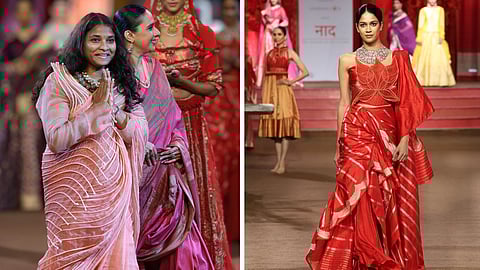
Tell us about Naad, your latest collection.
Through my journey, Naad wants to show what beauties can be made with handloom. [My journey] started with my first fashion week collection that admired the local weaves of Maharashtra with a raw creativity and strong adherence to traditions. It passed onto the revamping of Khun, and the exaltation of a different weaves—that I translated to Haute Couture through my own proprietary cording technique—where I could also give free hand to my creativity. Then came the western bridal, and now the Indian bridal, with a more delimitated playground of the Indian heritage, but my own way.
How do you strike a balance between delicate and statement-making design in your work?
That’s one of the things that I enjoy the most when pushing boundaries with a renewed harmony. I think in this sense, Kintsugi , my July Paris Haute Couture collection, was emblematic in its effort to show even broken pieces of shells, when put together harmoniously, can showcase inner beauty. On the garment, this was represented with a continuous shift from statuary broken 3D shapes, to flowing energy and a structured intact strength of the corsets.
As a designer, what does the word ‘luxury’ mean to you? What are some luxe fashion trends you see taking over the market in the coming years?
Luxury, for me, is handwork and the possibility of paying artisans like real artists. I see bespoke, and the tracking of who has done the garment, as strong trends for luxury.