
Subscribe
Subscribe
- Motoring
- Style
- Home & Design
- Travel
- Food & Drink
- Specials
- News & Tech
- Videos
Indian Mythology is a universe in itself. At the Paris Haute Couture Week, this universe of Gods, Goddesses, and timeless tales found its new home on the runway, and it felt like the birth of a new language of fashion.
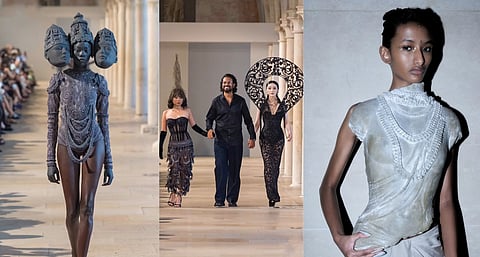
On July 7, 2026, Indian fashion designer Rahul Mishra made a grand showcase of his latest collection, Devi: The Eternal Muse, at Paris Haute Couture Week. Devi was inspired by the ancient sculptures of Southern India and the idea of the eternal divine feminine. “The collection is almost like time travel,” shared Mishra on Instagram. “We are reliving couture with the same ideas that created these sculptures and created a muse for the sculptures,” he explained.
Mishra’s latest couture collection is symptomatic of a larger shift in global luxury fashion, as it moves away from purely decorative aesthetics toward a craftsmanship rooted in deeper narrative substance. Spearheading this movement is a generation of Indian designers and couturiers who are increasingly borrowing from the subcontinent’s centuries-old philosophy, mythological iconography, and history — the lines often blurring between the three. These are then translated into avant-garde creations and wearable art, which not only push the limits of couture but also serve as a medium through which Indian heritage is interpreted and spotlighted on a global stage.
To uncover this rise of Indian history and mythology on international runways, we take a look at some of the key Haute Couture collections by the the master designersthat have played a catalystic role in redefining global couture.

Rahul Mishra’s latest couture collection, Devi, which was staged at the historic Petit Palais in Paris, operates as a form of high-fashion time travel, transforming the solid 2,000-year-old iconography of ancient South Indian temple carvings into wearable, stone-like sculptures. Employing metallic zardozi, dabka, freshwater pearls, and dense layers of threadwork, the collection treats fabric as if it were carved sandstone rather than stitched textile. On the runway, models appeared like living statues in a palette of stone grey, black, ivory, and antique gold, their silhouettes blurred by skin-toned bodysuits and ceremonial headpieces crafted in collaboration with traditional clay artisan Sumant Kumar and legendary British milliner Stephen Jones.
At the showcase, American rapper Cardi B embodied the collection’s spirit of the divine feminine in an ethereal ivory gown designed by Mishra, inspired directly by the Didarganj Yakshi, a much-celebrated Mauryan sculpture that was recovered near Patna in 1917. The dress featured an illusion bodice mimicking the sculpture’s famous glass-like polish, with delicate embellishments of pearl and crystal that trace the silhouette like layered ceremonial necklaces carved into marble. The rapper’s jet-black hair was styled into a long braided ponytail, with a crystal headpiece on her forehead, akin to a traditional maang tika.
Preceding Devi, Mishra’s 2024 FW couture collection titled Aura explored the metaphysical boundary between the physical body and the eternal spirit. Drawing from the second chapter of the Bhagavad Gita on the immortality of the soul (jiva), the collection sought to make the invisible visible. Mishra visualised the iconography of Lord Brahma, the four-headed creator deity who holds the ability to perceive the past, present, and future simultaneously. The runway featured striking silhouettes where embroidered profiles of human faces extended outward from capes on structural steel wires, while the expansion of the universe as emanating from Brahma’s mind was conceptualised using spiky nylon threads, glass beads, and rhinestones radiating from the centre of deep black garments.
Stepping from the earthly into the metaphysical, this collection anchored itself in the foundational Upanishadic philosophy of Aham Brahmasmi ("I am the Cosmos, the Cosmos is in me"). Here, Mishra’s atelier dedicated tens of thousands of hours to mapping the oneness of the human soul with the grander universe. On the runway, individual garments became complete, self-contained micro-ecosystems; hand-embroidered tigers, birds, and dense foliage gradually dissolved upward into a sprawling, shimmering galaxy of golden nebulae and stars.
Mishra’s The Tree of Life collection was grounded in the sacred mythology of the Kalpavriksha, the wish-fulfilling tree of life that connects the underworld, the earth, and the heavens. Mishra translated this ancient, rooted symbology into monumental velvet and sheer tulle capes. The garments featured striking, organic silhouettes where golden-embroidered roots wrapped around the models’ bodies, giving the illusion of living, breathing organisms walking the Paris runway.
Indian designer and couturier Gaurav Gupta’s contribution to the international runway is a masterclass in textile engineering, taking inspiration from India's rich mythologies and ancient philosophies for many of his collections.
Among all his creations, Gupta's metal-cast armour-inspired breastplate has emerged as the most visually arresting piece, bringing a sharp, sci-fi edge to traditional craftsmanship. The piece debuted in July 2024 as the centrepiece of his Fall-Winter Couture collection, titled Arunodaya, a Sanskrit term for "daybreak." Gupta turned a rigid, protective piece of armor into a fluid, sterling-silver structure featuring detailed mouldings intertwined with sculpted snakes and birds.
Harking back to mythology, the stone-like Divinity Breastplate from this collection was a recreation of an ancient temple sculpture. The breastplate’s form draws from the Mauryan Yakshi body, which was defined by a full bust, distinctly slender waist, and wide, heavy hips, embodying the ancient Indian ideals of fertility and divine beauty. The breastplate invokes these ideas from mythology, wherein jewellery defined anatomy and ornamentation became a mode of inscribing the body. The inspiration for the Divinity Breastplate was taken from sandstone temple reliefs of river goddesses in Deogarh, the sandstone figurine of Didarganj Yakshi, and other such figurines from the Mauryan Empire.
Earlier in May, Gupta’s custom ensemble for Isha Ambani at the Met Gala looked thousands of years into the past, answering the Fashion is Art theme by blending history with materials science. The foundation of the look was a luminous tissue saree woven entirely with pure gold threads. Gupta drew inspiration directly from the Ajanta cave murals, home to the earliest recorded visual depictions of the saree and classical drapes in Indian history.
Gupta utilised his signature resin-draping technique directly on the fabric, draping it into fluid, wave-like shapes that allowed the fabric to retain the look of soft, flowing cloth while actually being a rigid, architectural structure. Additionally, the saree’s border served as a canvas, with hand-painted, Pichwai-inspired motifs in soft, earthy mineral tones, then layered with meticulous zardozi and aari embroidery.
At the heart of Gupta’s couture collection was the ancient Indian philosophical idea of Advait or non-duality, which sought to question the deep binaries within which our relationships with each other come to be structured. Treating the body as a site where time and space are negotiated, and where the masculine and feminine coexist, Gupta crafted a collection in which every silhouette was a living structure. The looks featured hourglass silhouettes with handcrafted lace, twin looks held together with ribbons and filaments, white bridal looks made with petals and feathers, serpentine resemblances, embroidered jasmine temple flowers, and brocade corsets.
Drawing inspiration from the idea of aarohanam, the Sanskrit word for “ascension”, Gupta’s collection translated this journey from the solid to the sublime, and from darkness to light through carefully chosen colours: black to represent nothingness, orange to reflect the rising of a flame, sand brown for lightness, and ether blue for the infinity brought by ascension. The silhouettes experimented with volume and the couturier’s signature sculpting featured across the collection in cropped jackets, fluid trench coats, and lavish capes with badla, mukaish, and zardozi embroidery.
The Hiranyagarbha collection was interested in questions of origin and creation, as represented by its title, which invokes the Vedic idea of a primal golden womb of birth, from which everything — and nothing — is said to have emerged. Nothingness offers endless possibilities of metamorphosis. Gupta sifted through these ideas and created a stunning set of looks designed with taffeta, chiffon, glass bugle beads, and crystals embroidered in zardozi, nakshi, and dabka. The collection represented the five elements through its colour palette: pearl white, smoke grey, electric blue, malachite green, and fluorescent gold, reinterpretting the ideas of universal origin and being through textile.