
Subscribe
Subscribe
- Motoring
- Style
- Home & Design
- Travel
- Food & Drink
- Specials
- News & Tech
- Videos
Born in 1967 in Jodhpur, JJ Valaya grew up across India, following his father’s Indian Army postings, a journey that quietly shaped his eclectic aesthetic. Early on, he discovered his creative spark through painting and calligraphy. Although he completed a Commerce degree and even interned with a Chartered Accountant, destiny nudged him toward design. In 1989, he entered NIFT and quickly established himself as a standout, winning multiple accolades.
Valaya and his brother, ex-army officer TJ Singh, in 1992 launched the eponymous label JJ VALAYA. As part of India’s pioneering circle of fashion designers, he helped shape the country’s evolving couture landscape.
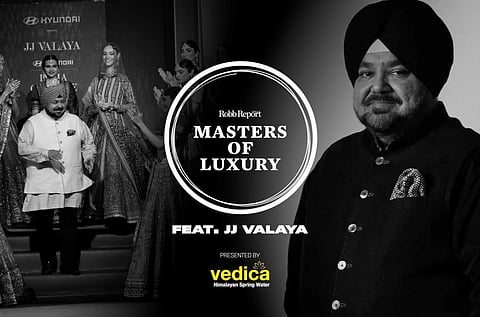
Today, he is celebrated as one of India’s foremost fashion visionaries, often referred to as the ‘Czar of Indian Couture’. In this episode of Masters of Luxury, he takes us back to his early days, his love for photography, his biggest learnings, and more.
JJV: I think it is a divine intervention. I was very clear about what I did not want to do, which was chartered accountancy. The fashion industry didn’t exist in those days, then the first NIFT opened in the country. So, I still remember those days when I felt, this is where I belong and where I want to be.
Everyone was like it is a tailoring institute. Turned out for the better, quite evidently. I am glad all this happened because unless you see things other than what you want to do, it makes your belief stronger in what you do. I was clear I wanted to do something creative, and fashion became an expression.
JJV: I think what has happened over the years is that we have become proud of our own identity, and it’s still happening.
We have still not reached pure perfection. We still have that ‘Gora Hangover’ because, for some strange reason, we seem to see that if the West accepts us, then we’ve arrived. But I think it is all changing because India is on a roll. We are already the fourth-largest economy; we will obviously become stronger. There is a lot of pride in the nation, in one’s own art and designers. The whole attitude shift is happening, which is something really positive.
JJV: We’ve always been a luxury player. We have not really believed in the mass market; it has not been our domain. And if I quickly break it up, the highest level of our portfolio is something called JJ Valaya Muse, where every single piece is only designed in consultation with me and the muse, my customer.
Each piece is individually created only for her or him. It will never be created again. Every piece takes close to 8 to 10 months to create. When we give the piece, all the traces go away with the piece, and we also don’t have access to it ever again. If we are doing luxury, it has to be uber, it has to be the best. Creatively how much we can push ourselves is what matters the most. We come to JJ Valaya Couture, which of course is a couture line. Currently, in India couture majorly translates to weddings and that’s around what we do our couture line. Here again, we do not compromise on quality but obviously these are not single editions. In 2022, we launched JJV Kapurthala, which is a bridged luxury line. I think it is very important that it’s accessible fashion. I want people to get a taste of what we’re all about.
JJV: Never rest on your laurels, and there’s no replacement for hard work. Our profession demands that we perform every six months and that we get a report card, so we are constantly under test, which is great because then you are striving to create more and more new things and keep yourself excited. Secondly, believe in yourself and believe in your look. Don’t look around; you will have your own intrinsic looks, your strengths, and your weaknesses. A lot of people will love your work, a fair amount of people will hate your work, go with the ones who love your work. Lastly, to have fun is really important. Don’t become too serious.
JJV: The trillion-dollar question. I think we are going to get very able assistance. And, that’s how I look at it frankly. I have always loved technology so I like this manmade (unnatural) evolution. This may just be quiet the eye opener if you are smart and know how to make it work for you. The trap is to not let them make you work for them. That’s where the big challenge is going to be. If you know the limitations of it, it is a very effective tool. Although, too much reliance on it will be the end of creativity.
JJV: That’s a long list. Right from actual kings and queens, film personalities, and businessmen, there are so many names. But surely, my fondest memory is with Shekhar Kapoor. He has made a film called Elizabeth, the cast was Cate Blanchett and Joseph Fiennes, so Shekhar asked me to dress them for their appearance in India. What surprised me when I dressed them was the humility and the openness to experiment. The second recent memory would be of working with Ruth Carter, who has won two Oscars for Black Panther. Ruth and I worked together on the costumes of Angela Bassett for Black Panther 2. Working with them, seeing the costumes on the Hollywood screen was very special.
JJV: Various things, and I have most of them. I have the luxury to do what I love doing. Luxury of time, if I need it. I do have the luxury of enjoying the things that I do. I also have the luxury of having a great team in terms of partners, colleagues, and family. I feel blessed, and above all of this, I have the living energy, a spiritual master who’s been with me for the last 26 years, and that is almost like having God in your life.
