
Subscribe
Subscribe
- Motoring
- Style
- Home & Design
- Travel
- Food & Drink
- Specials
- News & Tech
- Videos
Haute couture and art have always beautifully co-existed. Fashion, indeed, is an applied art form, no? Not surprisingly, the recently concluded Fall-Winter 2025 Paris Couture collections saw couturiers referencing significant artists and art eras.

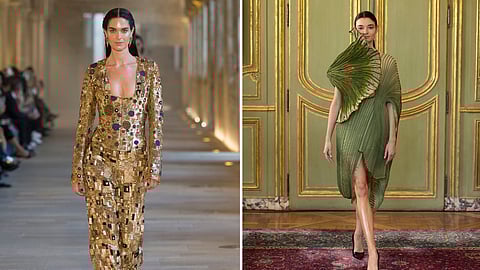
A section of Rahul Mishra's showcase, Becoming Love, drew inspiration from the artistic language of Austrian Painter Gustav Klimt, translated into the designer’s world through surfaces crafted in village ateliers across India.
Though referencing seminal artworks is nothing new to the Indian couturier, whose autumn/winter 2017-18 collection was soaked in the melancholia of Van Gogh's sunflowers, this season, he extrapolated ancient techniques of aari thread work, zardozi, naqshi, dabka, and fareesha embroidery with an of-the-moment flair, resulting in an epiphany of sorts at the crossroads of haute couture and the arts.
Mishra's attraction towards Gustav Klimt’s work comes from its emotional complexity—its symbolism, sensuality, and the obsessive detailing that almost feels sacred. “What really drew me in was the reverence in his art. Reverence not just toward the subject, but also toward the act of creation itself. And that’s something I relate to deeply in my practice. When you work in couture, and especially when you work with Indian craft, you come face to face with that same level of devotion—hours, days, even weeks spent on a single piece,” shares Mishra with Robb Report India.
He never wanted to use Klimt as is—not just replicate or print his artwork. That was never the point. What mattered to him was what he stood for: the detail, the mystery, the emotional tension. “His paintings often carry motifs that feel almost like sacred totems. So, for me, the real challenge and beauty was in interpreting that depth and emotion through Indian craftsmanship and own language of mixed mediums, layering, and textile storytelling,” he explains.
The designer worked with hand embroidery, appliqué, painting, and metallic threads to create an effect that doesn’t imitate Klimt, but carries forward his spirit. “The idea was to build that sense of mystery and ornamentation, using Indian craft as the vessel. In that sense, Klimt became a conversation, not a reference,” he quips.
Like Van Gogh’s Sunflowers, which the designer has explored before, Klimt became a chapter in the larger book his atelier writes every season. This particular chapter explored the themes of reverence and obsession, both core emotions in the Seven Stages of Love collection. “And his work gave us a lens to reflect those ideas through couture, craft and the hands of artisans who carry generations of memory in every thread they touch,” says Mishra.
Designer Vaishali Shadangule's showcase titled Kintsugi was inspired by the Japanese art of quiet poetry of broken seashells and delicate remnants shaped by time, tide, and resilience. “It is the Kintsugi (also known as kintsukuroi, is the Japanese art of repairing broken pottery by mending the pieces with lacquer dusted with gold, silver, or platinum) that has always attracted me, probably for my constant research to reuse everything and not throw away anything even when worn out or broken (they call it sustainability). And also how I tend to see these up-cycled pieces as more beautiful than the originals: a beauty taken out from their imperfection yet with a seamless beautiful energy flow," shares Vaishali.
Couture is Shadangule's creative expression; she sees it as a form of wearable art. "My garments will always evoke feelings, whether you are wearing them or just looking at them. Fabrics, textures, colours, are my tools, where the final garment is my canvas," she adds.
The art fashion osmosis was evident across the board. For instance, one of the pièces de résistance at Armani Privé show was a trio of sculptural black trousers paired with forest green and cobalt blue tops that conjured visions of Monet’s Water Lilies. Staying true to its heritage roots, Schiaparelli's show was peppered with an array of archival surrealist influences - from the sculpted torsos to the mechanical hearts. The padded faux skeleton details and molded torsos in duchesse satin recalled Man Ray’s Venus Restored of 1936. Apollo de Versailles motif, an embroidery of the chateau’s fountain historically worn by actress and interior designer Elsie de Wolfe in a cape from 1938, was reimagined on a transparent tulle cape.
Maison Margiela Artisanal collection, designed by Creative Director Glenn Martens, merits a noteworthy mention. Loaded with symbolism and savoir-faire, this outing was founded in the medieval architecture and atmosphere of Flanders and the Netherlands. The collages of (17th-century Dutch) nature morte paintings of flowers were printed on plastic or fabric and cut into three-dimensional forms.
Some collages of (17th-century Dutch) nature morte paintings of game were worked similarly on fabric and leather. One of the high points was the trompe l’oeil of hand-painted garments mimicking brushstrokes (of the Symbolist painter Gustave Moreau) and turning the body into canvas. A short-sleeved T-shirt was cut from an upcycled camisole and worn under a jersey plastron hand-painted in a Trompe-l'œil (bringing to mind the brush strokes of Gustave Moreau).
All in all, this was a season of significant artistic references enriching the couture landscape, lending gravitas and timelessness to the creations.