
- Motoring
- Style
- Home & Design
- Travel
- Food & Drink
- Specials
- News & Tech
- Videos
It's been a noteworthy year for Indian fashion with India Modern designs being recognised and revered across the world like never before, Gaurav Gupta's recent showcase at Harrods being a case in point. Even AK|OK Anamika Khanna, Love Birds, Raw Mango and Dhruv Kapoor hit some significant milestones entrenching the Indian aesthetic on the global map with runways showcases, presentations and collaborations. Here's looking at some design names who've reimagined Indian design heritage through a contemporary lens and taken it on global platforms.

After making ripples at Paris Couture Week for several seasons, GG clocked in a different kind of milestone. Nestled in Paris’s 8th arrondissement, the Delhi-born designer’s new by-appointment couture atelier sits just two minutes from the Grand Palais. Spread across 300 square metres in a 1930 building designed by French architect Charles Lemaresquier, the showroom makes for a historic backdrop complementing Gupta’s singular visual vocabulary, inculcating Indian craftsmanship, artworks and furniture designed by the couturier.
Adored by the fashion cognoscenti for its sculptural forms, intricate techniques and dramatic silhouettes, GG's growing loyalists include Beyoncé, Cardi B, and Priyanka Chopra Jonas, among others.
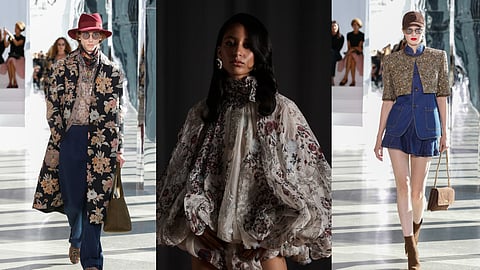
Known for reinterpreting and evolving her Indian soft grunge aesthetic, the designer's pret label AK|OK showcased its Spring-Summer 2027 collection, C’est OK, at the Paris Fashion Week. Recontextualising shirts, jackets, trousers, skirts, and dresses with a play of clever proportions and construction techniques, the designer underscored the beauty of layered, lived-in dressing. Extrapolating chikankari, hand painting, print and metal thread embroidery, she let Indian heritage craft sparkle on an international canvas. Moreover, AK|OK made its international multi-brand retail debut at Selfridges London, with a resort collection exploring relaxed silhouettes offset with considered structure and tactile fabrics.
Sabyasachi returned to NYFW after 20 years with Bengal Byzantine Broadway, a multi-sensorial carnival featuring High Jewellery in collaboration with The Metropolitan Museum of Art. Drawing on the cultural multitudes of Byzantium, the modernity of New York and the artistry of Calcutta, the showcase brought these worlds together through an Indian lens. At its most opulent, the collection came layered with embroidery, beadwork, jewelled tiger motifs and high jewellery from The Metropolitan Museum of Art | Sabyasachi collaboration, inspired by Byzantium and its sphere of influence.
The brand’s Spring Summer 27 show, 'India: IYKYK' marked Lovebirds’ made a thrilling debut at London Fashion Week. The collection drew on some memories of India like the hands and ears of the Ideal Boy, lifted from the chart, and set loose across the cloth. At the centre of the collection was chintz, a cloth with a long history of leaving India and coming back altered. Creative Directors Amrita Khanna and Gursi Singh partnered with block-printing artisans to rework, disrupt and re-layer classic chintz blocks, then trained artisans to brush over the printed cloth by hand. Overall, the design house presented a vibrant, nostalgic world of India against a minimal, entirely white set which acted as an ideal canvas.
Dhruv Kapoor has been dazzling Milan Fashion Week's runways with his singular aesthetic and original point of view, a case in point being the Spring Summer 2027 collection titled, 'Presence,' which turned towards awareness of the moment itself. This reflection took shape through a wardrobe defined by movement, layering and shifting proportions. Sun-faded hues made way for more saturated tones, unfolding various stages of ageing and transformation into the same palette and translating the passage of time onto both the body and the clothes.
Earlier this year, Sanjay Garg’s design house debuted at London Fashion Week with a show, ‘It’s Not About The Flower.’ Though the brand has presented in London before, this show was a continuation of that journey. Reflecting Garg’s penchant for blooms, the brand reimagined floral details in unexpected and clever ways, thus, breaking the stereotypes around flowers and the way they're perceived and presented. He wanted to expand his focus to the garland instead of the single flower. The result was a visually sumptuous spectacle.
Celebrating women who play by their own rules, the brand was named after the colloquial word 'gundi,' meaning "misfit" or a girl who refuses to behave.
Rooted in rebellion and independence, the design house was founded in New York City in 2019 by Creative Director Natasha Sumant, a Parsons School of Design graduate. What began as an underground art project evolved into a fashion label that presents collections in New York, Paris and Mumbai. Inspired by Sumant's personal heritage, the brand initiates an ongoing dialogue between ancient craft and modern silhouettes, reconfiguring traditional textile-making, embroidery, and couture techniques for the unconventional, experimental woman.
Gundi engages with artisans and communities who have practiced these crafts, working with more than 120 female artisans to create considered pieces that honour inherited knowledge while looking toward the future. Informing the brand's SS27 collection were messy, wild and free women who refuse to move through life in straight lines. Bandhani skirts, made by hand in the dunes of Kutch, gathered beneath clouds of beaded organza. Handwoven Chanderi silk crafted along the Narmada had a conversation with Eri silk handknitted in the Himalayas.
In a short span of time, Kartik Kumra has become a fashion force to reckon with. Since launching the brand five years ago from his college dorm room at the University of Pennsylvania, he's clocked in a series of milestones: opening a shop in New York’s Lower East Side; getting his tie worn by NY mayor Zohran Mamdani at his swearing-in; and, most recently, clinching the guest designer spot at next year’s Pitti Uomo trade fair.
Known for relaxed silhouettes crafted from natural textiles and finished off with folkloric details like block-print dyeing or hand embroideries, he's developed a distinct signature which is hard to replicate. Think instantly desirable chore coats, suede blouson-style jackets emitting a hint of sheen and zip-front jackets rendered in a faded, tapestry-like print overlaid with embroidery. Each ensemble features an unexpected detail. It would be interesting to see how Kartik Research's design language evolves in the coming seasons.