Subscribe
Subscribe
- Motoring
- Style
- Home & Design
- Travel
- Food & Drink
- Specials
- News & Tech
- Videos
2025 has been a turbulent year, not just for global politics and the economy but also for the fashion landscape. The year saw one of the most epoch-defining Paris Fashion Weeks, with heritage brands such as Chanel, Dior, Mugler, Loewe, Bottega Veneta, and Balenciaga ushering in a major style reset under the aegis of the newly appointed artistic directors.
Back home, celebrated designers such as Suneet Varma made a foray into premium ready-to-wear, and Tarun Tahiliani launched OTT Tarun Tahiliani, the much-anticipated luxury prêt label.
Moreover, the year saw India shining globally, with Louis Vuitton's menswear artistic director Pharrell Williams deriving inspiration from India for the brand’s Spring-Summer 2026 collection. Another high point was Indian model Bhavitha Mandava opening Chanel’s Métiers d’art show, bringing the spotlight on the subcontinent yet again. Here are some key highlights and trends that emerged this year.
Matthieu Blazy made a sparkling debut at Chanel, reimagining the house code with his personal touch. Jonathan Anderson mined the rich Dior archive and unveiled his first women's wear collection for Dior, following his men’s debut earlier this June. Dior's voluminous dresses featuring fabric folds sewn into a weaving pattern stood out. At Balenciaga, Pierpaolo Piccioli stepped into the maison, and Glenn Martens presented his first ready-to-wear collection for Maison Margiela, following his successful couture presentation.

It is seemingly evident that the corset has outdazzled the traditional blouse. Designers at the Lakme Fashion Week x FDCI experimented with corsets, styling them with lehenga skirts. Bhumi Pednekar, who turned showstopper for Amit Aggarwal, was seen in a metallic corset look. Designer Namrata Joshipura too showcased an array of sporty chic, corseted bodysuits and sweatshirts with corset detailing earlier this year.
Menswear showcased at Louis Vuitton, Dior, Gucci, Saint Laurent, and Dries Van Noten heralded the dandy dressing exemplified by couture-informed shapes, louche tailoring, and ornate details. Pharrell Williams at Louis Vuitton had the Indian dandy on his moodboard, which informed the tailoring—experimental, soft, and free-flowing. Another highlight this season was Jonathan Anderson's confident debut at Dior Men, and the artistic director served a vibrant reimagining of the house's heritage code.
The Dior Book Tote was reimagined with book covers—including Saints Pères editions of Les Fleurs du Mal by Charles Baudelaire and In Cold Blood by Truman Capote—while a crossbody bag offered a tribute to another iconic literary work: Dracula by Bram Stoker. The Lady Dior, meanwhile, was reconfigured by artist Sheila Hicks and cloaked in a nest of pure linen ponytails. At Louis Vuitton, LV Speedy P9 bags were amplified with painted stripes evoking those of archival trunks, with Monogram embroidery in vibrant blue, ochre, and purple, and with Monogram gold-thread embroidery on leather. The Speedy P9 also appeared in faded colours on ostrich, in green Sahara-finish crocodile, in scarf prints with three-dimensional monogram elements, and in a tree-of-life carpet weave with animal embroideries. Moreover, Hermès designed totes printed with gambling monkeys “just for fun,” and other iterations of weekend bags. However, the pièce de résistance was a triple-decker tan Birkin bag avatar.
It was an OMG-inducing epiphany as Indian model Bhavitha Mandava opened Chanel’s Métiers d’art show, staged on a New York City subway platform. The 25-year-old girl earned a bachelor’s degree in architecture in India before moving to New York to study for a master’s degree in interactive design and media at NYU. She was spotted by Chanel’s artistic director Matthieu Blazy on the subway, and that’s how she landed the opening slot at the show. She wore a quarter-zip and denim, a recreation of what she wore when Blazy found her.
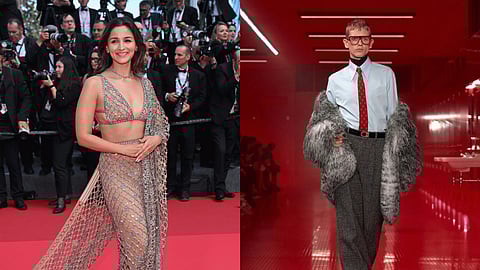
While Pharrell derived inspiration from India for Louis Vuitton’s SS 26 menswear collection, the Gucci team too couldn’t resist the allure of the Indian aesthetics. At Cannes, the Italian luxury house’s Indian face, Alia Bhatt, walked the red carpet in a nude-hued sequined Gucci sari-inspired drape covered with the brand’s signature GG monogram. Styled by Rhea Kapoor, the ensemble is reportedly Gucci’s first creation informed by the iconic Indian silhouette, clocking in a milestone. Beaded from head to toe in Swarovski crystals, the look was an homage to Indian heritage.
After crafting Indian couture for three decades, couturier Suneet Varma branched into ready-to-wear. Also worth mentioning is OTT Tarun Tahiliani. OTT redefines everyday dressing with intelligent design and a seamless blend of heritage and modernity through signature “India Modern” separates. Shantanu and Nikhil Mehra launched Shantanu Nikhil Luxe.
Luxury brands embraced faux fur like never before. The likes of Dolce & Gabbana, Emporio Armani, Zegna, and Prada experimented with shearling and faux fur, lending drama to their menswear at Milan Fashion Week. D&G’s theme this season was “Paparazzi,” and the collection spotlighted fur-lined pieces embodying Italian opulence. Prada too upped its shaggy game, serving raw-cut faux fur accents across sweaters and overcoats.
An offshoot of the noughties style, the classic ballet flats had their moment under the sun—whether it’s Maison Margiela's Tabi split-toe ballerina flat or Bottega Veneta's sole lug. The new Louis Vuitton Sneakerina was a hybrid creation that fused ballet flats with sneakers to allow for both unrestricted movement and a dynamic, feminine shape.
This year, Dolce & Gabbana rooted for pajama dressing, sending out models in PJ sets and proposing tailoring mixed with innerwear and sleepwear separates. Mixing suits with boxer shorts' peekaboo hints and accenting the collection with leopard prints—the designer made a case for boudoir-meets-boardroom dressing.