
Subscribe
Subscribe
- Motoring
- Style
- Home & Design
- Travel
- Food & Drink
- Specials
- News & Tech
- Videos
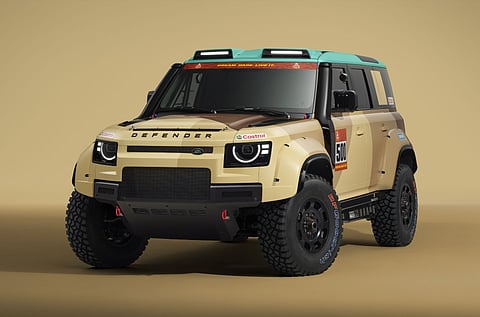
The toughest Defender yet is how Land Rover describes the Defender Dakar D7X-R that the Indian owned British marque will be fielding at the Dakar Rally 2026, this January. That’s really saying something because those who know the Defender and its legacy also know that it has always been an insanely capable vehicle.
Defender complies with all the regulatory requirements of the FIA (Fédération Internationalé de l’Automobile), the governing body for all motorsport in the world. The car is based on the architecture of the regular Defender OCTA and carries the same bodyshell as the Defender 110. However, it has been modified to the extreme to be able to take on rivals on the gruelling desert sands of Saudi Arabia, which is where the Dakar Rally is now held.

The Dakar D7X-R gets a bespoke 550-litre fuel tank to keep the 4.4-litre twin-turbocharged V8 engine. While the same engine produces 635HP and 750Nm of peak torque in the OCTA, Land Rover has not disclosed the power and torque figures for the Dakar D7X-R. Needless to say, it’s going to be even more than that to ensure that Land Rover drivers have enough speed to stay competitive over the 5,000km of rally stages. Transmission is achieved through the same 8-speed automatic gearbox as the OCTA but with altered ratios.
The car has an extra-long range fuel tank that will be filled with advanced sustainable fuel. Although the 3023mm wheelbase remains the same as in the OCTA, the front and rear tracks are up from the OCTA’s 1772mm and 1768mm to 1832mm and 1828mm in the Dakar D7X-R. Ground clearance has been jacked up to 370mm to ensure that it is able to clear even the largest of obstacles without having to slow down.
Approach and departure angles, which are critical to rallying off-road in extreme conditions, have been significantly increased as well. A bespoke rally-specification brake system has also been fitted to Defender Dakar D7X-R, with vented discs, six-piston front and four-piston rear calipers.
Defender Dakar D7X-R will compete in a raw, elemental, and powerful livery inspired by the tones and textures of the desert. The all-new ‘Geopalette’ design takes its cues from the arid landscapes that characterise the Dakar. It combines sand, stone, and earth tones with a hint of Aqua, drawn from the rare desert waters that bring contrast and clarity.
Piloting the desert-themed competition cars will be a team of crack drivers and co-drivers, including Dakar legend Stéphane Peterhansel and Mika Metge. Two other Dakar D7X-Rs will be piloted by Rokas Baciuška and Oriol Vidal, and Sara Price with Sean Berriman. All three teams will be backed by an experienced team of mechanics and engineers, with newly appointed Team Principal Ian James at the helm.
On board, drivers will carry eight litres of water, three spare wheels – housed in place of the rear seats and secured to the new roll cage – a tool kit, compressed air, essential spare parts, and a pair of integrated hydraulic jacks capable of lifting either side of the vehicle.