
Subscribe
Subscribe
- Motoring
- Style
- Home & Design
- Travel
- Food & Drink
- Specials
- News & Tech
- Videos
The G-Wagon, Mercedes-Benz’ cult favourite SUV, is born in Austria, and not Germany, its neighbouring country. Graz is a hallowed address for G-Wagon enthusiasts just as Affalterbach, in Germany, is for fans of AMGs.
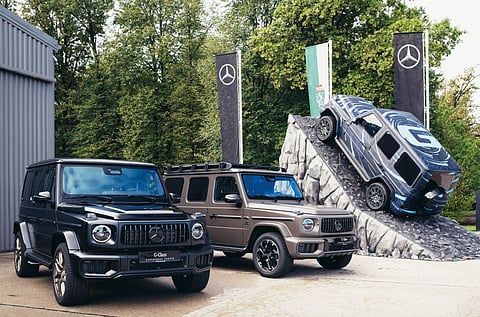
During a guided tour of the Magna Steyr factory in Graz, where G-Class vehicles are made, I spot the Mercedes-Maybach G 650 Landaulet casually parked in front of the G-Class Experience Centre. The Maybach is among the most coveted limited-edition vehicles in the world, with just 99 produced in 2017. The ultra-luxury off-roader has a retractable top, foldable tables, and custom Maybach recliner seats at the back. Its resale value in the market, we’re told, is upwards of INR 10 crores.
Before setting foot inside the factory, we are required to put our phones and any other camera equipment in a deposit box. Since 1979, every Mercedes Benz G-Wagon in existence has come off this assembly line. Hall 12 is historic—it’s where the 5,00,000th Mercedes-Benz G-Class vehicle was made in April 2023. Between 40,000 and 42,000 units are shipped to well-heeled car enthusiasts around the world from Hall 12.
Three types of G-Wagons are produced here: the standard combustion engines, the relatively recent electric Gs, and the performance-driven AMG versions. Interestingly, the AMG engines made traditionally at the Affalterbach plant in Germany are brought to this factory and fitted on AMG-configured models.

As we are guided through the production line, past large robots and machines, the manufacturing philosophy reflects the art of handmade philosophy which underpins the value of this much loved SUV. Almost 80 per cent of the entire production of every G-Wagon is done by hand.
Between halls, there is a wall where a brief history of the G-Wagon is mentioned—how, from its inception in 1979, the SUV has rapidly gone from performance driven military vehicle to civilian off-roader to status symbol. The popemobile, a modified version of the G-Wagon used by Pope John Paul II in the ’80s, is also on display.
One of its engineering highlights, rendering every move performative, is the ultra-sturdy ladder frame chassis, which is fascinating to see bare. The sheer size of each ladder frame is impressive. The factory craftsmen call the jaw-dropping moment when a completed body is lowered onto the frame “the marriage”. After this, the car is ready for a glow-up that includes a multi-step paint job, interior finishes, steering wheels, and all the technological bells and whistles, while passing through samples of Alcantara and Nappa leather. Special mention to the radio playing the greatest hits in the background at the plant, drowning out the industrial sounds of the production line.
Skilled engineers ensure the car undergoes extensive finishing, entirely by-hand, throughout the production process. Every model is then dispatched to the nearby Schöckl Mountain test track for an extreme endurance test. Upon successful testing, the vehicle is awarded the “Schöckl proved” badge.
It merits special mention that the design dimensions of the G-Wagon have remained largely unchanged from 1979 to 2025, including its unmistakable geometric, boxy silhouette, the high-placed indicators, and spare wheel at the back. Its design is as timeless as it is modern and luxurious on the inside. On a personal note, to be invited to the birthplace of the G-Wagon is definitely one for the books.
The German carmaker’s “Manufaktur” option is essentially a bespoke service where, for the right price, one can have their G-Wagon personalised. I spent a few hours in the studio, surrounded by a wall of custom spare wheel covers. Here, customers can choose from 20,000 colours, as well as pick the colour of the stitch on the car seats, the exact shade of leather upholstery, and get personalised steering wheels. Ninety per cent of all G-Wagons are customised in one way or the other under the Manufaktur offering.