
Subscribe
Subscribe
- Motoring
- Style
- Home & Design
- Travel
- Food & Drink
- Specials
- News & Tech
- Videos
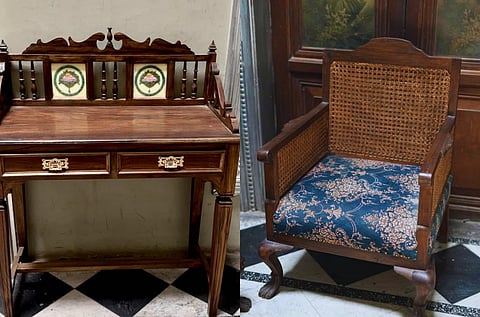
Some brands sell furniture — and then some tell stories. At House of Salempur, history is more than just a reference point — it’s the foundation of the brand. Co-founded by Pari Fatima and Farhan Hasan, this antique furniture atelier is rooted in the legacy of the Salempur estate and powered by a devotion to craftsmanship that’s all but disappearing in today’s world of mass production. Every piece here is hand-carved, with slow and precise movements, and steeped in generational artistry.
In this conversation with Robb Report India, Pari and Farhan open up about how they’re reviving a forgotten aesthetic, what defines Salempur style, and why true luxury lies in timelessness.
RR: Can you tell us about the origins of House of Salempur? What inspired you to start this furniture brand, and what heritage or local craft traditions does the brand draw upon?
Pari & Farhan: Heritage has always been a part of our identity, since we belong to the historic Salempur estate. We wanted to bring forward signature pieces that are now on the verge of extinction, preserving the artistry of the past for a new generation. Every piece we create is entirely hand-crafted — from carving to assembly — by highly skilled local artisans. We deliberately avoid machines so that the authenticity, soul, and imperfections of true handwork shine through.
RR: How do you define your design philosophy? What are the signature elements that make a piece distinctly ‘Salempur’?
Pari & Farhan: Our design language is rooted in heritage. Signature Salempur pieces include sofa mantles, catalogue furniture, and vintage articles that echo the grandeur of bygone eras. We work with both original sourced antiques and faithful replicas, ensuring each piece carries the spirit of timeless design. What makes our work distinctly “Salempur” is that blend of history, storytelling, and craftsmanship.
RR: What materials do you prefer to work with (wood, inlays, fabrics, finishes, etc.) and why? Are there particular local materials or artisans you always want to spotlight?
Pari & Farhan: We use only seasoned teak wood for our masterpieces because of its durability, timeless beauty, and deep connection with Indian craft traditions. Inlay work, intricate carving, and heritage finishes are integral to our style.
RR: In today’s fast‑changing luxury market, how do you balance preserving traditional craftsmanship with innovating (in form, function, or materials)?
Pari & Farhan: For us, tradition is not a constraint, but a foundation. We preserve age-old carving and joinery techniques, while innovating in form and function. For example, we reinterpret classic silhouettes for modern homes, or experiment with finishes and upholstery that suit contemporary luxury living. This balance allows us to honour the craft while ensuring our furniture remains relevant and desirable today.
RR: Luxury furniture is a crowded global field. What differentiates Indian luxury furniture — and particularly House of Salempur — from international competitors in terms of quality, story, and value?
Pari & Farhan: Indian luxury furniture is distinct because it carries not just craftsmanship but also culture. International competitors may deliver sleek perfection, but what we offer is depth, history, and exclusivity. The value lies not just in the product but in the heritage it embodies.

RR: Do your clients tend to want bespoke pieces? What is the process when someone commissions a piece? What do you enjoy most about making custom furniture?
Pari & Farhan: Yes, a large part of our work is bespoke. Clients often come to us with an idea or an inspirational picture, and we translate that vision into reality. Sometimes they need design guidance, and we co-create with them. What we enjoy most is the uniqueness each project brings — no two custom pieces are alike, and each carries its own narrative.
RR: What have been the biggest challenges you've faced (logistics, scale, maintaining skills, etc.)? And what opportunities do you see for luxury furniture in India over the next 5‑10 years?
Pari & Farhan: Because everything we do is by hand, bulk production and rapid scaling remain challenges. But this is also our USP — true luxury lies in rarity, not mass production. Looking ahead, the opportunity for luxury furniture in India is enormous. There is a rising appetite for heritage-rooted, authentic design that feels global in quality but proudly Indian in spirit.
RR: Which designers, cultures, or design traditions inspire you currently?
Pari & Farhan: “Our greatest inspiration is our ancestral home, the House of Salempur itself. Raja Syed Ahmad Ali Khan, one of our ancestors, redesigned and redecorated the house with a refined English aesthetic — his taste was deeply classy and layered with charm. Internationally, we admire the timeless work of Thomas Chippendale.
Next, Pari and Farhan are exploring collaborations with contemporary designers who appreciate heritage, as well as expanding into international markets where there is growing respect for handcrafted Indian luxury. New directions also include experimenting with mixed materials like stone and brass accents, and creating limited-edition collectable pieces that blur the line between furniture and art.