
Subscribe
Subscribe
- Motoring
- Style
- Home & Design
- Travel
- Food & Drink
- Specials
- News & Tech
- Videos
AI generated summary, newsroom reviewed
Twenty days, sixty-six artists, ten plus venues, fifteen plus events and one city, that is how the attractive tagline of the third edition of Contemporary Now goes. Safe to say, it is poised to be the meeting place of all the who's-who of the art world in India.
Bringing together India's leading galleries in a shared presentation of contemporary art as a platform for dialogue, discovery and exchange is, however, right up Contemporary Now's alley. In its third edition, happening this month from 8 to 25 with the theme that says Practices in Continuum: Tracing the Present, the platform is seeming its most ambitious so far. Chennai will be transformed into a destination for contemporary art through various programmes during its span. With exhibitions taking place at Lalit Kala Akademi, programmes such as artist walkthroughs, panel discussions, workshops and open houses, inviting audiences to engage with contemporary artistic practices that explore themes ranging from memory, migration and ecology to politics, identity and materiality, while reflecting the evolving ideas shaping the present moment will also unfold at several other venues in fair propinquity.

Leading galleries such as Ashvita's, Chemould Prescott Road, Chatterjee & Lal, Experimenter, Project 88, TARQ and Vadehra Art Gallery form its line-up. Leading artists Atul Dodiya, C. Krishnaswamy, Thukral and Tagra, K. Benitha Perciyal, Raqs Media Collective, and many more would grace the programme with their presence.
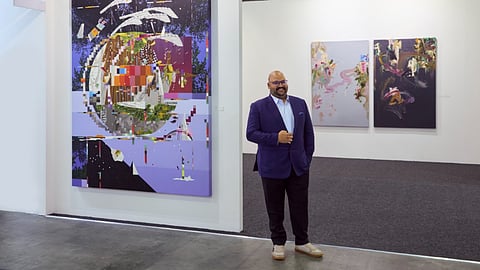
To get a better insight before the show takes off, Robb Report India managed to speak with Ashvin E. Rajagopalan, an important man who juggles several hats. A curator and cultural strategist, he is also the director of Contemporary Now. Additionally, as Director of Ashvita's in Chennai, he has curated a series of exhibitions spotlighting the Madras School and South Indian modernism, alongside retrospectives and solo shows for established and emerging artists. He also serves as Director and Chief Curator of the Piramal Museum of Art in Mumbai and is the Associate Curator of the India Pavilion at the 2026 Venice Biennale. His curatorial portfolio spans landmark retrospectives on Raja Ravi Varma and S. H. Raza, interdisciplinary exhibitions exploring artistic practice, and acclaimed Bhakti-themed exhibitions at the Nita Mukesh Ambani Cultural Centre (NMACC), reflecting his interest in connecting historical scholarship, living traditions and contemporary artistic discourse.
Presented below is an edited version from our conversation with the curator-director, reproduced in interview format.
Ashvin E. Rajagopalan (AR): Why have we expanded the format? Why have we scaled up? The reason for this is that, after having done Editions 1 and 2 in 2025 in two different locations and demographics, we realised that the fundamental concept is this: if there is availability, curation and a guided experience, it doesn't matter today in which city art is being shown. There is a local, sustainable market for art in India today. Whether it's Chennai, Ahmedabad, Hyderabad, Coimbatore or Cochin, every city has a group of collectors. What was not available before was access. It is this access, with curation, that we are providing, and the response has been better and better.
What we are also setting as a standard is, 'How does one do an exhibition?' In terms of the mechanics of transporting artworks, installing the artworks, the display, the locations and the event management, it's a whole new model that is arriving, and we are taking that lead. Obviously, it needs to be explored more, but we think that this is a new model that's coming to change what has existed in terms of art fairs, exhibitions, art weeks and so on.
AR: It was very simple. Contemporary Now isn't a standalone event. All the galleries, the artists and the practices—it's more of a review. So, Contemporary Now is a collector-focused event. The priority is, of course, to show good work and have the best galleries. But once you've done that, once you've chosen the best galleries in the country and once you've chosen their best artists, you kind of realise that there is a lot more assurance to a collector who is coming in and saying, 'Hey, I want to spend some money. How do I know that what I'm buying is good and relevant?'
Contemporary Now has determined that the price band is Rs. 5 lakh to Rs. 15 lakh in India today. So what we did was say, let's take these artists and look at their practice over time. Over the next five years, we might be curating the same artist. But what we are doing is seeing how they are evolving. That's the thing about contemporary art: you can't look at it historically.
When you look at the secondary market for moderns, the reason why it is Rs. 3,000 crore in auction sales for 2025–26 is because there is an entire history to look at, review, pick and choose. But in contemporary art, the art is evolving, the artist is evolving and the practice is evolving. So if we do not look at it over a period of time, it is very difficult to engage with contemporary art, which is why artists fall out of visibility very often, and it is very difficult for people to scale up.
AR: I know, it's funny. I did Bhakti and it branded me as a devotional curator. Bhakti was possibly the most deeply researched show. It was two shows: Bhakti I and Bhakti II.
My curatorial practice remains the same, whether it is Madras, Krishna or contemporary art. There is always a deep enquiry into creating the larger picture: how did one little point in time or one little object in space come to be? When you enquire, it just expands and expands and expands. I am, and have always been, a big-picture guy.
So when you take on Krishna, you take on the entire faith structure of billions or millions of people, and you have to decode it in such a way that it is information, it is facts, it is well researched, and there is room for questions, but there is no room for ambiguity. There is no room for questioning the narrative because the narrative is very well researched.
When it comes to the Madras School, as I keep saying, I excavate a lot of history because it was history that was not there. But the difference here is that while I am a curator, I am also the head of business. I play multiple roles, so it gives me the ability to look at everything from different angles: curatorially, how is it important? Art historically, how is it important? Commercially, how is it important?
When I am juggling all these different hats, my curation also looks at all these different angles. So Contemporary Now is also trying to contextualise contemporary art in Indian art history.
A simple example: consider the Madras School, Bombay School and Calcutta School. The fact that we are able to call these 'schools' is because there was an institution, everybody studied there and lived in those cities. But in the age of Instagram, what is the future of Indian art, or any kind of art? How long are we going to call it contemporary art? And when does this begin to create -isms and movements? Nothing.
How do you connect Subodh Gupta and Bharati Kher other than marriage? Jitish Kallat and Reena Kallat together? Other than the fact that they are all represented by the same gallery. The future is going to be just gallery-centric, so we're creating brands. There's no connection between Subodh and Jitish, there's no connection between Bharati and Jitish, and there's no connection between Jagannath Panda and Bharati Kher. Therefore, what is this history? They are all pretty isolated already.
So Contemporary Now is coming in as this layer to glue everything together, so going forward, storytelling and narratives can be comprehensible to the audience. Sometimes we forget the audience, and I think it is important, at least in my curation, that I am only speaking to the audience. My audiences are non-art-world audiences. They are general people. People with money.
AR: A very good question. I wouldn't look at it as different from, or competing with, those ideas.
With Contemporary Now, I have basically challenged myself. The three venues that we have put together at Lalit Kala Akademi use the infrastructure of a public space, which is kind of like the pavilions in Venice. It is what it is, and you have to make do with it. We believe we have taken it and converted it into a world-class space.
From the context of Chennai, or anything to do with Lalit Kala Akademi as a venue anywhere in India, I am looking at the quality of the deliverable I have to provide to the seven galleries, because they also represent certain artists. Overall, yes, we have elevated the experience, the curation, the display and the production for Contemporary Now. So that's one impact of being the curator at Venice. I am looking at things in a finer, deeper and more globally polished way.
That is what we are doing. If you look at the two shows we are doing at Ashvita's, I am curating there. One is by C. Krishnaswami. The way we have changed the gallery space and the production quality for that exhibition is something Chennai has never seen. It's probably something you'd mostly do in museums or foundation spaces, where something is sponsored and you've let the artist do whatever they want.
Similarly, with Benitha Perciyal's exhibition, we have moved her whole studio into the gallery, and that was a very interesting exercise. So yes, in terms of the quality of production, the finish and all of that, we are bringing to Chennai the quality somebody would see in Venice or any other international gallery.
AR: This whole show is built for first-time visitors, or the non-art-world person. We believe that the art world, on its own, does enough promotion for the art world. For instance, if you look at my Instagram today, it's just 5,000 photos from Ladakh and Leh because everybody was there over the weekend for the Ladakh Biennale. All of Delhi was there. I have been accosted by it. But that's insider viewing. That is galleries, core collectors and so on.
Contemporary Now is being made for the non-collector, for everybody.
While we have separated the galleries and the artists and kept them in islands, or contained spaces, it's to keep each gallery's programming cohesive and coherent with what they do. If I mixed all 66 artists in one space, it would be the worst bhel puri ever.
However, the entire curatorial note is based on a concept that it doesn't matter who the artist is or where they are from. They deal with the following practices: body, geography, boundary, border, whatever the issue may be. It could be political or personal. So we have broken it down into six or seven categories like that, and you can identify the artists based on their narrative storytelling.
Then you realise, 'Oh, this artist from Kolkata is talking about the same thing that this artist from Chennai is talking about, so let me look at their visuals and see how they tessellate.'
So it's a very exploratory idea, where we keep the gallery and the artist, per se, agnostic, but we look at their styles, their subjects, their storytelling, their narratives, their causes and their issues. That's how it gets curated, and the common person understands it more as storytelling and the larger picture, rather than worrying about -isms, which gallery it is, or who the artist is.
AR: The answer to this is pretty simple. Today, and this is a problem of this particular decade, I suppose, because next decade it will be something else, all engagement in the art world is happening through entertainment.
Whether you go to India Art Fair, Art Mumbai, the Kochi Biennale, any of the Mumbai Art Weekends, Art Night Thursdays or the Defence Colony Art Walk, you'd realise that this is happening.
Now, why? Because concentration is very important. Why? Because the average customer has too many things to be distracted by. We are competing against the food industry, the cinema industry, the music industry and all kinds of other things. There's so much in abundance today and, therefore, the customer, the consumer or the human being has only a certain amount of time to give to these things.
Therefore, the art world also has to do a lot now to command attention. So if I want people to come from all over India, or even within Chennai itself, we have to make it a much larger, more engaging weekend so that people can plan to be here, engage and focus.
While concentration happens through entertainment, engagement and programming, focus also happens when everybody is talking about the same thing. So it was a need, something we recognised had to happen.
Yes, it brings quality to Chennai. It brings people to Chennai. We are hoping that the next edition becomes even bigger. We are being ambitious in saying that we want to expand the next edition to 10 galleries. When that happens, the weekend gets even bigger.
We are also bringing the city along with us. All the galleries in Chennai, from (Gallery) Veda to Avatar Foundation, Chennai Photo Biennale and Apparao Gallery, have all been activated. We have curated with them and told them what to show so that it creates a rounded narrative for Madras. We have kept them geographically close to one another rather than spread all over the city.
So everything is about concentration, experience, engagement and entertainment. That is why we think this will do very well.
AR: Contemporary Now was called Contemporary Now very intentionally. We said we don't want to put a location to it, a time to it, or anything. So, as long as we keep calling art produced today 'contemporary art,' Contemporary Now will go all over the world.
I can do a Contemporary Now in Mexico, I can do a Contemporary Now somewhere in Germany. It doesn't matter. It's all about curating contemporary art from the best galleries, from an entire geography, for a particular region that is underserved.
We basically are a very light, very flexible, movable, full-service exhibition idea company, and we can actually go where the large fairs can't.
Fundamentally, the lack of a locational identifier gives us the ability to be global, and that's what we see as the future of Contemporary Now.
In 2026, there should be one more edition happening. We haven't announced the city yet. And in 2027, we should be seeing four Contemporary Now editions happening, potentially two in India and two outside India.
Contemporary Now · Edition III, themed Practices in Continuum: Tracing the Present, runs from August 8-25, 2026 at Lalit Kala Akademi, Chennai, with partner programmes across more than 10 venues citywide, bringing together 66 artists represented by Ashvita's, Chemould Prescott Road, Chatterjee & Lal, Experimenter, Project 88, TARQ and Vadehra Art Gallery.