
Subscribe
Subscribe
- Motoring
- Style
- Home & Design
- Travel
- Food & Drink
- Specials
- News & Tech
- Videos
AI generated summary, newsroom reviewed
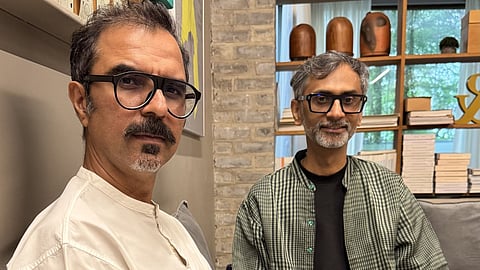
If you speak of India's most impactful and restless art duos, Jiten Thukral and Sumir Tagra might top that list. The elusive duo resists categorisation in any particular box and ricochets meaningfully across painting, sculpture, installation, video, performance and design.
Thukral, born in Jalandhar in 1976, and Tagra, born in New Delhi in 1979, trained on separate paths. While Thukral received his BFA from Government College of Arts, Chandigarh in 1998 and his MFA in 2000 at College of Art, Delhi, Tagra finished his BFA in 2002 from College of Art, Delhi, and later pursued his post-graduate degree at National Institute of Design, Ahmedabad. It was only later that they joined forces as a duo more than two decades ago, each bringing his own design and fine-art sensibilities to a shared practice that keeps reinventing its own form.
Overtime, their work has travelled to major platforms internationally, including the Asia Pacific Triennial, the Centre Georges Pompidou in Paris, the Arken Museum in Denmark, Kunstmuseum Bochum, the Lyon Museum of Contemporary Art and Tokyo's Mori Art Museum. Closer to home, their 2015 solo show Games People Play at Mumbai's Dr Bhau Daji Lad Museum is still one of the defining chapters in their career. All of this in addition to their long-running bodies of work wherein they have tackled everything from Punjab's migration culture to ecology and collective memory.
The duo has also taken to mentoring emerging artists through platforms like Jaipur Art Week, lending their cross-disciplinary instincts to the new generation of Indian contemporary practice.
Thukral and Tagra are part of our RR Art Circle this month and under the programme we had the privilege of sitting down with them as they shared with his their picks of artists, art institutions and other creative industry icons relevant to Indian contemporary art.

GABAA is one of several curator-collectives shaping the newer, more grassroots wing of India's biennale circuit. Most recently, it was named among the seven curators and collectives steering the sixth Kochi-Muziris Biennale's Students' Biennale (2025–26), working alongside groups like Angaa Art Collective and Secular Art Collective to bring together 70 student-artist projects from over 150 art institutions across the country. GABAA has also featured as a participating artist/collective in "INDIA. Of Glimmers and Getaways," a survey exhibition of emerging Indian artists at Milan's Palazzo dell'Arte (PAC), alongside names like Sumakshi Singh and Uzma Mohsin. The throughline in both appearances is a commitment to peer-led, non-market-driven artistic pedagogy — positioning GABAA as part of a younger generation building infrastructure for artists outside the gallery-and-collector circuit.
Jagath Ravi is a Chennai-based painter whose figurative work draws on an unlikely source: the classroom. A practicing art teacher for much of his decade-long career, he channels his time around children and everyday human gesture into large-format paintings — slouched postures, drifting gazes, fingers caught mid-motion — that read less like portraits of absence and more like studies of quiet presence. His recent solo exhibition, "Between Petals and Silence" at Ashvita's, brought together this body of work with characteristic soft, muted colour and pared-down figuration, and was featured as part of the India Art Fair's programme. Ravi's practice sits comfortably at the intersection of still life and figuration, favoring intimacy and stillness over spectacle.
Arguably India's most internationally decorated living photographer, Dayanita Singh is one who has spent decades quietly interrogating and redefining what a "photograph" is. Born in New Delhi in 1961, Singh trained in visual communication at Ahmedabad's National Institute of Design. After that, she studied documentary photography at New York's International Center of Photography, mentored early on by Mary Ellen Mark. Following a brief stint as a photojournalist, Singh turned towardbook-making as her primary medium — collaborating extensively with German publisher Gerhard Steidl on works like Myself Mona Ahmed, Privacy, and Go Away Closer. Her signature contribution to contemporary art, though, may be the "Museum" — portable wooden structures holding dozens of interconnected photographs that she endlessly resequences, blurring the line between book, sculpture, and exhibition. These have shown at the Hayward Gallery, the Art Institute of Chicago, and Frankfurt's MMK, among others. In 2022, Singh won the Hasselblad Award, photography's most prestigious international prize.
Khoj is the closest thing India's contemporary art world has to an incubator with institutional memory. Founded in 1997 in New Delhi by a working group of artists — including Anita Dube, Subodh Gupta, Bharti Kher, and Manisha Parekh, with Pooja Sood as director since its founding — it began as an annual artist-led workshop modeled on UK and African peer networks supported by the Triangle Arts Trust. It moved into its permanent home in South Delhi's Khirkee Extension in 2002, where it now runs residency programmes, exhibitions, and its long-running Peers programme for emerging artists. Nearly three decades on, Khoj has become a launchpad for major Indian contemporary artists and has helped seed sister organisations across South Asia, including Vasl in Pakistan and Britto Arts Trust in Bangladesh, cementing its role as one of the region's most influential — and stubbornly non-commercial — art spaces.
Olafur Eliasson is the Danish-Icelandic artist behind some of the most photographed installations of the past three decades, best known for turning elemental materials — light, water, fog, colour — into large-scale, immersive experiences. Born in Copenhagen in 1967 to Icelandic parents, he studied at the Royal Danish Academy of Fine Arts before founding Studio Olafur Eliasson in Berlin in 1995, now a sprawling interdisciplinary studio of architects, engineers, and researchers. He represented Denmark at the 2003 Venice Biennale and, that same year, installed The Weather Project, an artificial sun shrouded in mist, in Tate Modern's Turbine Hall, drawing over two million visitors and becoming one of the most-attended artworks in recent memory. His practice extends into architecture and public works, from Your Rainbow Panorama atop Denmark's ARoS museum to Fjordenhus, a building he designed partially submerged in a Danish fjord. Beyond the studio, Eliasson founded Little Sun in 2012, a social enterprise producing solar-powered lamps for communities without electricity access, testifying to art's ecological and social responsibility as inseparable from its aesthetics.