
Subscribe
Subscribe
- Motoring
- Style
- Home & Design
- Travel
- Food & Drink
- Specials
- News & Tech
- Videos
There are moments in art that move beyond aesthetics. In their prime, artists like Dada ditched traditional artistic values to pave the way for anti-aesthetic movements. At another time, conceptual art rose to fame (think Fabiola Jean-Louis’ Madame Beauvoir's Painting) wherein the idea behind the work was paramount. Wrapped in History, a ceremonial textile initiative curated by Vikram Goyal, belongs squarely to that realm.

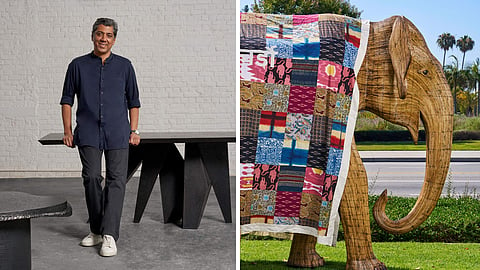
Unveiled on June 27 in Beverly Hills at the Wallis Annenberg Center for the Performing Arts, Wrapped in History marked the symbolic culmination of a 5,000-mile (roughly 8,050 kilometres) journey that began in the ancient forest of Southern India. There, within the Nilgiri Biosphere Reserve, a collective of Indigenous artisans sculpted 100 life-sized elephants from lantana camara (an invasive weed), as a symbol of resistance and restoration. The elephants, part of The Real Elephant Collective, thus became carriers of a message centred around coexistence.
At the culmination, each elephant was cloaked in a handcrafted ceremonial blanket—over 70 in total—curated by Goyal and created by 55 designers, brands, and Indigenous communities from around the world. Think names spanning Ralph Lauren and Diane von Furstenberg, to Gaurang Shah, Lovebirds, and the Chanakya School of Craft. Indigenous collaborators span the Navajo Nation, the Snoqualmie Tribe, the Osage Nation, and the Maasai.
“Blankets are vessels of protection, identity, and story,” says Goyal in conversation with Robb Report India. “In this context, each one becomes a monumental gesture, a way of honouring the past while materially supporting a more compassionate, interdependent future.”
Ruth Ganesh, the co-founder of Elephant Family, echoes this sentiment. “Culturally, this project has become a beautiful collaboration of traditions from around the world. And I think the finished pieces help us shift the image of an elephant in a blanket away from the more familiar — and often problematic — associations with tourism. Instead, the blanket becomes something far more meaningful: a symbol of respect, honour, completion, and connection. All values that sit at the very heart of The Great Elephant Migration,” says Ganesh to Robb Report India.
Interestingly, duality is a central theme in Goyal’s practice. Since founding his studio in 2000, he has worked closely with master artisans to recontextualise ancestral techniques, most notably repoussé metalwork, to craft structural furniture and limited-edition designs. “Our work has reignited the possibilities of traditional craft in modern life,” he says, adding, “Recontextualising ancestral techniques and material traditions for a contemporary world has been my core design philosophy […]It has been a creatively fulfilling journey, translating my passion, values, and ethos into work.”
With Wrapped in History, Goyal turns his attention to textiles, building what he calls a “shared act of cultural memory and future-making.” The project draws from the indigenous tradition of gifting blankets at moments of closure or transformation as a mark of honour and rite of passage. At the heart of it all is the elephant, an animal revered in Indian and African cosmologies for centuries as a symbol of wisdom, strength, and memory. The elephants in the collection migrated across the United States, transforming both urban spaces and tribal lands into contemplative grounds for conservation and connection.
For Goyal, the choice of the blanket, made of wool and thread, as a medium was intentional. “For me personally, contributing a blanket was both an offering and a reflection, a culmination of years spent working with Indian artisans and learning that craft is not merely decorative, but devotional, intellectual, and deeply intergenerational,” he explains. “This understanding shaped every element of Wrapped in History, from choosing collaborators to framing the ceremonial unveiling. It reaffirmed my belief that design must be in constant dialogue with community and context.”
This desire to honour, rather than appropriate, permeates the entire project. From the elephants’ journey through American cities and tribal lands to the final convoy of 25 trucks, each hand-painted in traditional Indian lorry art, the route is intentional. For the first time, members of The Real Elephant Collective, the Indian artisans who crafted the sculptures, joined the U.S. leg of the journey.
As striking as the visuals were, Wrapped in History was never meant to be spectacle alone. The blankets will be auctioned on Artsy from July 18 to August 1, with 100 per cent of proceeds going toward more than 20 conservation NGOs including INDIGENOUS LED, Lion Guardians, and the Wallis Annenberg Wildlife Crossing. The act of giving, too, is part of the ritual. “I'd like the collectors to view the artworks as having a broader power to convey messages not just about themselves, but about the world as a whole.”