
Subscribe
Subscribe
- Motoring
- Style
- Home & Design
- Travel
- Food & Drink
- Specials
- News & Tech
- Videos
Charles Dickens once famously said: "What greater gift than the love of a cat." If you are someone who relates to it (or even not), this exhibition at Museum of Art & Photography (MAP), Bengaluru, will ensure you look at cats in a new light.
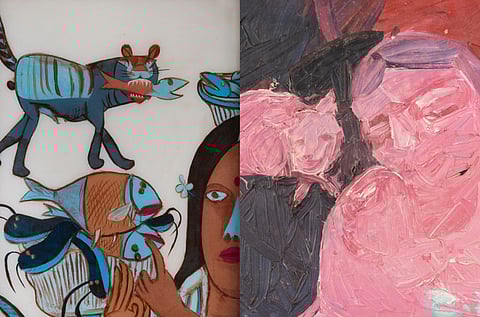
Curated by Khushi Bansal, The Many Lives of the Cat traces the feline in different situations—whether subversive, political, mischievous, or whimsical—and how they have been represented in Indian art history. The show has 35 works from the likes of Jamini Roy, K.G. Subramanyan, and Chandana Hore, as well as miniature paintings, pop culture work, and more.
Art historian B.N. Goswamy’s seminal book, The Indian Cat: Stories, Paintings, Poetry, and Proverbs, is the inspiration for this exhibition. “He was a dear friend of the institution. It was important for us to honour that friendship and legacy. That became the starting point of this exhibition, and it [has now] evolved into looking at how cats have been depicted in art through history, time periods, mediums, and artists,” says Bansal to Robb Report India.

Split into four sections, the first part of the exhibition looks at domestic cats as companions and explores this relationship with humans. One such artwork is a hand-painted postcard of a cat with a bow tie. This almost three-dimensional Gelatin silver print is believed to have been modified at some point.
There is a textile label, a common advertising tool in the 19th century, that has a little boy with a cat. This artwork shows how cats have been integral to communication as well. “Such depictions of relatable figures became central to mass-produced imagery that came from printing presses at that point of time,” says Bansal. The show also has a textile label called Dilpasand Begum, a chromolithograph from the late 19th to early 20th century that shows a Begum, cat, parrot.
Another contemporary work by Shibi Balakrishnan shows a man reading a newspaper, with a cat sitting below. This artworks not only shows the relationship between humans and cats, but also the viewer and the painting. This is especially important as there is much discourse around the relationship of people looking at, and perceiving, art.
There are also few sketchbooks on display—a first at MAP. It is interesting to see how artists Bhupen Khakhar and NN Mohandas interpret cats from a personal perspective.
The second part of the exhibition shows the cat as a thief. Here, a textile label is tilted in its display to signify movement, as cats never stay still. A collection of matchboxes, all reproductions from a larger collection, is a nod to pop culture. These labels showcased what the masses related with at that point in time. “There are some interesting ones here, like the one called The Jolly Cat, where the cat looks angry!” points out Bansal.
The next section is all about the political cat, which specifically looks at the Kalighat depiction of the cat with aquatic creatures like prawns and lobsters. Here you see works by Jamini Roy, who was inspired by the Kalighat painting tradition for the depictions displayed. However, look deeper and you can see that the artworks are a commentary against the powerful priests of the temple preying on the less privileged. “It becomes a critical analysis of how those in power often take advantage of the less 'powerful',” says Bansal.
The final section shows the fierce cat, where the focus is on large, non-domestic felines. In one painting, a black cat is seen lit by the moon—the moon painted specifically to showcase this work. The final section has interesting bits tied to history, from the representation of cats in Persia's Ganjifa cards (a game from the 15th century) to the Hoysala period. A stunning metal lion sculpture by Bhupendra Baghel is also on display. I am told animal's tail was broken, but the conservation team has now fixed it.
As I picked up the book that inspired this exhibition, I'm smitten by its cover: a cat, clad in blue robes, sitting in a meditative pose with closed eyes. And I cannot help but think how this exhibition opened my eyes to the wonders of an animal that has so many ‘tails’ to tell.