
Subscribe
Subscribe
- Motoring
- Style
- Home & Design
- Travel
- Food & Drink
- Specials
- News & Tech
- Videos
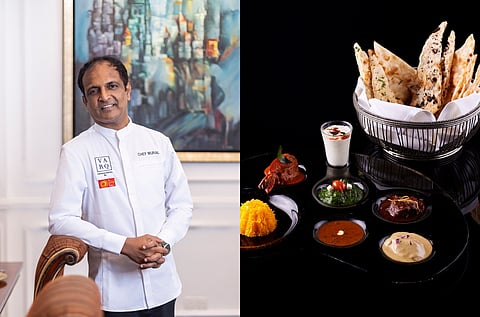
Chef Manjunath Mural might be the first Indian Executive Chef to earn a Michelin award for an Indian restaurant in Southeast Asia, but the acclaimed culinary expert remains a Mumbai boy at heart. Ask him about some of his favourite eateries back home, and there’s hardly any mention of a fancy restaurant. Instead, he fondly remembers the taste of the lip-smacking vada pavs from Shree Krishna Batatawada on Chhabildas Road or the simple but wholesome dishes he enjoyed as a student at the small Malvani eateries dotting Dadar (West). Now settled in Singapore for the past two decades, these continue to remain his haunts whenever he visits his family in Mumbai.
It is this simplicity, perhaps, that has helped him to stay rooted to his Indian culture and flavours, which he incorporated in his dishes when he joined the Singapore-based The Song of India and led it to Michelin acclaim four years in a row from 2016 to 2019.
Although the modern Indian restaurant was forced to shut its doors during the global pandemic, it spurred Chef Mural to delve into opening other F&B ventures, including the casual dine-out Adda and the restaurant chain CaliChilli in Los Angeles, USA.

The Michelin Star remains the brightest feather in his much-feathered hat, but there are plenty of instances where the Chef, who trained at IHM Bangalore and discovered his passion for cooking during his industrial training at Taj President in his third year, felt rewarded for his efforts and dedication. At a WTA Tour in China a few years ago, the event organisers were sceptical when he decided to go with lamb chops. “In China, people generally don’t prefer lamb chops, but I made it with Chinese marination, and 300 portions got sold out within two hours. They had to order more lamb chops!” he smiles, recalling the incident.
In Greece, once, on the invitation of a luxury resort, Chef Mural received standing ovations and applause on both nights that he served them dinner. “They told me that I had changed the perception of Indian food for them. It is a moment I will remember for the rest of my life,” he says.
For the last year or so, the Chef has been pouring all his energies into creating a variety of dining experiences for his loyal clientele in Singapore. In the vibrant neighbourhood of Race Course Road, Chef Mural runs Indian Saaga, an affordable North Indian halal restaurant, Amrith by The Song of India on the first floor, which is a casual and elegant space, and above that, Varq, a beautifully-designed 14-seater private dining space. “People had expectations from me as a chef and a brand. I feel I have given my all to these three spaces,” he says.
At Indian Saaga, customers drop in for their delicious Lamb Shank Biryani and Palak Paneer, while upstairs at Amrith, the food is more refined. The Chef serves Fish Tikka and Tandoori Chicken on a special glass plate through which dry spices such as cinnamon, clove, and bay leaves can be clearly seen. “Indian food is all about spices,” says Chef Mural, adding that diners, especially Europeans, are quite curious about the spices, and this glass plate, designed especially for their restaurant, makes it easier for them to tell their story.
The Art Palette is a showcase of regional favourites – Mustard Prawn Curry from West Bengal, Dumpukht Chicken in Potli Masala from Lucknow, Garlic-enhanced Spinach and Cottage Cheese from Punjab, among other delicacies served with a variety of Indian breads and rice. “I call it an art palette because these are small samples from the vast culinary landscape of India – akin to a painter’s expression,” he says. Amrith also houses a bar that makes bespoke cocktails with innovative names such as Campari Threat and Padro Martinez.
A spiral staircase leads to the private dining space Varq, where Chef Mural hosts intimate dinners for smaller groups. Sometime in the near future, he plans to bring back The Song of India and is working towards it. “It will be smaller and more intimate than the original, but it will be special,” he adds.
On his website, the Chef writes – “My dream is to share my style in presenting Indian cuisine in a way which is relevant to the diners across the world, and haute Indian cuisine will one day be as accepted as haute French dining.” This single-minded pursuit is perhaps what sets him apart from his contemporaries.