
Subscribe
Subscribe
- Motoring
- Style
- Home & Design
- Travel
- Food & Drink
- Specials
- News & Tech
- Videos
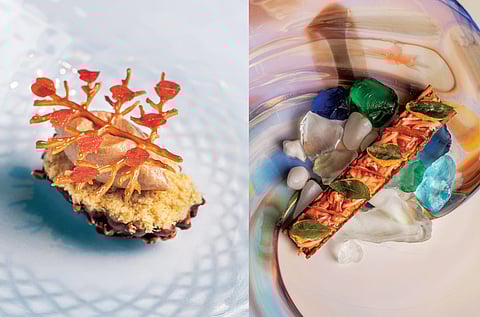
At Papa’s in Mumbai, one of India’s finest chefs, Hussain Shahzad, isn’t hidden in the kitchen; he’s waiting for you at the table. You’re in his zone, part of his process. You hear every exchange with his team, watch each dish come alive step by step, and see the plating unfold right under your nose. And yet what finally lands on your plate is always a surprise.
The explanations, the tension and the banter—each moment pulls you deeper into Shahzad’s mind. You marvel not just at what’s on the plate, but at how it was imagined in the first place. Surrounded by just a handful of fellow diners, you realise you’re not just eating dinner. You’re witnessing a performance, and you’re part of the cast.
Papa’s is part of a quiet revolution reshaping luxury dining in India. A new wave of chef driven micro-diners, typically seating just 10 to 20 guests, is redefining what it means to dine out. These aren’t just restaurants; they’re intimate stages where food, craft and storytelling collide.

Modern Indian diners, particularly the well-travelled and food conscious, are seeking more than just good food. They want a connection with the chef, the kitchen, the ingredients and the story. “It’s the sense of exclusivity that appeals to diners,” says Shahzad, executive chef at Hunger Inc., which operates Mumbai’s Papa’s.
“They enjoy being in the chef’s hands, not having to make decisions. It’s fun, but also a huge responsibility. When someone devotes three hours of their life to you, it has to count.” At Papa’s, the evening unfolds like a well-scripted play: drinks at the bar, a 12-course tasting menu in full view of the kitchen and a dining room that doubles as a stage. For Shahzad, it’s as personal as it gets: “It’s like throwing a party in your own kitchen.”
Small-scale operations offer something larger restaurants often can’t control. For chefs who are also entrepreneurs, that control is everything, from storytelling and guest experience to ingredients and precision. “To keep everything under control, you need an environment that is micro, not macro,” says Chef Himanshu Saini, whose Trèsind Studio in Dubai holds three Michelin stars. “Dining rooms are getting smaller, but the food is more precise, the service more focused, and the ingredients of the highest quality.” The format allows chefs to take risks and refine every detail. It also allows diners to place deep trust in the chef to the point where they’re willing to travel, plan in advance, and pay a premium simply for the opportunity to be cooked for.
India’s most ambitious micro dining spaces aren’t just restaurants—they’re destinations. Farmlore, for instance, has no menu and accepts only pre-paid reservations. Chef Johnson Ebenezer, who returned from Malaysia to start the 18-seater, says the format makes the experience more meaningful. “Every single element is curated, from the dish to the playlist,” says Ebenezer. “We cook for just 180 guests a week. We communicate with each one up to three or four times between booking and the actual meal to ensure it’s seamless.” Diners take a mid-meal walk through the farm where ingredients are grown, then return for the final courses. Vegan, gluten-free, and under-12 requests are declined—not to exclude, but tostay true to the experience. “We tell people to come with an open mind,” says Ebenezer. “And many do—often flying in just for dinner.” Up north in Kasauli, Chef Prateek Sadhu’s Naar has become another dining destination. Nestled in the mountains, it seats just 18 and serves a 15-course Indian tasting menu that’s revealed only at the end.
“This is a chef’s passion project,” says Sadhu. “There was no reference point, no footfall logic. There was no reason for anyone to come here. But people came from everywhere.” What encourages him most is that no one’s in a hurry. Diners take their time, appreciate the story, and engage with the surroundings.
For Chef Avinash Martins in Goa, the story begins with the land. His restaurant, The Table in the Hills, is perched atop a mountain in a 250-acre forest. Guests arrive by noon, sip welcome drinks, explore the landscape, and then sit down to an eight-course lunch inspired by Goa’s food traditions and communities.
“The forest is my dining room. Nature is the star,” says Martins. “The goal is to immerse people in the chef’s world to show them where their food comes from and why it matters.”
One thing that unites all these restaurants is the understanding that micro-dining is as much performance as it is hospitality. Timing, grace and presence matter. “At such small spaces, guests are watching your every move,” says Shahzad. “Cooking and service have to be graceful. The dinner is a show, and that takes real training."
Today’s diners aren’t just after pretty plates. They want narrative. “People are drawn to story-driven concepts,” says Panchali Mahendra of Atelier Hospitality. “This is one occasion when diners put their phones away and truly engage. The chefs choose their top 10-15 dishes that they can put all their creativity into. It’s not just about applause. It’s about chefs opening up about their career, their culture and their creativity.” Aditi Dugar, whose Masque Lab in Mumbai is part R&D kitchen, part 14-seater chef’s table, agrees. “Limited seating allows deeper storytelling. The chef can speak to each guest, explain techniques, or show how we brine, ferment and develop flavours. The Lab lets us explore ingredients more thoroughly and share that process with the diner,” she explains
If the early 2000s belonged to high-volume, multi-cuisine restaurants, the 2020s are seeing the rise of focused, chef owned ventures. “This is the renaissance period in F&B,” says Sadhu. “Chefs are creating concepts that aren’t commercial at first glance, but they’re meaningful. And diners value that.” Dugar adds that this blurs the line between kitchen and table. “Chefs are able to ensure that guests are experiencing each plate of food the way it’s meant to be, and nothing is lost in translation.”
These restaurants aren’t chasing scale. “They’re about precision, emotion and intent,” says Sadhu. And while these experiences come at a price—for both chef and guest—the value lies in their purpose. You’re not just paying for a meal. You’re buying into a philosophy, a point of view, and a story that unfolds in real time. Micro-dining may be small in size, but its impact on India’s culinary future is set to be massive.
Tiny Tables, Big Reasons
Hyper-personalisation: Every dish is tailored. Every diner feels seen.
No menus, no choices: You surrender control and let the chef guide you.
Immersive storytelling: From farm walks to bar conversations, the experience goes beyond food.
Chef access: You see the maker, hear their voice, and feel their intent—in every bite.
Limited availability: With just 10–20 seats, every reservation becomes a prized experience.
• A front-row seat to culinary creativity.
• Unfiltered access to the chef and
their vision.
• A slow, intentional dining pace where
flavours aren’t rushed.
• An immersive journey from farm to
fork, plate to palate