
Subscribe
Subscribe
- Motoring
- Style
- Home & Design
- Travel
- Food & Drink
- Specials
- News & Tech
- Videos
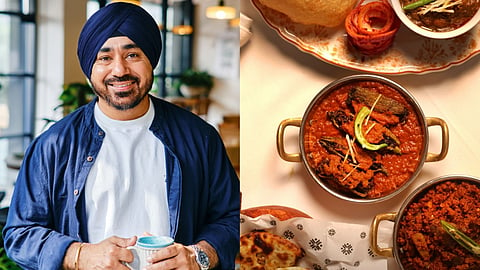
Rajan Sethi has spent the better part of two decades in India's restaurant business. From his early days at KPMG (Klynveld Peat Marwick Goerdeler) to launching a grill and bar in Connaught Place in 2007, to building concepts as contrasting as Ikk Panjab and OMO, his journey through the industry has not followed a straight line. But it is Ikk Panjab, the pre-Partition Punjabi restaurant he founded with his wife Deepika, that has defined the most meaningful chapter of that work.

When the Sethis set out to build Ikk Panjab, they found almost no contemporary references to draw from. The menu was built not from research alone but from lived experience, from recipes that existed in fragments across generations, pulled from the kitchens of their own childhoods: mathi chole, namak-ajwain parantha, seviyan, shakkar ki roti. The dishes on Ikk Panjab's menu are a time capsule to 80 years ago, a freeze-frame of a point when Punjab remained united and undivided. Those meals are now nearly extinct in modern-day India.
It is from that position of deep, specific knowledge that Sethi's recommendations carry weight. What follows is his list, offered with the caveat that it is intentionally short. "Punjabi cuisine, in its truest form, is still largely found in homes rather than restaurants," he says, "and the few places that do it well stand out for that very reason."
Established in pre-Partition India, Kesar Da Dhaba remains one of the most credible addresses in the country for Amritsari culinary heritage. "It remains deeply tied to Amritsar's culinary heritage," says Sethi, "continuing recipes and techniques that originate from undivided Punjab."
Bharawan Da Dhaba is a family-run institution with origins linked to pre-Partition Punjab. Sethi values it for preserving the region's vegetarian food culture in a way that has nothing to do with the butter-forward, restaurant-standardised version of Punjabi food most people are familiar with. "It reflects the cooking styles that predate the line that was drawn in 1947," he says.
Pal Dhaba happens to be a legacy establishment shaped by post-Partition migration into Punjab's urban centres. "It carries forward robust, everyday Punjabi flavours rooted in the region's agrarian food culture," says Sethi. "The kind of food that comes from the land, not from a restaurant kitchen."
Run by the same family, with roots in West Punjab, now Pakistan. "These establishments are part of the migrant story post-1947," Sethi explains, "bringing with them recipes and food memories from across the border and adapting them to Delhi's evolving dining culture." The lineage, he says, is intact.
Sethi considers it one of the more thoughtful international addresses for Punjabi-influenced cooking. "It incorporates Punjabi influences through dishes inspired by North-West Frontier and pre-Partition culinary traditions, interpreted with a contemporary, global lens. The execution is serious."
Not strictly traditional, but Sethi finds it worth understanding in context. "It's an interesting hybrid that draws from Punjabi tandoor cooking and diaspora influences, reflecting how Punjabi food has evolved outside India through migration."
Primarily inspired by Bombay's Irani cafés, but Sethi points to a thread worth tracing. "Certain dishes and flavours trace back to the movement of North Indian and Punjabi migrants across cities and borders," he says. "It subtly reflects that journey."
"A more polished, export-ready format," Sethi acknowledges, "but still rooted in the culinary identity of the region, shaped by chefs drawing from North Indian and Punjabi traditions." Enough rigour, he says, to make it onto his list.
"True Punjabi cuisine is far more rooted, seasonal, and land-driven,” says Sethi. “ It comes from homes, from farms, from community cooking, and often sits at the opposite end of the spectrum from what is popularly served in restaurants today."