
Subscribe
Subscribe
- Motoring
- Style
- Home & Design
- Travel
- Food & Drink
- Specials
- News & Tech
- Videos
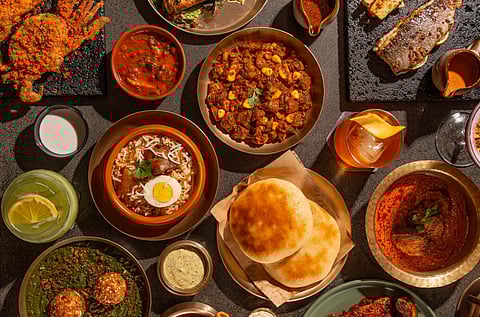
When I first walked into Ikk Panjab in Chandigarh, it felt like walking into a family get-together with a bar manned by an uncle, a Maharaj who had been cooking for your family for generations, and food served on plates passed down from your grandparents. To someone, the maah ki dal tasted like their grandmother’s; another swore the kunna gosht matched a wedding memory from Amritsar. The dishes on the menu were from an undivided Punjab, evoking memories of family kitchens and perhaps a history partially lost. It felt less like innovation or discovery, and more like a recognition of the past.

A few years earlier, in Mumbai’s BKC, I felt something similar at Taftoon, which had recently opened in the middle of India’s progressive-cuisine era. Yet here was a young restaurateur going the other way by serving centuries-old recipes collected through travel, research, and conversation. His menu traced the old Grand Trunk Road, from Kabul to Bengal. There was everything, from the taftoon bread to the Dak Bungalow chicken, a colonial-era dish from Bengal. While others restaurants asked “what if?”, Taftoon asked “what was?”
And maybe that’s where this story really begins—with a handful of kitchens that have stopped chasing the next big thing and started listening to memory.
For nearly a decade, “modern Indian” set the standard for sophistication. Restaurants such as Indian Accent, Masque, and The Bombay Canteen redefined what Indian fine dining could look and feel like. Despite the elevated experience, diners began craving food that felt familiar, yet belonged in a fine-dining room. They wanted comfort served with the same precision and poshness reserved for tasting menus.
The NRAI’s 2024 Report points to a clear trend: diners are turning toward regional flavours and high-quality Indian cooking, even in fine dining spaces. The same diner who books a 12-course tasting on Friday wants kebab and dal on Sunday but plated with finesse, in a space that feels as special as the food.
“We were surrounded by restaurants doing modern Indian,” says Pankaj Gupta, founder of Taftoon. “Instead, I wanted to serve classics exactly as they were meant to be. The real innovation was in staying faithful.” His kitchen includes ustads, or specialists, who’ve spent decades perfecting one dish.
Even the luxury set has taken notice. At The Taj Mahal Palace, Mumbai, Loya redefines grandeur through restraint. The menu celebrates centuries-old techniques like dhungar, dum, and baghar. “Progress isn’t about changing recipes,” says Chef Rajesh Wadhwa, the restaurant's chef consultant. “It’s about changing perception.”
If Loya proves heritage can wear couture, Ikk Panjab shows authenticity can travel. The latter thrives on one simple promise: representation over reinvention. The menu is a love letter to Punjab’s culinary geography, be it Sialkot Masala Raan, Desi Chicken Curry and Chawal, or Tarn-Taran di Jalebi Rabdi. “We’re not reinventing anything,” says founder Rajan Sethi. “We’re representing it.” And the success of Ikk Panjab indicates that it's a reflection of diners ready to reconnect with food that feels like theirs.
Some restaurants don’t chase relevance because they’ve never lost it. Khyber in Mumbai has been serving the same depth of flavour since the ’70s. “We’ve always stayed true to our roots while evolving with the times,” says Ishaan Bahl, CEO of Khyber. “Timeless quality and consistency never go out of style,” he adds.
And he’s right. The Mughal arches, M.F. Husain and Anjolie Ela Menon paintings, and the signature Khyber Raan have seen generations walk through its doors. “What’s trending today,” he says, “has been Khyber’s foundation for decades: tradition, family and community.”
In an age of quick concepts and flash openings, endurance has become the real flex. Folk, Mumbai, distils that same philosophy into something small and personal. Founded by Jasleen Marwah, who began as a home chef, Folk runs on instinct. “I cook the way I always have: from memory and from what feels right,” she says. “That’s what people connect with.” Her food is simple and regional. Always buzzing, Folk shows that being rooted is knowing who you are.
This confidence is echoing far beyond India. In New York, Vikas Khanna’s Bungalow celebrates Indian food with no footnotes or filters. It’s rich, joyful, untranslatable. And Chef Vijay Kumar’s Semma turns Tamil Nadu’s spice and soul into one of the world’s most talked-about tables.
And then there’s Manish Mehrotra, the chef who helped define “progressive Indian” but doesn’t believe in the label anymore. “It’s not modern, it’s not progressive,” he tells Robb Report India. “It’s today’s Indian cuisine.”
The idea that authenticity is about playing it true runs from Mumbai to Manhattan. The next wave of restaurants will be clearer. Expect chefs to move from invention to intention with smaller menus, regional focus, and flavours that taste unmistakably like home. We’ve had our fusion moment, foraging era, and fine-dining breakthrough. Now, the boldest move in Indian food might just be the simplest one: to cook as it was meant to be.