
Subscribe
Subscribe
- Motoring
- Style
- Home & Design
- Travel
- Food & Drink
- Specials
- News & Tech
- Videos
There’s a moment when you step into Jamun, the 153-year-old Goan homestead reborn as a fine-dining sanctuary, where time slows and flavours speak before words do. At Jamun, Goan comfort finds its reflection in both North Indian and regional ingredients. What sets it apart from Goa’s celebrated food resurgence is its innate intimacy: rustic, soul-led hospitality that’s anchored in India’s diversity but grounded in the memories of a family home.
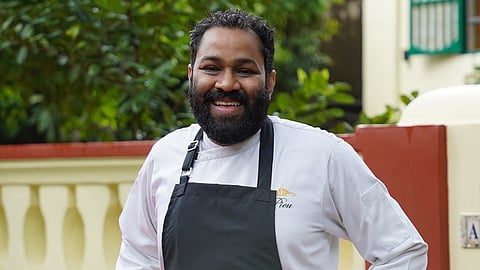
At the heart of Jamun is Chef Rahul “Picu” Gomes Pereira, a culinary rebel with deep roots in Indian kitchens and a gentle insistence on recognising the familiar in every plate. Having started his career at the Oberoi group, Chef Picu now straddles multiple restaurants, including the Asian resto-bar Ping’s, the cuisine-agnostic Saz, and the brand-new Mister Merchant’s at Moira in Goa, which is a celebration of the Middle East.
In this conversation, Chef Picu shares how he bridges legacy and innovation, and how Jamun’s homegrown ethos isn’t just a backdrop.

RR: Can you tell us a little about your journey?
Chef Picu: I was born and brought up in Goa. Growing up in Goa was fun, interesting, and very different from city life. It really exposed me to cuisine, culture, and ingredients. I moved to Mumbai to study at Dadar Catering College [now IHM Mumbai] to pursue culinary arts. After that, I joined the Oberoi Group of Hotels and was selected for one of Asia’s most prestigious culinary programs—the Oberoi Centre of Learning and Development (OCLD).
While at OCLD, I had the opportunity to represent India at the WorldSkills Forum, which led me to work in Australia and Germany for a number of years. Once I completed the program, I continued working with the Oberoi Group for four years.
Eventually, I transitioned into standalone restaurants, which were still fairly nascent in India at the time. That journey led me to head a restaurant in New Delhi, alongside my current partner, Rakshay Dhariwal, and his sister Radhika Dhariwal, at a private members’ club called ATM [At The Maison]. I later partnered with them to open restaurants in Delhi, Goa, Hyderabad, Kolkata, and across the NCR. One of the brands that was born out of that collaboration was Jamun.
RR: In Goa, Jamun is housed in a 153-year-old local home, filled with memorabilia and subtle design details. How does this living history inspire your menus?
Chef Picu: Everything you see on the walls of Jamun Goa - the architecture, the design, the layout, the celebration of fabric, of small knick-knacks on the walls was personally done by us. This has been, and always will be, one of my biggest passion projects.
All of this does inspire the menu, my thought process of coming up with dishes, because it's when you take so much care and love and build out a product, the menu has to reflect that.
RR: What was your thought process when you started creating the menu at Jamun?
Chef Picu: When we started creating the menu at Jamun, the idea was to celebrate Goan food and work with local ingredients and flavours I grew up with. We wanted to offer dishes you don’t usually see on restaurant menus—familiar, comforting, and homely—not something with 15 elements plated so precisely you’d rather look at it than eat it.
It was about using quality ingredients, cooking things right, and incorporating techniques you don’t often see in city kitchens—like wood-fire cooking, smoking, and using terracotta. We’re able to do that in Goa because we have the space and the outdoors. We even bake our own bread in a wood-fired oven, something that’s just not possible in Mumbai or New Delhi. That’s what makes us unique.
RR: High-profile restaurants like Masque, Bombay Canteen, and O Pedro are all celebrating modern Indian cuisine in their own ways. In your eyes, what makes Jamun distinct in this community?
Chef Picu: Well, I mean, Masque, Bombay Canteen, O Pedro—again, all the chefs, Hussain, Varun, and I, are close friends. We each have our own thought process when it comes to food, but what’s common between us is a deep respect for original Indian food and ingredients, and a shared love for celebrating that.
Of course, Masque takes it to another level in terms of fine dining. O Pedro and Bombay Canteen are playful, experimental, and fun. But you can’t really compare each restaurant—we do things more naturally, more earthy, less refined. I wouldn’t necessarily call it ‘real,’ but we try to go back to how food was made 20, 30, 40, even 50 years ago, rather than reimagining it. That said, our new tasting menu is a bit of a reimagination of Goa itself.
RR: Are there home recipes or family memories that have shaped a dish on the menu?
Chef Picu: A lot of home recipes and family memories have shaped this menu. Many of the Goan dishes are based on recipes passed down through generations in my family. One of the rooms in the restaurant is actually dedicated to my family, with photographs of different generations on the wall.
Celebrating history is something I care deeply about. Even with the house and restaurant we’re in, restoring it to its original form was a priority. We really wanted to preserve the elements used in homes back in the day—every bit of construction, every detail.
Preservation, restoration, and celebration of heritage—that’s a big part of our ethos. It’s woven into both the space and the menu.
RR: As Indian cuisine gets global recognition, how do you ensure that regional voices—like Goan—remain prominent and honest?
Chef Picu: Yes, Indian food has definitely gotten global recognition—and it's only growing. I’d love to see Goan food on that world stage someday. A few years ago, Vindaloo made its way across the globe and got people talking. But there’s so much more to Goan cuisine than just Vindaloo. I genuinely believe we’re not far from a breakthrough moment—where more chefs like me feel confident showcasing Goan food to the world. That time is coming soon.