
Subscribe
Subscribe
- Motoring
- Style
- Home & Design
- Travel
- Food & Drink
- Specials
- News & Tech
- Videos
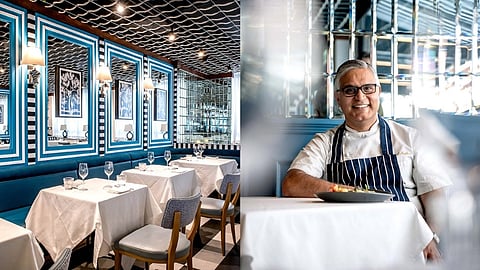
This October, the legendary British Pullman will transform into a moving stage for one of Britain’s most fascinating culinary stories. Its Celebrity Chef Dinner Series—featuring Andrew Wong and Phil Howard—culminates on 24 October 2025 with Atul Kochhar, the first Indian chef ever to win a Michelin star, reimagining British-Indian cuisine aboard the train’s storied Art Deco carriages. In an exclusive interview with us, Kochhar talks about this curation, among other things, and his journey from India to the hubbub of British fine dining.
Robb Report: You are headlining the finale of the British Pullman’s Celebrity Chef Dinner Series this October. How does it feel to bring your food aboard such an iconic train?
Kochhar: It’s an incredible honour. The British Pullman is steeped in history and glamour, so to curate a menu for its Art Deco carriages is like stepping into a living canvas. Food tastes different in motion—when paired with a sense of occasion, luxury, and nostalgia. Growing up in India, I have fond memories of long train journeys with family, eating snacks, sharing stories, and watching the countryside roll by. To now create a five-course menu on one of Britain’s most iconic trains feels like coming full circle. It’s both personal and professional—a chance to tell my story of migration, memory, and identity through food while paying homage to the journeys that shaped me.

RR: You’re crafting a British-Indian menu for this journey. Could you walk us through the inspiration behind it?
Kochhar: This menu is essentially a narrative. Each dish carries a memory or emotion, but also matches the glamour of the British Pullman. For instance, the Beetroot Croquette is inspired by the humble Indian nashta—those quick bites that punctuate travel in India. The Nori & Spice Cured Salmon nods to India’s coasts, where coconut moilee is a staple. Then I’ve done a Chicken Tikka Pie, which brings together Britain’s deep love for pies and North India’s bold masalas—two comfort foods fused into one. The Lamb Saag Gosht pays homage to Punjab, but with an elevated twist, paired with a delicate Keema Aloo Tikki. Finally, dessert is a playful Chocolate Bombe. It has layers and textures, a bit like Indian mithai, so it’s familiar but also surprising. My goal was to make each course a story—of spice, memory, and modern indulgence.
RR: You were the first Indian chef to win a Michelin star. Looking back, how did your journey from Punjab to London shape the way you cook today?
Kochhar: Coming from Punjab, food was always about generosity—tables brimming with flavour, laughter, and hospitality. When I came to London in the 1990s, I entered a fine-dining culture that was rigorous, technical, and precise. The early years were challenging, but they taught me discipline and respect for detail. Blending those worlds—the warmth and spices of India with the refinement of European technique—became my culinary language. Winning a Michelin star was validation that Indian cuisine belonged on the global fine-dining stage, but more importantly, it gave me confidence to experiment without losing authenticity. That spirit guides everything I do, including this menu for the British Pullman.
RR: Many of the dishes seem rooted in memory and migration. How important is storytelling to you as a chef?
Kochhar: Storytelling is everything. Food without context is just sustenance. But food with memory, history, and culture becomes something else—it’s a bridge. Migration has always been about carrying flavours with you, adapting them, and finding comfort in new lands. Britain today is a beautiful example of that; curry is as British as fish and chips. On the train, with champagne flowing and the countryside rolling past, I want guests to feel like they’re part of a cultural journey. Every dish is a little reminder that food is not static; it evolves, travels, and tells the story of who we are.
RR: The British Pullman is synonymous with luxury. How did that influence the way you approached this tasting menu?
Kochhar: Luxury isn’t just about caviar or truffles. It’s about thoughtfulness, balance, and making guests feel cherished. On the Pullman, there’s already a sense of opulence—the velvet seats, the Art Deco chandeliers, the clinking glasses. My job was to match that atmosphere with dishes that are refined yet comforting.
RR: The global high-end culinary scene is constantly evolving. What trends do you see shaping it right now?
Kochhar: One of the most exciting trends is the shift toward authenticity and storytelling. Diners are no longer impressed by just technical brilliance—they want a meal that feels personal and rooted in culture. Sustainability is another big driver; chefs are being held accountable for sourcing, waste, and seasonality, which is pushing creativity in a new direction. There’s also a global curiosity for regional cuisines that were previously underrepresented—whether it’s India’s northeast, Latin America beyond Peru, or indigenous foodways in Australia. Fine dining is becoming less about elitism and more about inclusivity and connection, and that resonates deeply with me.
RR: Finally, what do you hope diners will take away from this experience?
Kochhar: I hope they walk away with more than just the memory of good food. I want them to feel they’ve been part of a story—a story of journeys, both literal and metaphorical. The train ride mirrors my own journey from Punjab to Paddington: carrying flavours across borders, adapting them, and creating something new. At its heart, this dinner is about celebrating cultural synergies—how Britain and India have influenced one another for centuries, and how food continues to be the language that connects us. If diners leave with a smile, a story, and maybe a renewed love for spice, then I’ve done my job!