
Subscribe
Subscribe
- Motoring
- Style
- Home & Design
- Travel
- Food & Drink
- Specials
- News & Tech
- Videos
AI generated summary, newsroom reviewed
The last time a ship left Saint-Nazaire and genuinely changed the way the world thought about ocean travel, it was 1935, and the vessel in question was the Normandie. Nearly a century on, the same Joubert graving dock — the very berth where the Normandie took shape — has produced something that deserves to be spoken of in the same breath.
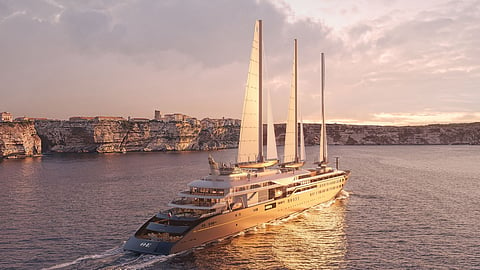
Orient Express Corinthian was named on April 29, 2026, before an audience that included a French government minister, a bottle of Balthazar, and four Fouga Magister jets trailing the tricolour across the sky. The yacht is 220 metres long, displaces 15,000 tonnes, flies the French flag, and moves when conditions allow, which is on wind alone. This is, by some margin, the largest sailing yacht the world has ever seen.
The wonder of the vessel is not merely the scale, though the scale is staggering. It is that Orient Express and shipbuilder Chantiers de l'Atlantique spent 10 years working out how to make a vessel of this size sail properly and then actually did it.

The answer is the SolidSail: three rigid rigs, each spanning 1,500 square metres and rising to over 320 feet, fully automated and capable of rotating through 360 degrees to maintain perfect trim on any point of sail. Carbon masts that slant to 70 degrees mean the yacht threads beneath the world's great bridges without struggle. During sea trials in February 2026, the ship made 12 knots in 20 knots of wind, under sail alone. In simpler terms, with strong enough wind, the boat could move efficiently just by wind power, reaching 12 nautical miles per hour. No ship of this size had managed that before.
Where the wind falls short, hybrid liquefied natural gas propulsion takes over. An AI system scans continuously for marine mammals ahead; dynamic positioning replaces anchoring entirely, leaving the seabed undisturbed below. The result is the best Energy Efficiency Design Index rating in the class by a considerable distance.
Architect Maxime d'Angeac drew his interiors from the golden age of ocean travel, the great liners, the original Orient Express train, and rendered them in a spare, contemporary hand. Close to 2,000 craftsmen, artists, and ateliers — all French — contributed to what passengers will actually see, touch, and sit in.
There are 54 suites ranging from 45 to 230 square metres across four decks, each with a 3.6-metre panoramic window and ceilings raised 25 centimetres above anything else afloat. Leather, precious wood veneers, and marble. A personal butler per cabin. Five restaurants under Michelin-starred chef Yannick Alléno. Eight bars, including an art deco speakeasy. A 115-seat cabaret. A Guerlain spa. A 16.5-metre swimming lane. A marina. Everything here is fully inclusive, and the word "indulgence" barely covers it.
Having left Saint-Nazaire on May 2 bound for the French Riviera, the Corinthian will work the Mediterranean and Adriatic through summer, cross the Atlantic in autumn, and spend winter in the Caribbean. From 2027, the marine carriage reaches further — the eastern Mediterranean, Northern Europe. The sister ship, Orient Express Olympian, launched from the same yard just 12 days earlier and is already being fitted out.
The itineraries range from one to four nights — brief enough to pair together, yet long enough to ease into the slow, unhurried rhythm that defines the experience. The era of the sailing liner is not making a comeback; in many ways, it is only just beginning.