
Subscribe
Subscribe
- Motoring
- Style
- Home & Design
- Travel
- Food & Drink
- Specials
- News & Tech
- Videos
AI generated summary, newsroom reviewed
We reached Wari La just around noon and found a spot near a small glacial stream. Monk Gyalten Samten settled into a cross-legged position and between us lay a carpet of wildflowers, their fragrance released by the afternoon heat. Closing my eyes, the roar of the modern world was replaced by the gurgling of water and the rustling of the wind. Then came the chanting that filled the silence of the pass. As the final notes drifted away into the air, the peace remained something that is becoming the region’s most sought-after offering.
Beyond the prayer flags and the jagged, snow-dusted peaks, a wellness scene is quietly flourishing in Ladakh. This is not the world of saunas and clinical luxury spas. Instead, wellness experiences in Ladakh are rooted in the land and its ancient Buddhist traditions. From private meditation sessions with monks to foraging for medicinal herbs, the focus is on a complete physiological and spiritual reset.

“In a world where wellness is often packaged and prescribed, Ladakh offers an environment where healing is intrinsic,” says Stanzin Tsephel, founder of the boutique hotel Stonehedge Ladakh in Nubra Valley. “True wellness needs inner peace, physical ease and a supportive environment.
Ladakh is one of the few places where all three come together seamlessly.”
At Stonehedge Ladakh, this philosophy is applied through the practice of Sowa-Rigpa, one of the world’s oldest living medical systems. During my stay, I had my first amchi (traditional doctor) consultation. Unlike modern medicine, the diagnosis was slow and intentional, centred entirely on the pulse. By reading its subtle variations, the amchi mapped my constitution, identifying shifts in the three energies: lung (wind), mhris-pa (bile) and bad-kan (phlegm).
I was prescribed a blend of foraged Himalayan herbs specifically to address my lingering allergies and gut issues. Sowa-Rigpa shares deep roots with ayurveda and remains the primary traditional healing system across the Himalayas. For centuries, it was the only medical care available in Ladakh, and even today, it remains central to local life. Amchi doctors are highly respected not just as practitioners, but as spiritual representatives of the Medicine Buddha.
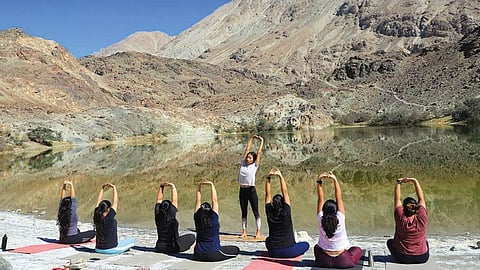
In Leh, the luxury retreat Dolkhar approaches wellness as a series of immersive rituals. At the spa Tsas, the experiences range from Himalayan treatments using indigenous herbs to plant-forward culinary explorations, where seasonal ingredients are sourced from local farms. Guests can engage in dawn chants at Thiksey Monastery or yoga sessions on the terrace.
“At over 3,500 metres, the landscape imposes a certain discipline. The air is thinner, movement is slower, and the body becomes more aware of itself,” says Rigzin Wangmo Lachic, founder of Dolkhar. “This natural deceleration, combined with silence and minimal sensory clutter, creates conditions that are inherently restorative.”
Beyond the monastery walls and luxury retreats the landscape of Ladakh itself proves to be restorative. Long, arduous treks at high altitude meadows 15,000 feet above sea level demand a complete focus on breath. In the Nubra Valley, these walks often lead to riverside picnics where meals of local grains, soups bubbling with dumpling and apricots are served against a backdrop of the Saltoro and Karakoram ranges
These treks are often accompanied by an amchi, who helps guests forage for wild garlic (yarkun), sea buckthorn, stinging nettle (zadtsod) and medicinal herbs like ephedra and myricaria used in Sowa-Rigpa medicinal baths to alleviate stiffness and numbness of the veins.
“There is satisfaction in gathering these ingredients—some destined for the evening’s soup, others to be dried and ground into traditional remedies. By the time you reach the riverside for a picnic, the physical exertion of the trek has shifted into a deeper awareness of the land,” says Tsephel.
Further into the Nubra Valley, the wellness programme at Lchang Nang Retreat, an eco-conscious luxury hotel, is structured as a living history, retracing the ancient Silk Route. The four-night journey begins with a blessing at Ensa Monastery, a ritual once sought by caravan traders before they crossed the formidable passes. This historical immersion continues with therapeutic visits to the natural hot springs of Panamik and guided treks through the Tirisha forests.
The highlight of the trip is an intimate audience with an onpo, or village astrologer. Unlike Western astrology, an onpo uses ancient Tibetan charts to provide insights into one’s life. The experience is less about prediction and more about understanding one’s alignment with the elements. Guests spend the nights in a luxury tented camp, dining under the stars by a campfire just as the nomads once did.
Ladakh’s appeal lies in a commitment to tradition over trends. The rituals don’t feel like performances, but practices that have survived for centuries. My time here taught me that the best medicine is often the simplest like the steam of a natural hot spring, the slow chant of a monk, or a bowl of foraged-herbs broth. I came looking for a retreat but found something more permanent—a reminder that healing happens best when we finally stop rushing.