
Subscribe
Subscribe
- Motoring
- Style
- Home & Design
- Travel
- Food & Drink
- Specials
- News & Tech
- Videos
AI generated summary, newsroom reviewed
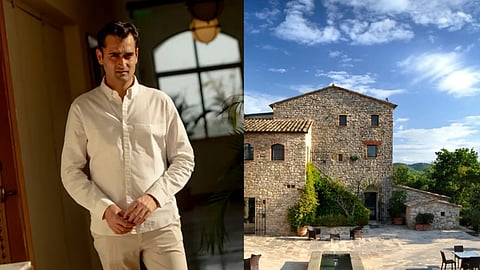
Yash Malhotra grew up watching and learning from the hospitality business up close at his family's restaurant in Kanpur. That early education followed him to Cornell University and then to New York, where he spent his days surrounded by independent hotels and designers. It was there that his idea of what a hotel could be began to take proper shape.
That ambition now lives as Hotel Irada, a 32-key luxury property built on a 66-acre former winery estate which was once the country retreat of businessman Vijay Mallya. The place is wrapped in 4,000 acres of untouched forest in Pune's Daund taluka and every corner of it carries Yash's fingerprint, from interiors by Humming Tree to wellness spaces shaped by Nyāsa Wellbeing, right down to the padel courts and the forest plunge pool.
Like every good idea, Irada too draws from a range of influences. Here, Yash shares the five international stays that left a mark on him, and, in turn, on Irada itself.

Of everything on this list, Yash points to Costes as the one that shaped Irada most and it is easy to see the courtyard, the way the music is programmed almost like a set list and the sheer detailing of the Castiglione wing.
Tucked along the Rue Saint-Honoré, close to Place Vendôme and the Tuileries Garden, Hôtel Costes has been the last word in Parisian glamour since brothers Jean-Louis and Gilbert Costes opened its doors in 1995. Interior architect Jacques Garcia took the 18th-century mansion and gave it a dark and velvety ambience. As the hotel grew to absorb the neighbouring Hotel Lotti, designer Christian Liaigre brought in a more contemporary counterpoint so the property now moves between old-world opulence and clean modern lines.
Costes has also changed hospitality in a quieter way, by turning its in-house DJ sets into bestselling lounge albums and giving hotels everywhere a reason to think seriously about sound. Even its scent is bespoke created with perfumer Olivia Giacobetti, so the whole experience, sight, sound and smell feels very composed.
Yash speaks of this one almost like a home and he puts that feeling down to Fabrizio Casiraghi's interiors and the custom Piaggio tuk-tuks that ferry guests about. Long before Saint-Tropez became shorthand for glamour, La Ponche was simply a fisherman's bar tucked into the old town overlooking the Mediterranean. Over time it turned into a meeting point for the French New Wave crowd, writers, painters and actors who wandered in for a drink and stayed for the view.
The place also earned a permanent place in film history as the backdrop to Roger Vadim's 1956 classic And God Created Woman, starring Brigitte Bardot. Picasso, Sartre, Simone de Beauvoir and Romy Schneider all passed through its doors at one point or another, which gives the place a lived-in, storied feel that no amount of money can manufacture.
Today the hotel holds just 21 rooms and suites and many opening onto private terraces that look out over the sea or the lanes of the village below. Artwork and lithographs connected to the hotel's history, some from former owner Simone Duckstein's own family, still hang on the walls so the past never quite feels far away.
Walking into Mamounia, Yash says, feels like stepping onto the set of a Bond film. Part of that magic comes from a hidden network of tunnels running beneath the property, which keeps staff moving discreetly out of sight for the seamless service.
Set right against the 12th-century ramparts of Marrakech's old medina, facing the Koutoubia Mosque, La Mamounia has spent close to a century being the grandest address in the city. Its name comes from the Arabic for safe haven, tracing back to gardens gifted by Prince Al-Mamoun in the 18th century and over the decades the hotel has welcomed guests as varied as Winston Churchill, Nelson Mandela and Charlie Chaplin. The design leans hard into Moroccan craft with intricate zellige tilework, carved wooden screens and mashrabiya windows and it is layered with art deco that keeps the whole thing feeling contemporaray.
Between the 135 rooms and 71 suites, plus three secluded riads with their own kitchens and round-the-clock butlers, there is something for everyone. The food alone is worth the trip with Moroccan dishes from chef Rachid Agouray, Asian plates by Jean-Georges Vongerichten and pastries from Pierre Hermé all under one roof. And then there are the gardens, seventeen acres of olive groves, citrus trees and rose blossom, which is really what gives Mamounia that cinematic, larger-than-life feeling.
Yash sums this one up in two words, pure ambition and once you see the place, it is hard to disagree. Perched high on a hilltop above Porto Heli on Greece's Peloponnese coast, Amanzoe was built to feel like a modern-day Acropolis.
And it delivers on that promise with panoramic views that sweep across olive groves and out to the Aegean Sea. The architecture leans into classical Greek references, colonnaded pavilions, cool marble surfaces and still reflection pools, so the whole resort feels more like a piece of ancient design that happens to have excellent room service. There are 38 Pavilions and private Villas scattered across the hillside and nearly all of them come with their own plunge or infinity pool.
The resort's Aman Spa is famously extensive and dining ranges from Mediterranean classics to Japanese cuisine, so you are never short of a reason to linger at the table. A private Beach Club rounds things off nicely. Getting there is part of the experience too, whether that's a 2.5-hour drive from Athens, a scenic 25-minute helicopter transfer, or a hydrofoil ride from Piraeus, each option setting the tone for the calm that awaits on arrival.
Yash hasn't made it to Reschio yet, but he is quick to admit it sits right at the top of his list of most anticipated stays. Straddling the border of Umbria and Tuscany, Reschio is a private estate with a thousand years of history behind it as it spreads across more than 3,700 acres of hills of olive groves and oak woodland.
Count Antonio Bolza bought the estate in a state of near ruin back in 1984, and it was his son, architect Count Benedikt Bolza, who spent three decades bringing it back to life. The result blends genuine medieval architecture with understated kind of luxury. At the heart of it sits Castello di Reschio, a 36-key hotel inside the old castle itself, with every room designed differently.
Food is taken seriously here, with produce from the estate's own organic gardens and vineyards making its way onto the tables at Ristorante Al Castello and Ristorante Alle Scuderie. Beyond the kitchen, there is a striking Bathhouse spa, an equestrian centre with Spanish-bred horses, tennis courts and an outdoor pool with a mirror-like finish that has become something of a signature image for the estate.