
Subscribe
Subscribe
- Motoring
- Style
- Home & Design
- Travel
- Food & Drink
- Specials
- News & Tech
- Videos
AI generated summary, newsroom reviewed
Think Berlin and what usually springs to mind is its storied techno scene (Berghain, here’s looking at you), operas, Döner Kebabs and pretzels, leafy parks and lakes where locals and tourists soak up the spring sun, and not to mention, the Berlinale. But the German capital is equally famous for its superb state-run museums, a burgeoning gallery scene and the constant influx of artists and creative minds from around the world whose arrival and cross-cultural engagement have given the city a character vastly distinct from other European towns.
To better understand Berlin’s fascinating history, start with the UNESCO World Heritage site of Museumsinsel, or Museum Island. One of the city’s best-loved cultural spots, the museums inside the 200-year-old Museumsinsel offer a unique insight into Berlin’s history — in fact, into European history. Wandering around this cathedral-like complex, it is easy to see both Berlin’s historical scars and its remarkable resilience. The city is torn between its imperial past and urban future, and a visit to the Museumsinsel reveals both the city’s paradoxes at once.

With its treasure trove of antiquities — the vases, bronzes, busts of Caesar and Cleopatra, Old Master paintings and Roman sculptures, you name it — the Altes Museum is one of the most important state institutions spotlighting Prussian cultural might. The Altes houses the largest collection of Etruscan art outside of Italy. Designed by urban planner and architect Karl Friedrich Schinkel at the behest of King Frederick William III, the neoclassical-style building — supposedly inspired by Greek antiquity — first opened its doors in 1830.
If the Louvre Museum boasts the Mona Lisa, the Neues Museum in Berlin features another of the world's most recognisable faces in visual culture — the limestone bust of Queen Nefertiti. The Alte Nationalgalerie, on the other hand, celebrates 19th-century art. It recently inaugurated a blockbuster show honouring nature-based experiments from Impressionism and the classical modernist period, drawn from the collection of legendary art dealer Paul Cassirer (1871–1926.
Originally a railway terminus in the 19th-century, Hamburger Bahnhof — Nationalgalerie der Gegenwart is a major hub for contemporary art today. It displays art from all over the world, usually juxtaposing it with Germany's homegrown greats. Artists like Lina Lapelytė, Shilpa Gupta and Petrit Halilaj are currently having their finest shows in this museum. Our very own Shilpa Gupta's What Still Holds has been staged as a historical dialogue between her and the post-war German master Joseph Beuys. Not surprisingly, Hamburger Bahnhof houses an enviable collection of Beuys, featuring large works like Das Kapital Raum (1977-1980) alongside smaller yet equally striking pieces, such as the iconic yellow light bulb plugged into a lemon. Born in Kosovo and now living in Berlin, Petrit Halilaj's solo presentation An Opera Out of Time within one of Bahnhof's cavernous halls, reimagines the Kosovo war. Till Fellrath, one of the directors of Hamburger Bahnhof, notes that the museum "not only presents art history, but actively supports and advances artistic creation at the forefront of our times.”
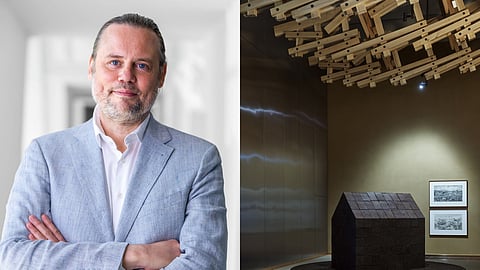
Opposite Museumsinsel lies the site of the Berlin Palace — now home to the Humboldt Forum. Taking its name from the Humboldt Brothers, Alexander and Wilhelm, the Humboldt Forum building houses, among other museums, the Asian Art Museum. Its mission is to collect, promote and preserve the outsized universe of Asian art, covering a diversity of art from South, Southeast, Central and East Asia, from its early beginnings in the Indus Valley civilisations and ancient China to relatively contemporary expressions. "Our so-called permanent exhibitions are far from permanent," smiles Raffael Dedo Gadebusch, who has been the head of the Asian Art Museum since 2018. Anchored in queer and migrant experience, its new show Nothing As Our Ground is a case in point. Envisioned by guest curators Minh Duc Pham and Hai Nam Nguyen, it explores ideas of family and connectedness through the disparate lenses of a wide-ranging group of artists.
Speaking to Robb Report India, Gadebusch recommends visiting Gropius Bau for its ambitious programming and the Neue Nationalgalerie, Ludwig Mies van der Rohe's modernist architectural masterpiece, which is currently in the news for hosting a rare Constantin Brâncuși retrospective. "Our museums and their collections can outclass those in London, New York and Paris," vouches Gadebusch, suggesting yet another hidden gem visitors must include in their itinerary — the Sammlung Scharf-Gerstenberg Collection. This museum tells the story of the art of the fantastic, starting with Giovanni Battista Piranesi and Francisco de Goya and culminating in masterpieces of surrealist art, which forms the bigger part of the collection. "It's a stone‘s throw away from Berlin’s Charlottenburg castle, which gave its name to one of the coolest neighbourhoods in Berlin," he explains.
Julia Ballantyne-Way, who runs the Société gallery in the Charlottenburg area, recommends visiting Berlin during either Gallery Weekend in May or Berlin Art Week in September. “Berlin’s gallery landscape has evolved through communities of artists, collectors, curators, and cultural institutions developing alongside one another,” she tells us, explaining that for a long time, Mitte was the centre of Berlin’s gallery scene, particularly following the shift of Germany’s art world from Cologne to Berlin in the 1990s.
Over the past decade, Charlottenburg and Schöneberg have emerged as cultural hubs, with a growing concentration of galleries, institutions and collectors. “Beyond these, there are also exciting contemporary art spaces in Neukölln, including KINDL: Centre for Contemporary Art and Spore Initiative, which are worth exploring,” she suggests.
Spending my last day in the city exploring the East Side Gallery, I could viscerally feel what it must have meant to live during the repressive days of the Berlin Wall. The Wall came down in 1989. But East Side Gallery’s murals continue to serve as a grim reminder of the Cold War and all the historical trauma of Berlin’s Nazi past. "Berlin doesn’t have the elegance of Paris, the urban density of Milan or Madrid, but you breathe a kind of freedom, candour and openness that you will not encounter in any other European city," quips Gadebusch.