
Subscribe
Subscribe
- Motoring
- Style
- Home & Design
- Travel
- Food & Drink
- Specials
- News & Tech
- Videos
As the hooded 1975 Land Rover made its way through the tropical forests of the Golden Triangle, my anticipation grew thick. “Are we going to stay inside the forest?”
I was at the Baan Boran, which translates to “House of Antiques” after the antique carvings throughout the property, originally built in 1989 by architect Mon Luang Tridhosyuth Devakul, a descendant of the Thai royal family, now known as the Anantara Golden Triangle Elephant Camp & Resort. Perched atop a hillside on the misty highlands where Thailand, Laos, and Myanmar converge along the Mekong River, the region, once synonymous with the opium trade, has undergone a striking metamorphosis and redefined itself as one of Southeast Asia’s most compelling luxury escapes.
Today, the Golden Triangle beckons discerning travellers with the allure of its undulating mountain ranges, cooler climes, and richly layered cultural heritage. Ancient hill tribe community life thrives here, still—among them, the Akha, Yao, Lahu, Lisu, Hmong, and Karen—each shaping the spirit of the land. Steeped in tradition, yet open to discovery, this borderland offers an immersive experience where history, nature, and soul-stirring beauty come together with Asiatic elephants for company.

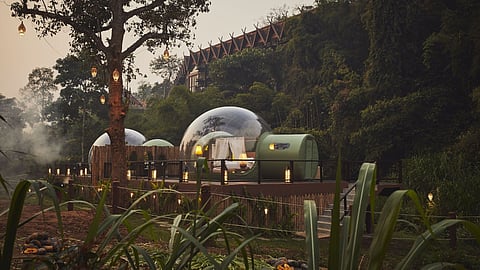
My mystique transformed into awe as we approached the ‘Jungle Bubble’, the resort's star offering. Built by SkyBubbles, the climate-controlled tents are round, with entry ways that come with a single set of warning, “Not to open both doors at the same time”. The inflatable tents come replete with a four-poster bed, and amenities include a pool attached to the deck itself. But it also offers something priceless. An open deck watching just over the enclosure where two elephants spend the night with you!
A thrilling ambience, made safe by the presence of these gentle giants. In my case, I spent the night with Dah, a 36-year-old nanny to the 6-year-old Shop Tek. They seemed at ease with our presence. While I sat down for a lavish dinner spread brought in by the team at Anantara in classic pinto style boxes, the two elephants nodded along the grass patch that was carefully grown, so they don’t run out of food at midnight. It’s a clever proposition. As the night sky lit up with stars on the unlikely monsoon night I spent there, the animals grew familiar, their incessant chomping catching a rhythm that felt just right for a night in the jungle. Amid the sounds of crickets and an occasional trumpeting, the night was peaceful, and I slept like a baby in the comfort of the bubble. The experience ends post tea in the morning, and knowing that, I woke early to spend a few last hours in the close presence of the elephants. What happened next was a memory so beautiful that it will be etched in my mind forever.
I was watching Dah intently as she masterfully managed the grass rake to scratch her underbelly, and suddenly, she saw me. A happy nod and a few quick steps forward, her trunks reached my hands with a delicate urge, “What about breakfast?” If only she could say the words. But she waved at us gently, gesturing her trunk to her mouth, and in that moment, I became so intently involved in this surreal interaction that the bee sting on the back of my neck came only as a “gift from nature”.
Leaving the bubbles behind, the breakfast bore further surprise. Held on a canopy 52 metres high, you are raised along with the paraphernalia to a 360-degree view of the valleys of the Triangle. Walkie-talkies supply confidence as the team communicates about any requirements or fears. The unhindered views will make you wander several times through the Pinto-style breakfast, each course having three different items. Predictably, I slurped on my dessert course with great enthusiasm, wiping off the mango sticky rice while watching the golden spire of Laotian temples on one side and a Burmese pagoda on the other.
Upon descent, I went back to my belongings at the Mekong Explorer Suite that I occupied the day before. Paying homage to intrepid travellers who charted the Mekong River centuries ago, fusing the rich traditions of the Lanna Kingdom with refined colonial influences, the suites offer ‘three country views’ from its outdoor balconies. But my room for the day was to be the Mekong Explorer Tent at the top of the hill. Leaving the Baan Boran, the same vehicle took us on a steep uphill ride, passing by the SkyBike station to my tent. The circular tent looks rustic, but offers very modern charms of tent living. Equipped with an outdoor roll-top tub and an infinity pool with daybeds, it offers an exclusive living, with a personal butler at service.
My hands were washed in a Lanna ritual before entering the tent. Dark wood panelling and intricate elephant motifs evoke the essence of Asian heritage, while vintage chests, embellished with antique brass hardware and leather straps, add a touch of old-world glamour. Handcrafted furniture and locally sourced artefacts immerse guests in the region’s rich culture, with sustainable teas from Sawanabondin, chocolates from Kad Kakao, homemade elephant-shaped butter cookies, and a Praewa cloth bag, traditionally used by hill tribes in the Lanna region.
Built with care, nearly two decades ago, the property sparks an emotive connection with the rescued elephants and their mahouts, one that is unlikely to fade from the memory of every guest.
Pricing: The Jungle Bubble experience starts from $820 (INR 71,818 approx.) per night, including a night stay and sunset dinner for two. The Two-Bedroom Jungle Bubble Lodge experience starts from $1,300 (INR 1,13,769 approx.) per night, including a private chef, butler service, and sunset dinner experience for four.