
Subscribe
Subscribe
- Motoring
- Style
- Home & Design
- Travel
- Food & Drink
- Specials
- News & Tech
- Videos
AI generated summary, newsroom reviewed
If there is one place where cutting-edge comfort, authentic adventure, soul-searching moments, unimaginable expanses and heart-warming sustainability and conservation come together seamlessly, it is Great Plains Conservation Camps in Kenya. Founded by award-winningfilm makers, conservationists and National Geographic Explorers Derek and Beverly Joubert, Great Plains has emerged as one of the defining names in high-end safari travel, reshaping the industry through a model that places conservation, privacy and emotional immersion at the epicentre of the guest experience.
Great Plains Conservation operates camps from three safari destinations in Botswana, Zimbabwe and Kenya, with Kenya emerging as the most popular among Indian travellers, due to the convenient direct flights from Mumbai to Nairobi. Yet beyond just accessibility, Kenya also offers a uniquely diverse safari experience, with properties that embody the polished elegance and luxury associated with the Relais & Châteaux name to camps that feel more remote, exploratory and immersed in the landscape. Mara Plains and Mara Nyika offer a combination of exceptional comfort, design and highly personalised services with unmatched wildlife access, while Ol Donyo leans more into adventure, with horseback safaris, walking tours, open air beds and a stronger connection to the wilderness. Together, they reflect what modern-day safari travel stands for i.e., luxury, adventure and a strong connection to the place.

What truly distinguishes Great Plains from all other safari camps is that conservation is not just an add-on to the guest experience but the foundation upon which the camps are built. Their mission is to conserve and expand natural habitats in Africa through innovative conservation initiatives with a long-term commitment to the environment, wildlife and local communities. Each camp and every decision is based on the idea that wildlife and the people who live alongside it must benefit from the tourism or the entire model would fall apart.
Great Plains operates inside private conservancies in the Masai Mara and Chyulu Hills rather than in overcrowded public reserves that define most Kenyan safaris. These conservancies enforce hard caps on the number of camps and vehicles that are permitted on the land. This is, however, not designed to be a selling point but a structural limit that keeps ecological pressure on the land manageable. Across the area, critical wildlife corridors and migration routes stay open as landowners receive payments, incentivising them and making conservation an economically rational option for them. Furthermore, Ol Donyo sits within 275,000 acres of Masai land in the Chyulu Hills and the revenue generated here is returned to conservation operations and the communities and tribes that inhabit the land.
Great Plains does not treat luxury and responsibility to the land as competing priorities but as factors that facilitate each other. A night in one of their camps does not cost the environment but is in fact what allows conservation to run.
Conservation, perhaps unexpectedly, is also the ultimate luxury as for travellers this model changes the safari experience entirely. National parks often come with crowds, with dozens of vehicles converging on a single lion sighting, all looking to capture the same perfect picture. The conservancies, on the other hand, operate differently, with fewer vehicles, fewer camps and a safari that retains its magic when it does not feel choreographed for mass tourism. At Great Plains, overrun tourism is traded with genuine immersion and exclusivity. Off-road driving, night safaris, guided walks on foot, experiences that are typically prohibited in national parks are just the beginning. Beyond this, it is the personalisation of pace and encounters that guests remember; guides have the opportunity to build each drive around what the guests want to see, with the chance to follow an animal across open grounds, sit with a sighting for as long as they wish, and not be rushed or constrained to park timings and rules.
It doesn't just stop at the safari either, the cultural immersion of guests is just as personalised and not performative. Travellers can spend time with local and tribal Masai communities, not as staged village visits but as genuine engagement with the people whose ties to this land go back hundreds of generations. Giving travellers the opportunity to understand the relationship between preserving historic communities and modern conservation, this adds a layer of meaning that no other safari can come close to offering. Furthermore, this connection is not just staged for guests but is how Great Plains operates on a day-to-day basis. The people running community engagement, managing conservation logistics and liaising between camps and local landowners for Great Plains are themselves from these communities. They grew up on the land, meaning that the cultural exchange that travellers experience isn’t brokered from the outside, but comes from the people who have a personal stake in what’s being protected.
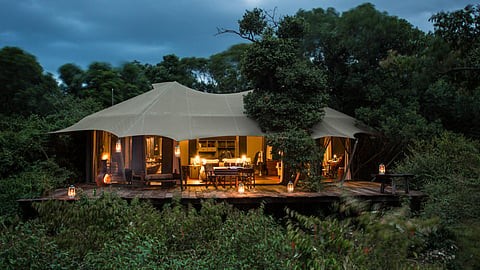
Conservation might be the foundation but luxury is woven into every aspect of the experience. At Mara Plains and Mara Nyika, the camps are designed with the golden age of East African exploration in mind, canvas suites with copper tubs, antique furnishings, private decks, wine cellars and libraries. The service is personal and precise, something that can only be achieved with small properties. The experiences are no less impressive: private bush breakfast, sundowners on the plains, hot air balloon flights above the Mara, photography focused drives with professional equipment provided by the camp. These Relais & Châteaux properties do not disappoint.
Ol Donyo, in the Chyulu Hills, has a slightly different energy; it is more remote and cinematic. Private villas with plunge pools and fireplaces looking toward the open savannah and Kilimanjaro. The property has rooftop beds, allowing one to sleep under the stars and has a variety of day excursions that include horseback riding, guided bush walks, helicopter tours or a spa treatment with a view.
The camps are beautiful, wildlife is extraordinary and the conservation is real. But what guests take home isn't a photograph or a highlight reel, but the sense that they were somewhere that mattered, alongside people who understood who intend to keep working for it long after you've left.