
Subscribe
Subscribe
- Motoring
- Style
- Home & Design
- Travel
- Food & Drink
- Specials
- News & Tech
- Videos
Two kilometres. It had been two kilometres, and there was no human being to be seen. It was unbelievable. But that was the magic of Mongolia.

I recced the Great Indian Desert, made the whole route, and crossed it in 76 hours—without sleeping. I zipped through 1,222 kilometres. I did it again with my friends a year later.
We were about eight Jeeps with my staff, musicians, cooks, and drivers—25 friends and 30 crew members, 55 in total. It was in collaboration with Jeep and we called it the Legacy Drive by Jeep India.
While crossing, we had already decided that next it had to be the Gobi Desert. The idea is simple: to cross deserts around the world.
The idea is simple—it’s about being together with friends on a journey where nothing is easy. You’re not checking into five-star hotels. You pitch your own tents, cook your food, wash utensils, clean clothes on riverbanks—everything. We did that for 24 days.
When we decided on the Gobi Desert—basically Mongolia—we started from Ulaanbaatar, crossed the Gobi, went into the Altai Mountains, and finally did the Mongolian steppe.
We first made the route at home—me, my brother, and my friend, Oliver Sinclair. Then we got in touch with two companies that run horse safaris in Mongolia. They gave us suggestions—areas we should definitely explore. After that, we researched further: if midway we could turn left or right to explore more, then continue ahead. Finally, we mapped the whole route on Gaia GPS, an app usually used by the American army for exact tracking.
We designed the route here in India, and then I convinced my friends. Out of many, only 10 agreed. Mongolia is the coldest desert (if the polar deserts are not included)—and so beautiful. This helped convince my friends.
We were a group of batch-mates and schoolmates, all from Mayo College, Ajmer. Everybody was good at something, and I handpicked each one of them. I knew they would add value to the trip.
For example, Pratap Kanota, who runs beautiful hotels in Jaipur—Narain Niwas and Rajmahal Palace—is a brilliant cook. He and I planned the entire menu. Based on that, we bought groceries, shipped them to Mongolia via our travel agent, and then made a master checklist of over 100 items, even specifying quantities.
It was very detailed. Everyone was amazed—it made things so much easier. We carried cameras, drones, GoPros, sound equipment—everything. We shot the whole thing together as a team. My brother worked with Oliver to design the route so we wouldn’t miss anything. Raj handled admin work in Ulaanbaatar. Everyone had a set duty—without brilliant coordination, nothing would have been possible.
We mapped the route, finalised the cars, and flew into Ulaanbaatar via Hong Kong. Once there, we checked into a hotel, partied that night, and the next day went to the agent’s workshop to see the cars, spare parts, translator, and mechanic. We also bought groceries. The first day was crucial—we got everything ready, chilled, slept early, and set off at 5:30 am.
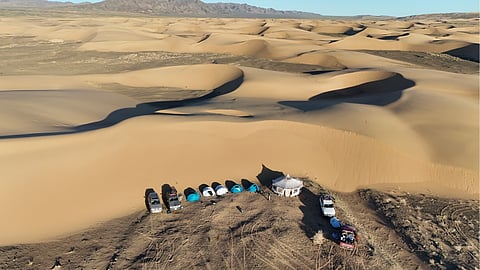
At the beginning of the Gobi Desert, we stayed behind a massive dune—it was beautiful. In Altai, the mountains revealed stunning landscapes—breeding grounds of the great Indian swan and other birds. We stayed for two days at a crystal-clear lake, entering around 10:30 am and leaving at 9:30 pm. Behind us was the desert, and in front—endless water. That lake, around 27 kilometres wide and 117 kilometres long, felt like an ocean.
That was the end of the mountains. We had traversed three distinct terrains in one journey.
One day, while riding, we saw hills layered with red, green, and blue. I thought, “Is this really happening?” I said, “We’re camping here tonight,” turned the wheel, and went straight toward the range. We found a protected ravine and set up camp.
The Khongoryn dunes and that lake were unforgettable. Around the third or fourth day, we climbed dunes about 300 metres high in minutes. At the base, a small stream of chilled mountain water flowed. Beyond lay dunes stretching 300 kilometres in length and 40 kilometres across. That evening, I witnessed the most beautiful sunset of my life.
Oliver and I always rose at first light for drone and sunrise shots, no matter how late we’d slept. Then we’d wake everyone else. Morning routine included a jog, shaving, and cleaning up—but water was scarce, so every drop mattered.
Breakfast was usually leftovers from dinner, reheated. Packing up took at least three hours—it was like moving houses every few days. We drove from 10 am to about 2 pm, stopping wherever we wanted. Lunch was an hour-long break—noodles and sausages. Small mining settlements appeared once every seven days, so we carried at least four days of groceries.
By 5:30 or 6 pm, we’d start mapping the area, decide where to pitch camp, and by 6:30, begin setting up tents. The first tent was a big circular one—20 feet by 20 feet, 12 poles. With 12 people holding one pole each, it went up in five minutes. Music, speakers, and full-on celebrations followed every night.
We had a Starlink connection for one hour a day to talk to our families, then switched it off. We came to be away from everything.
If you want peace in your life, go to Mongolia for a month. You’ll come back a completely different person. The desert itself—it’s so soft, almost therapeutic.
− As told to Bayar Jain