
Subscribe
Subscribe
- Motoring
- Style
- Home & Design
- Travel
- Food & Drink
- Specials
- News & Tech
- Videos
AI generated summary, newsroom reviewed
It’s past midnight. Groggy-eyed, I check my phone. I’ve completely lost network. I check the WiFi; it’s wavering. I walk up to the teal door of my room and there’s nothing as far as my eyes can see. Panic strikes and I consider using one of the emergency phones lining the pathways reserved, as you might guess, for emergencies.
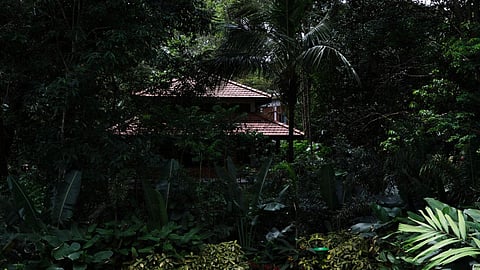
‘Look for five things you can see,’ I console myself, thinking of the 5-4- 3-2-1 grounding technique for anxiety. I see a dead phone, an empty room, an open-air shower, a coffee machine with fresh coffee beans (a welcome departure from the coffee pods now a signature at most hotels), and an inviting bed with plush pillows. I’m inside one of the Forestlight villas at The Leela Coorg Forest Sanctuary. ‘Four things you can touch,’ I remind myself. The wooden flooring beneath my feet, the room’s laterite stone walls, the cold brass doorknob, and the linen of the bed.

‘Three things you can hear.’ I stand still in my tracks, trying hard to focus. I hear crickets and the rustling of leaves swaying in the wind. But, most of all, there’s the sound of silence. I tune out. This time, I let the silence work its magic, allowing the anxiety to be carried away by the wind. Calmer, I lie down on the bed. I hear the gentle gurgling of water falling from a stone spout into the private pool. Beyond the glass doors, the crickets now seem to be singing me a lullaby. Within minutes, the sounds of the jungle fade into the backdrop, taking my anxiety away.
The next morning, I wake up to the sound of birds chirping. Beyond the glass door of my bedroom, koi fish flash orange in the courtyard pond. The outdoor hot tub and the temperature-controlled deck pool, both still and gleaming, catch the early light filtering through the canopy. I strap on my sandals and leave the buggy behind. I needed to move quickly through the property’s 76 acres of winding roads lined by jackfruit trees and coffee plants. At the Companion Meadow, animals surface in their pens—Nigerian pygmy goats, an African spurred tortoise, emus, and rabbits, among others—but I don’t stop. The yoga deck is further out. I’m trying to cover ground, to understand the scale of this place, and standing still isn’t part of that plan, yet. Until I reach Vinyasa, the yoga deck.
Dappled by the soft glow of the morning sun, the bamboo structure faces the lake and the sunrise. Around it sit neatly lined yoga mats, awaiting their first guests. I am not one of them. Still, I stop by, admiring the calm. The water is still as glass, the air is cool, and the sky holds gold at the horizon, fading to pale cream above. There’s a small island at the centre of the calm waters which, I learn later, is designed for intimate dining experiences
At the other end of the lake is the all-day dining restaurant. Seating up to 180, it offers a global dining experience with delicacies ranging from Italian to Thai. Being in Karnataka, I choose to sample regional Kodava delicacies.
The soft akki roti, a spiced flatbread made of rice, paired with kadala curry, a black chickpea curry slow-cooked with coconut and spices, is hearty and indulgent. The kadambuttu, soft steamed rice dumplings, arrive a pale white. Though mild on their own, the humble dish is transformed by the kootu curry alongside. Eaten together, the meal is deeply comforting, courtesy of the earthy, thick, gently spiced lentils and vegetable curry. The neer dosa comes with the classic trio of chutneys: tomato, coconut, and chilli. The tomato saaru, a tangy, mildly spiced lentil and tomato soup, cleanly cuts through the earlier flavours. Warming, thanks to the black pepper, it is just what I need to clear my sinuses.
Those looking for Pan-Asian fare can visit Zen. An overwater sanctuary surrounded by tropical greens and dancing fountains, this restaurant serves classics such as hakka noodles and Thai curry, and experimental fare such as watermelon sushi and pla neung manao (steamed fish with lime and garlic). Each dish, I learn, is the result of a thoughtfullycurated culinary programme that leans heavily on hyperlocal ingredients sourced directly from Coorg’s plantations and spice farms.
Black pepper is one of the countless plant species on the property. During a guided trail through the forest, IT professional-turned-naturalist Bhargavi points to pepper vines climbing their host trees in spirals, coffee cherries waiting to ripen on the branch, and rubber trees with their scored bark, pale and geometric against the green. As I cautiously take another step, Bhargavi stops me. “That’s the Malabar giant squirrel,” she says, pointing to a bushtailed, maroon-coated rodent perched in the trees. Considered one of the largest squirrel species in the world, it seems unbothered by our presence, hopping from one branch to another with ease. As we near the end of the trail, Bhargavi tells me of the two natural waterfalls nearby. “Unfortunately, the waterfalls are running dry at the moment, as it is not the right season,” she explains, still asking whether I’d like to take a look. I decide against it, making a mental note to return post-monsoon in October.
Instead, the coffee experience deck is my next stop, as I am drawn by curiosity for the region’s famous coffee. The sweeping bamboo deck is striking, its arched ribs curving overhead like the inside of a great shell, open on all sides to the plantation beyond. The pace, much like the rest of the property, is slow and still.
Shivam, my host for the coffee experience, is waiting. At my request, he walks me through the entire process from cherry to cup. It begins with the cherries themselves: arabica and robusta side by side. The arabica are smaller, rounder, and their skin a deeper red when ripe; the robusta larger and hardier, less delicate in flavour. Shivam runs them through a mesh sieve, sorting and grading by size, setting aside anything unworthy of the cup. What remains goes through pulping wherein the outer fruit flesh is removed to reveal the raw, pale bean beneath. He shows me the sun-dried version alongside. The same bean, now shrunken and hardened, is concentrated by days under the open sky. Next comes milling, then roasting, which Shivam demonstrates in front of me. The beans are darkened steadily in the heat; its aroma shifting from grassy and raw to smoky and unmistakably coffee-like. Then, the hand-wound grinder. Slowly, he turns the handle. The aroma is instant. Carefully, he measures the grounds, packs them into the filter, and pours hot water over in a slow stream. The decoction drips down, dark and steady. One sip is all it takes to understand why this region has been famed for its coffee culture for centuries.
On my way back, I pass Aujasya by The Leela Spa, the property’s 27,000-square-feet wellness centre, housing Ayurvedic treatment rooms, western wellness therapies, and a Turkish Hammam—the only one of its kind in the region. I save the therapies for another day.
Today, I choose to retire to my room instead. That night, I find myself in the pool of my villa, looking up at the stars. The jungle is loud around me—crickets, leaves, the occasional bird. But this time, I am calm and clear-headed. It took a forest, a squirrel, a cup of coffee, and a sleepless night for the sanctuary to finally still me.