
Subscribe
Subscribe
- Motoring
- Style
- Home & Design
- Travel
- Food & Drink
- Specials
- News & Tech
- Videos
On a wet and windy day in September, I set course for Sawantwadi Boutique Art Palace Hotel—tucked an hour away from North Goa airport in Maharashtra's Sindhudurg district, on the Goa–Maharashtra border. The undulating landscape of rural Maharashtra, the light drizzle dotting the windshield, and a pensive, non-chatty driver made for perfect companions on my solo journey. As the cab snaked past quiet villages and lush green fields, the anticipation of stepping into another world grew stronger.
Sawantwadi, a small town best known for its rich art and craft heritage, is home to the Moti Talab–facing palace, from which the hotel derives its name. Built between 1755 and 1803 during the reign of Khem Sawant III, the palace still stands firmly in the present, largely owing to the foresight and passion of its young custodians, Yuvrani Shraddha Sawant Bhonsle and Yuvraj Lakham Sawant Bhonsle. Both trained chefs, who met at The Culinary Institute of America, fell in love and restored Lakham’s ancestral palace and reimagined it as an intimate luxury art hotel.

Shraddha, who lovingly calls herself “a typical South Bombay girl”, stayed on in New York until love rerouted her life. She followed her heart to Sawantwadi, and ended up rebuilding an entire legacy. Together, the couple has meticulously given the palace a facelift, blending reverence for heritage with their shared sensibilities for gastronomy and contemporary design.
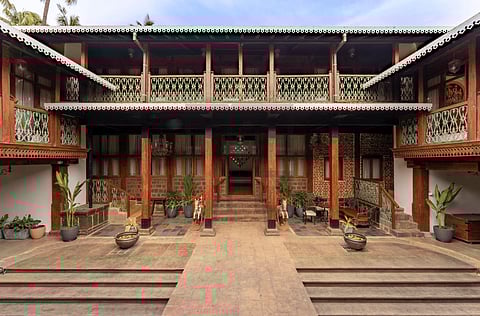
Red laterite stone walls crowned with sloping roofs rise dramatically in the landscaped grounds of the six-and-a-half-acre estate. While one wing of the palace remains the private family residence and the other houses a museum, ateliers for local artisans ensure that Sawantwadi’s art traditions continue to thrive.
Stepping into the wada, the courtyard that anchors the property, feels like walking into a living memory. Teakwood pillars, a stone fountain trickling gently in the centre, worn balustrades lining the upper verandahs—each visual triggered curiosity about the lives once lived here. Just as nostalgia begins to settle, a rush of present-day warmth takes over: smiling staff, all locals, and Sushi, the resident golden retriever who insists on belly rubs before check-in.
The six suites of the boutique art hotel draw from avatars of Hindu deity Vishnu and feature Ganjifa artwork, heirloom furniture, bay windows framed in coconut palms, Ayurvedic bath products, and cane-woven bar cabinets. This interplay of eras—the stately and the familiar—defines Sawantwadi from the outset.
Dinner that evening was not what one expects in a 300-year-old palace in Konkan. Shraddha, a trained Culinary Arts Chef and a Certified Sommelier who has worked at Michelin Star restaurant Oceana in New York City and with the late chef Floyd Cardoz, had prepared a seven-course Korean tasting menu.
By the time I arrived, the dining table had transformed—chopsticks, minimalist plating, and a theatre of service one associates with upscale Seoul fine dining. The servers, all trained in-house, moved with an intuitive confidence.
Shraddha began her culinary procession course by course. The evening opened with an amuse-bouche of a one-bite, layered rice cracker, cream cheese and tuna. The crunch gave way to an impossibly airy creaminess cut by the brine of tuna. It set the tone: elegant, minimal, confident.
Other highlights of the meal were the crisp Vietnamese spring roll; the Korean fried chicken bao, where the bao stayed soft as a cloud while the chicken crackled beneath, lacquered in heat and sweetness; and the cold peanut soba noodles, tempered and silky.
I was surprised when I was served Pan Asian food for dinner the following day. Each dish had different flavours. Shraddha introduced the meal with what she called “a memory of Osaka in Sawantwadi.”
There was crispy chicken gyoza, inspired by her travels to an Okonomiyaki bar in Osaka, where everything is cooked on a griddle and “crunch is treated like religion,” she mentions. “It’s so simple,” she smiled, adding: “but the crunch changes the entire experience—and you know how important crunch is.”
The next course followed with depth and surprise—Prawn Gyoza served with a seaweed and a spicy broth poured only at the moment of eating, releasing layers of heat and umami; and a mushroom truffle gyoza topped with shaved truffle and paired with a hijiki aioli, a soy-based umami bomb for vegetarians.
I wondered aloud where such ingredients could come from in a town like Sawantwadi. Shraddha answered in her matter-of-fact way: “From Goa — you don’t compromise if you want to create magic.”
The centrepiece of the evening was a dish that lives somewhere between memory and inheritance: PWR Ramen, short for 'Plated With Royalty.' “I was introduced to these flavours by my father-in-law when I married into the family,” she shared. A creamy and spicy broth with a trio of mushrooms, layered with precision—hearty enough to comfort, refined enough to demand silence. The ramen was crowned with karaage chicken, soft-boiled egg, and a chilli filled with cream cheese. The dinner impressed because it was personal and studied.
Yet Sawantwadi is not only about modern culinary wanderings.
At its heart lies its heritage cuisine—a celebration of slow cooking, local produce, and Konkani-Maratha heirloom recipes prepared exactly as they were generations ago. Dishes like mutton bhakri, kombdi vade, and modak, rooted in royal kitchens and perfected through memory, sit proudly on the menu. “These are not recipes we recreated—they were already perfect,” says Shraddha. “Our role has been to protect them, respect them, and serve them with the dignity they deserve.”
This philosophy shines brightest in the Rajwada Thali, served at lunch. It is an elegant parade of traditional preparations, each arriving in copper and brassware engraved with the Sawantwadi crest. Slow-cooked meats, seasonal vegetables, coastal curries, homemade pickles, and fresh phulkas made moments before they reached the table reminded you that royal food was never opulent for show; rather, it was opulent in craftsmanship. The desserts, including melt-in-the-mouth modaks and coconut payasam, were an interplay of restraint and familiarity. “Food in royal homes was always about abundance of love,” Shraddha notes. “We want guests to walk away not just well-fed, but emotionally fed.”
Beyond hospitality, Sawantwadi plays a significant cultural role. Many elements of the property—from the woodwork to art installations—were commissioned from local artisans whose craft had dwindled due to lack of patronage.
Shraddha and Lakham have become catalysts in the revival of Sawantwadi’s art ecosystem, ensuring that heritage thrives as a livelihood. Guests can sign up for private Ganjifa workshops, where, under the trained eyes of the artists, they can create their own souvenirs to take back home.
Sawantwadi Boutique Art Palace Hotel is luxury built for connection—connection to place, people, culture, and an enduring legacy that evolves with every generation that touches it. From traditional homemade meals in a Sawantwadi household to picnics in Amboli Ghat and excursions to Chittari and Pinguli villages, the hotel ensures that you truly experience the region.