
Subscribe
Subscribe
- Motoring
- Style
- Home & Design
- Travel
- Food & Drink
- Specials
- News & Tech
- Videos
AI generated summary, newsroom reviewed
Something odd has happened to weekends over the world. Few years ago, people met for a coffee or a pint. Now they meet for a game. Padel, squash and pickleball have quietly become the new way friends, colleagues and neighbours spend time together. They are racket sports, yes. But they have turned into something bigger, a mix of fitness, fun and social life, all rolled into one on a court.
From premium sports clubs and luxury wellness destinations to members-only communities, these fast-growing racquet sports are redefining how the country's affluent millennials and Gen Z executives exercise, socialise and unwind.
This piece looks at all three sports in plain, simple terms. What they are, how hard they work your body, what they cost, and why they have become such a big part of club culture and modern social life and here's how these three contenders compare.

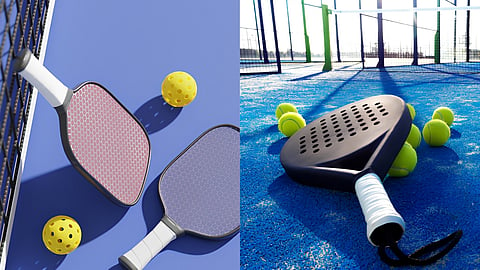
Padel is played in doubles, almost always. Two people per side, on a court measuring 20x10 metres which is closed in by glass walls or metallic mesh. The ball can bounce off the glass and stay in play, which makes rallies last longer. You do not need a big serve or years of training for this. The underarm serve and smaller court make it far easier to pick up than tennis or squash.
That accessibility is exactly why padel has spread the way it has. It is, above almost anything else, a social sport. Ask any regular player why they keep coming back, and the answer is rarely "the exercise." It's the people. Padel has become its own form of social networking through sports, and it has found its natural home among urban professionals looking for a way to combine a workout with actually seeing their friends.
On fitness, padel sits in the middle of the pack. Research and player data suggest most people burn somewhere between 400 and 600 calories per hour, though intensity changes this a lot. Beginners tend to burn 300–400 calories an hour, while advanced players in competitive matches can reach 600–800. Because the walls keep the ball alive, rallies run longer and there are fewer natural breaks than in tennis, so an hour goes by quickly without feeling brutal. That combination of low-impact exercise, reflexes, and steady cardio makes it easy on the joints and easy to keep coming back to.
Squash on the other hand has never chased a trend. Long before padel or pickleball existed, squash was already the sport gym-goers whispered about with a mix of respect and dread. It is almost always a singles match, played alone in a tight enclosed court, and it is genuinely demanding
The numbers back that reputation up. Squash has been ranked among the world's healthiest sports for years, with players able to burn up to 900 kcal an hour and heart rates that sit between 85 and 95 per cent of maximum for most of the game. Some studies push the figure even higher, with competitive players burning between 800 and 1,000 calories in a single hour, driven by fast-paced rallies, constant changes of direction, and a ball that comes back at you off the walls in ways you can never quite predict.
This is what makes squash so good for pure strength training, endurance and agility, arguably better than either of the other two. But there is a cost. The sudden sprints and sharp turns push up the injury risk, particularly for knees and ankles, in a way padel and pickleball simply don't. It also asks more of you as a beginner. The serve, the strategy, the shot placement, none of it comes as naturally as padel's more forgiving style.
Squash's social life has always looked a little different too. It has long been the sport of choice for business people, thanks to a sharp 30–45 minute session that fits around a working day and doesn't care what the weather is doing outside. That's exactly why it still sits so comfortably inside premium sports clubs and elite sports circles. It is quick, intense and easy to fit between meetings.
Pickleball borrows a little from tennis, a little from badminton, a touch of table tennis, and plays comfortably as either doubles play or a singles match. The scoring is simple and the court is small. The ball moves slower than a squash or padel ball, which makes it about as forgiving a racket sport as you'll find.
That forgiveness doesn't mean it's soft as exercise, though, it can flex from a gentle knockabout to a proper sweat, depending on how hard you push it. Casual play burns around 400 calories an hour, while a competitive match can climb as high as 700. What really sets pickleball apart is who ends up playing it. The body weight, agility and mobility matters a lot. It builds hand-eye coordination, agility and quick thinking, all while being gentler on the body than higher-impact sports which is why you'll see a teenager, a parent and a grandparent sharing the same court without anyone looking out of place.
That, more than the calorie count, is pickleball's real story. It has become the sport of the social club and the local community court, where the chat between points often matters as much as the score. For anyone wary of injury risk but still keen on proper exercise, it's found a gap in the market that padel and squash never quite filled.
Strip away the calories and the strength training talk and the real story here is what these sports have done to the way people spend their free time. Membership at a padel or pickleball club has become something people talk about the way they once talked about a gym membership or a golf club subscription, a small marker of lifestyle sport and club culture, worn lightly. Court booking apps have turned what used to be a casual, occasional game into a fixed weekly habit, in much the same way a standing dinner reservation might have worked a decade ago.
For sports for executives chasing networking sports that actually work, padel and squash both offer something a boardroom never could which is a relaxed, competitive setting where working relationships turn into something more genuine. For families and mixed-age groups, pickleball has built its own sports community, one that leans on friendliness rather than intensity. Between the three of them, they've quietly reshaped weekend sports into something that delivers a full-body workout and genuine friendship in the same breath.
Fairly, there isn't one right answer. It depends entirely on what you're chasing. If what you want is the best social sport, one that's easy to learn and still a proper workout, padel is very hard to beat. If you want the toughest cardio sport on, the sharpest fitness gains, and don't mind going it alone, squash wins. And if you want something gentle, inclusive and kind to the joints, with room to make it as competitive as you like, pickleball is the one that fits best, particularly for mixed groups, families.
As luxury sports and everyday sport keep blurring into one another, and clubs keep adding courts just to keep up with demand, the honest truth is that all three beat an evening on the sofa. The best racket sport, in the end, is simply the one you'll actually turn up for, week after week.